Jenell Taylor
Staff Writer
When Lisa Hoke was in the early phases of her career, women weren’t always accepted in art spaces. She found herself looking to fellow female artists for inspiration, and her practice has since burgeoned into one of colorful installations and abstract sculptures born out of her continual fascination with gravity, movement and problem-solving.
“When I first started working in New York, there was still a lot of pushback against women in the art world. I always felt like I had to compete on a grand scale with the same kind of machismo as my fellow male artists,” she said. “As I started to see really strong women like Judy Pfaff and Ursula Von Rydingsvard, I realized that the really inspiring thing about New York is how you are rubbing shoulders with people you admire.”
As the daughter of a Navy test pilot, Hoke and her family spent many years moving abruptly between towns and had to frequently adapt to new faces. This constant state of flux taught her the importance of taking risks, which she carries into her craft. “They’d take me out in the middle of a school year, so I learned to jump in right away,” she said. “It made me fearless of trying new things because everything was always new.”
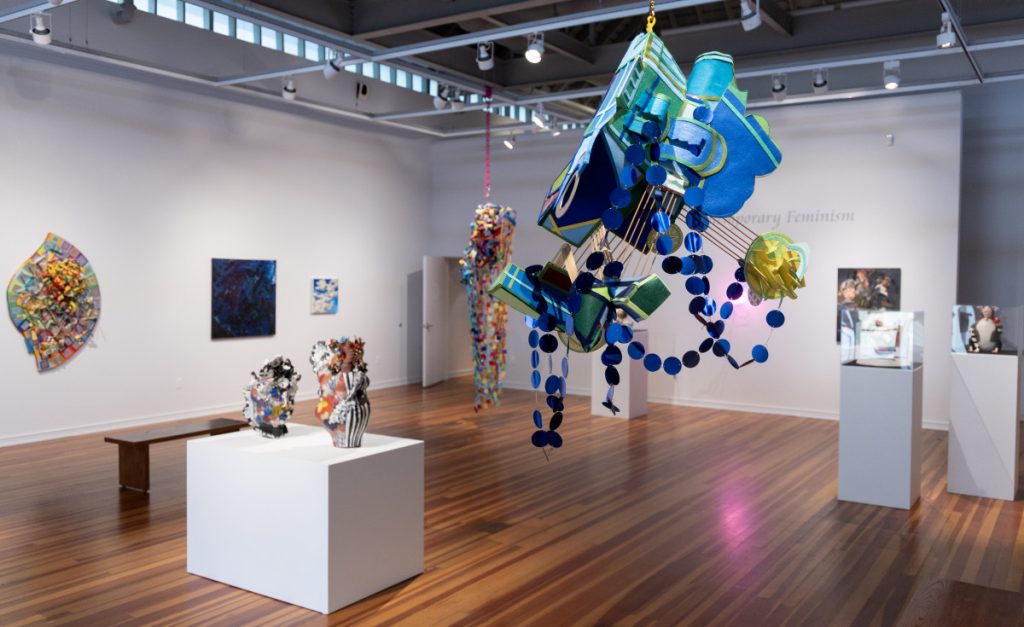
Hoke’s contributions to Chautauqua Visual Arts’ first exhibition of the 2026 Summer Season are sculptures that were born from the monotonies of life. Made from easily overlooked everyday objects, these pieces transform mundanity into a spectacle. “My materials are what (the viewer) sees all day long in their lives,” she said.
The exhibition, titled “Here and Now: Contemporary Feminists,” is dedicated to intimately exploring the unique intricacies between the works of six acclaimed female artists, placing their works together to create a meaningful dialogue around the connection between modern feminist theory and current contemporary art. Thoughtfully linked to Chautauqua Institution’s Week One lecture theme, “Icons and Instigators: Women Who Change the World,” this display focuses on how these artists are shifting the contemporary landscape.
Curated by Judy Barie, Susan and John Turben director of CVA Galleries, the exhibition features works by Lisa Hoke, Sarah Jacobs, Tiffany Calvert, Patti Warashina, Adero Willard and Judy Pfaff. It will run from June 28 to July 3, and the opening reception will be held from 3 to 5 p.m. Sunday in the Main Gallery of Strohl Art Center.
Pfaff’s legacy spans several decades and boasts numerous accolades, including the International Sculpture Center’s 2014 Lifetime Achievement Award. Her extensive work gives thought to the meaning and function of space and color. From elaborate installations to vivid print works, Pfaff traverses the contemporary world and dismantles long-held misconceptions of what female artistry looks like. According to her artist statement, Pfaff’s “urgent and ferocious need to labor for the visual and tactile is remarkable in an era where language dominates artistic activity.”
In contrast to the real-world material of Pfaff and Hoke’s pieces, Jacobs sifts through themes of existentialism with her maximalist and surrealist works. She utilizes oil paint, digital collages, assemblage and gold leaf, among other mediums, to tell her stories.
Life and death as topics revealed themselves to Jacobs through grappling with her atheist upbringing, the abrupt loss of a family member and prolonged complications with her health.
“I started allowing myself to feel like everything was interconnected and that we are all a part of nature,” she said. “I just got to a point where I’m not afraid of dying anymore.”
Jacobs’ work plays with depth and texture mixing meant to confuse the viewer and call them to introspect, as demonstrated in her 42-by-42 inch piece “Hope.” As potential energy that has yet to transform into kinetic energy, “Hope” serves as the precursor to her brighter — yet equally non-conformist — painting “Reception.” Jacobs describes these works as a “celebration of life.”
“The idea with this series is that we’re all individuals within a greater society,” she said. “And so, what is one person compared to the whole?”
The nuances of human nature are also unearthed through sculptor Warashina’s works. Exaggerated expressions, contrasting colors and striking poses attempt to identify her place within humanity. With more than 55 years of artistic experience under her belt, Warashina navigates the world and the human form with ceaseless fascination.
“The use of the body gives affirmation to Warashina’s own daily existence, and serves as the subject of her own ‘visual diary,’” according to her artist statement.
Calvert further examines that concept through the use of artificial intelligence in her oil paintings. In collaboration with the McKelvey School of Engineering at Washington University in St. Louis, Calvert, who chairs the Sam Fox School’s MFA in Visual Arts Program, developed a custom AI diffusion model to explore practicality, reliability and truth in artistic expression. The model is processed on campus and contains images curated solely by Calvert.
Once the image is printed, Calvert uses stencils to protect the generated image as she paints over them. The distortion that’s revealed once the stencil is removed is where she wants the conversation to begin. “Abstraction has always done a good job of making us feel less moored to the trustworthiness of our own vision,” she said. “If perception is destabilized, we can talk about how reality is destabilized in a world that is sort of being operated by AI.”
However, for her, the abundance of AI in creative fields is not cause for concern within her artistic process. “I think that worrying about machine models replacing creativity is the least of my worries,” Calvert said. “I am much more concerned about the way AI is deployed in other areas of our civic life: policing, medicine, surveillance.”
Willard’s sculptures explore the abstract through the fluidity of molding and carving clay. Vibrant colors, intricate patterns and unconventional shapes make up her creative voice. “As an artist who identifies as a Black woman with mixed heritage, my artwork celebrates our identities’ beauty, complexity and interconnectedness,” she said in her artist statement. Her work “invites viewers to question and appreciate the intricacies of identity and cultural heritage.”
“Here and Now: Contemporary Feminists” is dedicated to amplifying the artistic achievements of female artists while creating space for the innovative ways in which they share their social perspectives.
“What I see is the empowerment of younger women now,” Hoke said. “There are vital moments when you’re young that your instincts are exactly right. Those instincts come back in cycles, so it really is important to trust them and push them at the same time.”