
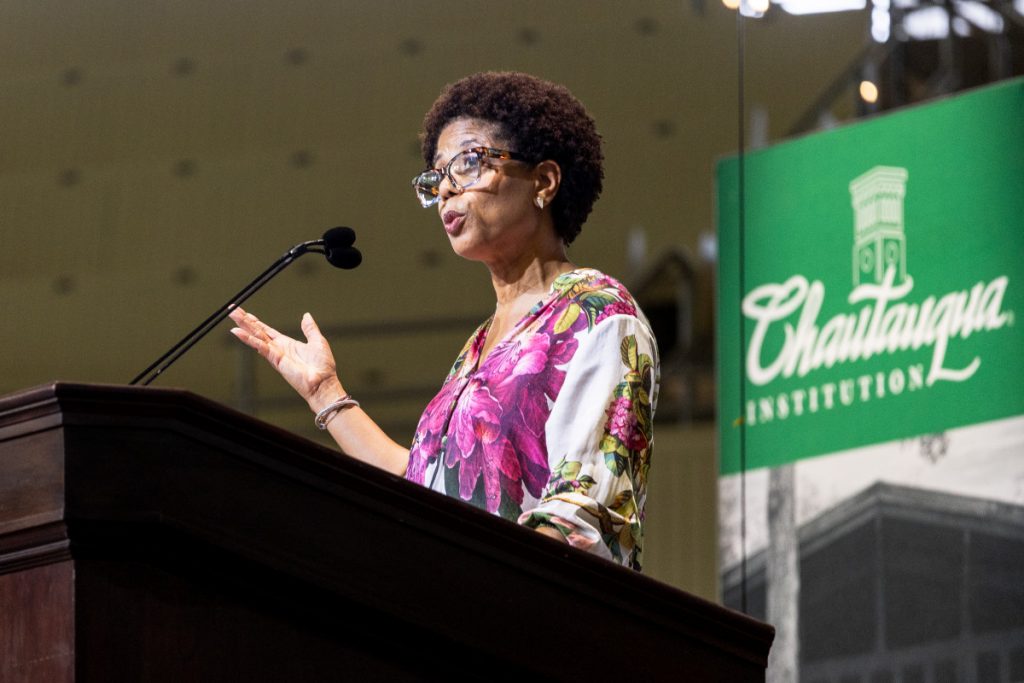
University of Virginia Karsh Institute of Democracy Founding Executive Director Melody Barnes speaks about how the founding fathers designed democracy in the U.S. Thursday in the Amphitheater.
ARIANNA NEVAREZ
Staff Writer
Melody Barnes was born at the height of the Civil Rights Movement, a few months after Lyndon B. Johnson signed the Civil Rights Act. She said she remembers the bicentennial moments and “Schoolhouse Rock!” videos that came with it. She worked on Capitol Hill on Sept. 11, and also worked to shape the nation’s response in the days, weeks and months after.
After experiencing some of the most pivotal moments in U.S. history during her lifetime, Barnes asked the question: “What enables a constitutional democracy not simply to survive, but to endure from disagreement, through crisis and through profound social change?”
“I believe the answer lies in one of the central insights of the American founding: that self-government requires both popular sovereignty and the rule of law,” Barnes said. “The founders believed that legitimate political power flows from the people, but they also understood that popular power left unconstrained could become as arbitrary as any case. Their great innovation was not simply to establish a government of the people, but to create institutions capable of channeling power through the law.”
At 10:45 a.m. Thursday in the Amphitheater, Barnes discussed self-government, the challenge of faction and citizens’ role in democracy. Barnes is the founding executive director of the University of Virginia’s Karsh Institute of Democracy. In 2024, she was an inaugural recipient of the Chautauqua Perry Fellowship.
To ground the idea of self-government, Barnes cited the Declaration of Independence and said it framed the nation’s “case for self-government in declaring that governments derive their just powers from the consent of the governed.”
As the founding fathers built the declaration, Barnes said they were skeptical about democracy because they equated the idea with “unchecked majority rule” and “being impulsive, unstable and vulnerable to the passions of the moment,” which shaped how they created “a new constitutional order.”
The founding fathers avoided building a simple majority rule. Instead, they designed a system where citizens have the power, but it is exercised through branches of government and their processes.
“In the American model, democracy is judged not merely by who wins power… but whether power is constrained once it is won,” Barnes said. “Liberal authority rests ultimately with the people, but those entrusted with exercising authority remain accountable both to the people and to the Constitution.”
Barnes said power is grounded in popular sovereignty through the system by which citizens vote for representatives. Representatives are entrusted with political power and should only be used within the boundaries of the Constitution, according to Barnes. To carry her point, she cited James Madison in Federalist No. 51, where he said government must be grounded in popular sovereignty, and political power must also be constrained to prevent “a form of domination.”
In an analysis of what the founding fathers built, Barnes said their idea of popular government was “incomplete.” She said participation was exclusionary at the government’s founding, and recently, people have raised concerns about the Electoral College being “flawed.” Yet, Barnes said separation of powers, checks and balances, federalism and representation have all helped make “democracy durable.”
In recent years, there has been increased concern with executive power and the balance among the branches of government, according to Barnes. She said Madison believed representatives would not “simply mirror every passing public passion, but would exercise judgment in pursuit of the public good.” Simultaneously, Madison said no design could guarantee “virtuous leaders,” so Barnes said the founders created safeguards.
“That insight led Madison to one of the Constitution’s central purposes: addressing the challenge of faction,” Barnes said. “More than two centuries later, this challenge is very much with us today. … Political polarization is consistently identified as one of the nation’s most pressing concerns, yet recent research from an organization called More in Common suggests that our divisions may be, in part, a trait of perception.”
The research said Americans estimate that “roughly twice as many of their political opponents hold extreme views as actually do,” Barnes said. She argued that divisiveness isn’t the only problem; misjudgment of one another is the larger issue.
Barnes said Madison wasn’t attempting to eliminate division and people’s differences, which are “natural consequences of liberty itself.” Instead, he was trying to prevent the division from becoming destructive. Barnes said the “constitutional system” was designed to require negotiation and coalition building, which would “discipline ambition” and move disagreements through “institutions” rather than allowing a majority to make decisions without checks.
“The Constitution does not eliminate factions; it channels and controls their effects,” Barnes said. “That emphasis on constitutional institutional design, on how power is exercised — not simply where it originates — remains one of the defining strengths of the American constitutional tradition. This does bring us to a critical clarification. In the American political tradition, popular sovereignty does not mean unbounded power.”
The U.S.’s limited government uses its authority to direct toward a shared end of broader civic meaning, which is “life, liberty and the pursuit of happiness,” according to Barnes. She said this referred to creating conditions where people can “build families, pursue meaningful work, practice their faith, participate in civic life and shape their own futures.”
Though people think of freedom as the ability to have a voice in the decisions that affect their lives, Barnes said the “republican tradition adds another dimension.” She said freedom can be undermined, and one can still not be truly free if it depends on someone else’s discretion. Barnes cited slavery as an example of this because even though some enslaved people lived separately or were given passes to travel, they were still “at the will of another.”
“This illustrates the central insight of the Republican tradition: freedom depends not only on how power is exercised, but on who wields it,” Barnes said. “Liberty that exists only by permission is fundamentally insecure. It is contingent rather than durable. The rule of law, not benevolence, is what transforms temporary remission into lasting freedom.”
Barnes argued democracy depends on the people of the U.S., from legislators upholding constitutional responsibilities to citizens who do more than vote every few years. Barnes said democracy asks people to “respect institutions” and “reject the temptation to abandon constitutional principles simply because they have become inconvenient.”
“We are living through a period of extreme democratic strain, deep polarization, institutional stress, erosion of shared norms and declining trust-not only in public institutions but in one another,” Barnes said. “But this is not the first such moment in American history. Periods of democratic stress are not anomalies; they are woven into the American story.”
The system has been tested, according to Barnes, but she said it has held because individuals within “chose fidelity to law over loyalty to faction.” She said the government has stayed alive because people have shouldered the responsibilities of disagreement, holding people in power accountable and defending the rule of law.
“As we mark 250 years of the American experiment, we are reminded that self-government is not a destination; it is an ongoing project for every generation,” Barnes said. “Our history bears the sound. Progress toward a more perfect union has never come from abandoning the rule of law, but from insisting that it live up to its highest commitments. They are conditions that allow people to plan their lives and live freely, imagine a better future for themselves and generations to come.”