
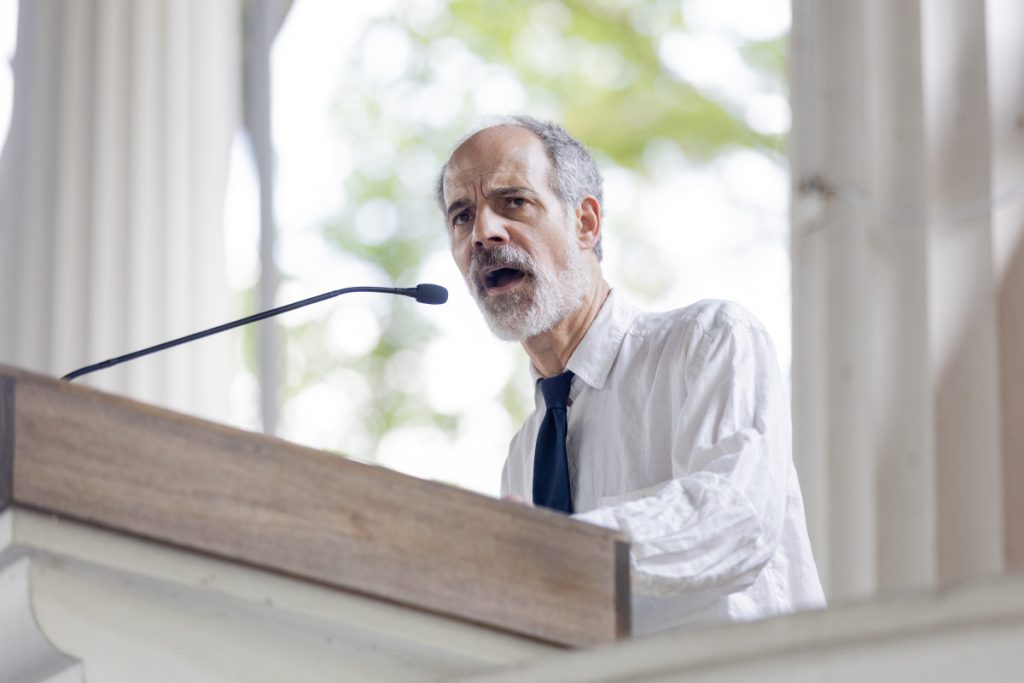
Distinguished Professor of History at the Graduate Center of the City University of New York David Waldstreicher talks about poet Phillis Wheatley’s impact during the American Revolution Thursday in the Hall of Philosophy.
LILY RESLINK
Staff Writer
During his Interfaith Lecture, David Waldstreicher, distinguished professor of history at the Graduate Center of the City University of New York and author of The Odyssey of Phillis Wheatley: A Poet’s Journeys Through American Slavery and Independence, sought to answer the question of how Phillis Wheatley contributed to anti-slavery efforts through her poetry.
He delivered a lecture at 2 p.m. Thursday in the Hall of Philosophy to “talk some history, read some poems and try to explain how a young female African born in 1753 became famous, a one-woman anti-slavery argument and [a] political actor.”
In his lecture, Waldstreicher explored the topic through the lens of religion and the American Revolution.
“[Wheatley’s fame] isn’t supposed to have happened, and yet it did,” he said. Understanding this anomaly guided Waldstreicher’s explanation of the religious and historical implications of Wheatley’s poetic impact.
To inform both his lecture and biography about Wheatley, Waldstreicher said a key consideration was the limited number of sources about Wheatley’s life.
Waldstreicher’s process of presenting a more comprehensive narrative of Wheatley’s life involved a cross-analysis of about 53 poems and 18 letters, literature she read, news she digested, people she interacted with and historical moments she experienced.
Waldstreicher said, during the research process, he realized that with so few documents, an alternative avenue to learning more about Wheatley was to read everything he could be sure she also read. He said he began with the Iliad and the Odyssey.
Acknowledging the gaps in knowledge and the degree of speculation in piecing together Wheatley’s story, his lecture concentrated on religion’s influence in both Wheatley’s personal life and slavery in the U.S.
In both Wheatley’s secular and religious impacts, Waldstreicher used the context of the historical movements and tensions surrounding her work and decisions. He explained the contextual importance of “popular poetry” at the time of Wheatley’s gradual emergence as a famous poet, comparing it to the culture of popular music today.
“Everybody was experimenting with rhyme. People were copying out poems that were philosophical and spiritual and political in their diaries, in their almanacs, in their ‘commonplace books,’ as they called them,” he said.
When Waldstreicher began reflecting on the American Revolution as an “interfaith story” to prepare this lecture, he said he thought of Wheatley’s 1772 published book of poetry: Poems on Various Subjects, Religious and Moral.
He said this book captures the variety of what she was doing at just 19 years old: “It puts religion at the center, but it also insists on variety. It does not assume that all that is religious is moral, but it still insists on moral discourse.”
Waldstreicher explained the religious influence of John and Susanna Wheatley, the family who bought Wheatley as a slave. Susanna’s connections to the network of Evangelical reformers interested in converting Africans to Christianity became integral to the creation and distribution of Wheatley’s writings.
Waldstreicher also explained the questions some religious communities began to ask, for example, “Can slavery be Christian?” He said Wheatley leaned into these questions with her poetry and took on “the role of a lay clergyperson.” He tied her literary influence to her religious influence, which then propelled her path to greater public recognition.
“What might seem like a very secular literature, the Odyssey, and this very pious literature that she’s been doing, they come together,” he said.
Waldstreicher said he sees themes explored in Homer’s writings, such as divinity and salvation, incorporated into Wheatley’s works. As proof of Homer’s influence, he said he found that her poetry even paraphrased some of the Odyssey’s most popular translations.
To conclude, Waldstreicher said, “Wheatley’s story is a story about the possibilities and limits of the American Revolution, and it’s also a story about how the American Revolution is both a sacred and secular, religious and not religious event.”
He made a closing call to action that referenced a line from America, Wheatley’s unfinished epic, which he read earlier in the lecture. He said, “And that openness to multiple traditions and to dialogue and the possibilities that ‘sometimes by simile, a victory might be won’ is a lesson that Wheatley leaves for us, if we are willing to listen.”