
From left, live audio describer Ermyn King, audio description users Maurita Peterson Holland, Roger Chard, Holly Kasbar and Warren Williams, and Chautauqua Theater Company Managing Director Emily Glinick pose with CTC’s live audio description equipment Friday outside Bratton Theater.
SOPHIA ROOKSBERRY
Staff writer
For centuries, the world of performing and visual arts has been inherently inaccessible to those with limited or total loss of vision. A few years ago, Ermyn King began dismantling these barriers to entry across Dance, Opera and Theater programming at Chautauqua Institution.
In addition to her career as a creative arts therapist and arts accessibility practitioner, King is a credentialed live audio describer who introduced Senior Director of Community and Belonging Amit Taneja to the concept in summer 2022. By summer 2023, Chautauqua Theater Company’s mainstage productions featured select offerings of live audio descriptions.
Before the curtain rises on this afternoon’s performance of Best for Baby, King will position herself behind the scenes with a view of the stage on her monitor and a microphone transmitting her voice to certain audience members via headset.
At 3:45 p.m., King will begin reading through the pre-show notes she gleaned from numerous previews of the play, detailing the visual world of the set and providing context for those listening. At 4 p.m., the show will begin and King will offer a glimpse into the onstage happenings for those who cannot visually interpret it themselves.
“I do my best once it starts to provide succinct, vivid, imaginative descriptions of the visual elements — costumes, props, scenery changes, movement, body language, facial expressions, etc. — in real time between the dialogue and other auditory cues, helping patrons to seamlessly follow what is taking place on stage,” King said.
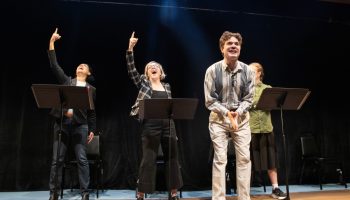
Although live audio descriptions are valuable at any theatrical production, Best for Baby is a particularly visual play and a feast for a live audio describer.
“With a production like Best for Baby, we’ve not just got a set and costumes, but we have very amazing lighting design and we’ve got projections … and there’s a lot of information that’s either subtly told by costuming and lighting, or very literally told by projections,” Emily Glinick, managing director of CTC, said. “You really aren’t going to get the full story if you’re just listening to it … You want to get an understanding of the visual storytelling, because it’s just as important as the storytelling that is being done by the playwright.”
One of the audience members who will tune in to King’s descriptions of Best for Baby is Roger Chard, a retired Michigan attorney who has been blind since infancy.
“I’m particularly interested in what is going on when there is silence on the stage, what people are doing, where they’re going, repositioning themselves … if there are gestures that they are making that have something to do with the play that I can’t see or otherwise know about,” Chard said.
While live audio descriptions have revolutionized Chard’s theater-going experience, he is not the only one who benefits; without King’s descriptions, Chard’s partner, Maurita Peterson Holland, would also have a very different experience at the theater.
“Ermyn has taken away my job, which I’m grateful for because I’m always concerned that we might make noise that will be interrupting people around us, so this is a really important aspect for me,” Peterson Holland said.
In addition to patrons like Chard and Peterson Holland, many others can benefit from attending a show with live audio descriptions. According to King, people who are autistic and people with learning disabilities or difficulties with sensory processing can all have an enhanced theatrical experience with live audio descriptions, as well as sighted people like Warren Williams.
Williams is a retired professor from Eastern Michigan University and attended his first play with live audio descriptions on the recommendation of Chard and Peterson Holland.
“I had seen the play the first time,” Williams said. “I went back to have the [live audio description] experience, and I saw so much more, … it was like having a private guide to the theater. … She pointed out things that I hadn’t noticed that were of consequence. I still remember the first time that happened: An actor was acting nervous, and young actors act nervous. I didn’t know it was part of the play, but Ermyn knew this was part of the significance of the play, and I just enjoyed the play more.”
Implementing the live audio description infrastructure has been a collaborative effort. In addition to King’s work alongside her summer extern, high school student Holly Kasbar, these accessibility systems have been the result of efforts from the Office of Community and Belonging, CTC leadership and patrons who benefit from these services and provide vital feedback.
“There were some early shows that Maurita and I attended, and Ermyn asked for some responses and evaluations afterward,” Chard said. “We gave critiques from our different perspectives as to what was good, what might be improved, what might be dropped, and in her customary meticulous way, Ermyn responded very thoroughly to those ideas and incorporated them into her next audio description.”
Makayla Santiago-Froebel has witnessed the evolution of live audio descriptions at Chautauqua from a variety of vantage points, first as a member of the house management team at CTC and now as interim associate director of Belonging and Community Relations.
“It’s been wonderful to see it from this perspective working in the Belonging office,” Santiago-Froebel said. “I believe that making Chautauqua accessible to all patrons is very important, which is why our office was created. … Chautauqua is the perfect place for something like [live audio] descriptions, because the arts should be accessible to all.”
Glinick is another champion of accessible arts whose contributions have brought live audio descriptions to Chautauqua, along with other leadership at CTC.
“A lot of the coordinating that I’m doing is just ensuring that [Ermyn] has, especially with a world premiere production, the most up-to-date script so that she knows what the action is and is prepared before she does this marathon,” Glinick said.
In her role as a live audio describer, King has experienced no shortage of stories about how accessible arts programming has touched the lives of countless Chautauquans.
“Last year … one of the actors’ … grandmother had never been able to really partake in her acting before,” King said. “She came from New York City and partook in the audio description for her granddaughter in the play, and that was very moving.”
In addition to today’s matinee, live audio descriptions of Best for Baby will be available at 4 p.m. on July 28, as well as the second mainstage production of the season, How I Learned What I Learned, on Aug. 12 and 15. Those who wish to watch these performances with live audio descriptions should arrive at the theater 20 minutes before the show is scheduled to begin.