
ARIANNA NEVAREZ
Staff Writer
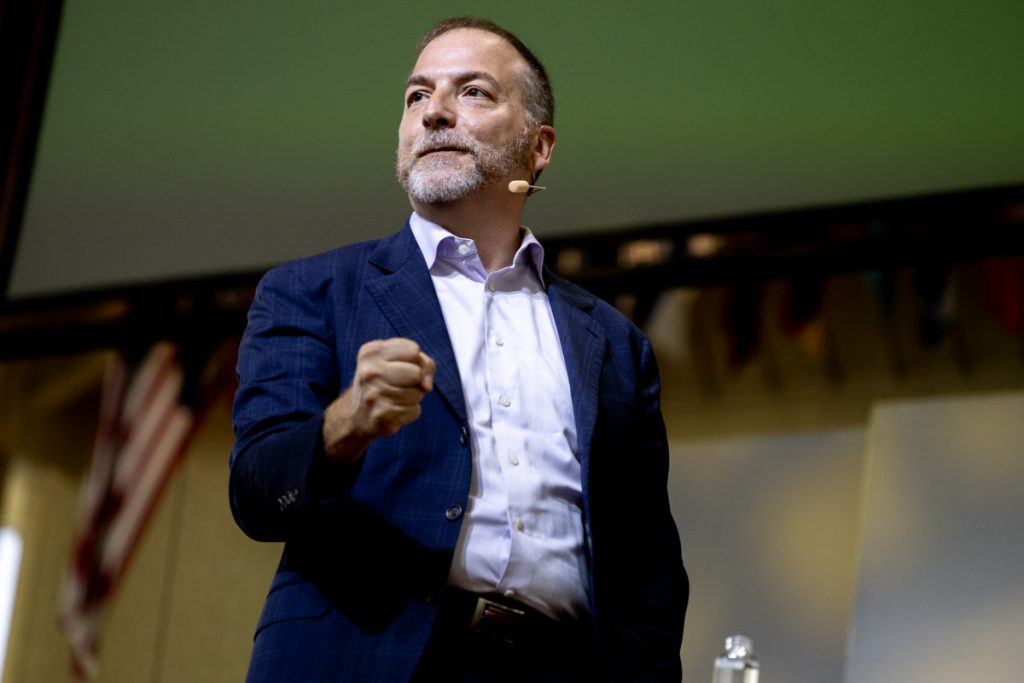
To understand the state of journalism and politics, longtime NBC journalist and podcaster Chuck Todd said the audience must look to the past. In the era of the Cold War, Todd said, the news was less partisan because they all had the same “enemy.” Now, the two-party system is affecting the media and the American population.
“There was one big threat [news media] were constantly covering, one big story that we were constantly dealing with,” he said.
At 10:45 a.m. Tuesday in the Amphitheater, Todd lectured on the local news’ need to be rebuilt and how politics parallels the media.
Todd discussed the information ecosystem; he noticed new technology would be introduced, which led to an explosion of that medium. Then, once a more advanced technology was introduced, there would be fragmentation and consolidation. It became a cycle, he said.
Life magazine was once mainstream media, but then radio and eventually TV took over. He said TV was more controlled, but now, there is an apparent consolidation happening among networks due to more access to broadcast beyond traditional TV.
This cycle reflects what is happening in the political sphere, according to Todd. He said he often hears that the media ruined politics or vice versa, but he said the media is a “mirror.”
“Most people hate what we look like in a mirror, right? …, and that’s why people hate us in the media, because we’re the country’s mirror, for better or for worse, right? I think that’s sometimes why we could be so hated. So I do believe we’re in a cycle here,” Todd said.
Todd said the trust issue in journalism falls into the lack of local news. He said national news never fully had the audience’s trust. Instead, they had a derivative trust due to the fact that they were on the same channel or network as the local news.
Referring to his time on national news, Todd said, “If you trusted the local anchors, you were going to give me a chance. Didn’t mean I automatically had your trust, but it meant I had a better shot. So when we got rid of local media, we lost our best character references.”
Small-town Americans no longer feel heard because of this gutting of local news, Todd said. He also said this forces people into national conversations and highlighted how there used to be papers for each party in the 19th century. Now, people have to turn to only a few larger channels that don’t necessarily feel familiar.
“It’s not that our politics is either too far right or too far left. It’s not that our press is too far right or too far left. It’s that everything isn’t local enough,” Todd said.
He said this feeling of people not being seen even affects the political party system. Todd said he had more options for coffee than he did for political parties. From his perspective, people should demand more choices of political alignment because there has become a clear duopoly; there are barriers to independent or third parties’ ability to break into politics, preventing the public from having more options.
Todd noted the downsides to having two parties holding all the power.
“When you have a coalition that big, it actually becomes easier for a small, determined faction to hijack the entire organization, and I can tell you this: One thing about American politics is that reactionary politics is met by reactionary politics,” Todd said. “I’m very concerned we’re in a spiral of extremism, and that we are going to sit here and rationalize our extremism.”
Todd then turned to talk about how O.J. Simpson’s trials “broke the media.” Todd said CNN realized that these trials would be the “Watergate hearings of this generation,” so they made a move to cover it and were the only cable news channel at the time to do so. This “serialization” of the news never stopped because it became a way for these stations to make a profit, according to Todd.
“So O.J. was the first time where the managing editor of the news organization became the public. Let’s give the public what it wants, not what it needs,” Todd said.
Todd said he has witnessed a shift in media where people try to make a profit by taking a side; he said the easiest way to garner a following is to make people angry or feed into the strong beliefs they already have. In response, Todd aims to carve out his own “space” and build an audience for his podcast, “The Chuck ToddCast,” for “the rest of us.”
“When it comes to solutions, I don’t think it’s one big dramatic thing, but we could use some leadership that understands the story of America,” Todd said. “That’s something that’s missing.”
Other than leadership, Todd said, the nation needs reforms that might not be grand. Instead, he said local news needs to rebuild trust, and there needs to be a movement of community. He said they need to cover local sports, politics and weather. These are small things, like the weather, the audience can fact-check by going outside and verifying within their communities.
People are yearning for community, according to Todd, which is why he thinks there is success in right and left movements such as the Democratic Socialists of America and Make America Great Again. He went on to describe MAGA rallies as happy places, saying followers of the movement have found a community within it.
“We should look at this as our own failure,” Todd said. “We didn’t figure out how to build a community to welcome these people into this bigger field.”
Not only does America need local news and community, but Congress is broken, Todd said. He said politicians are now more incentivized to look out for their party than the institution. He said people are judged on whether they are aiding their party rather than how they uphold ethics.
“The boring work of fixing Congress doesn’t allow a YouTube clip to go viral, doesn’t get you a TikTok that goes to a million, so we have a bunch of broken incentive structures,” Todd said. “We’ve got a politics that rewards our culture. We’ve ‘celebrified’ our culture, where we really do mix the real and the fictional into one sort of world, and so the people that are best able to navigate politics now are people who are more comfortable being famous than they are being public servants.”
Todd said it is a harsh environment for politicians, and people are scared to even step into that world. He said he sees more one-term presidencies in the future and sees the “ping-pong” continuing between the two parties.
“Until we understand how our system works again [and] more people understand it [and] we do a better job of explaining it [and] we have more local media [and] we have more local politicians that feel familiar to you — we can not restore what we have, but build on something that will feel at least a little bit familiar,” Todd said.