
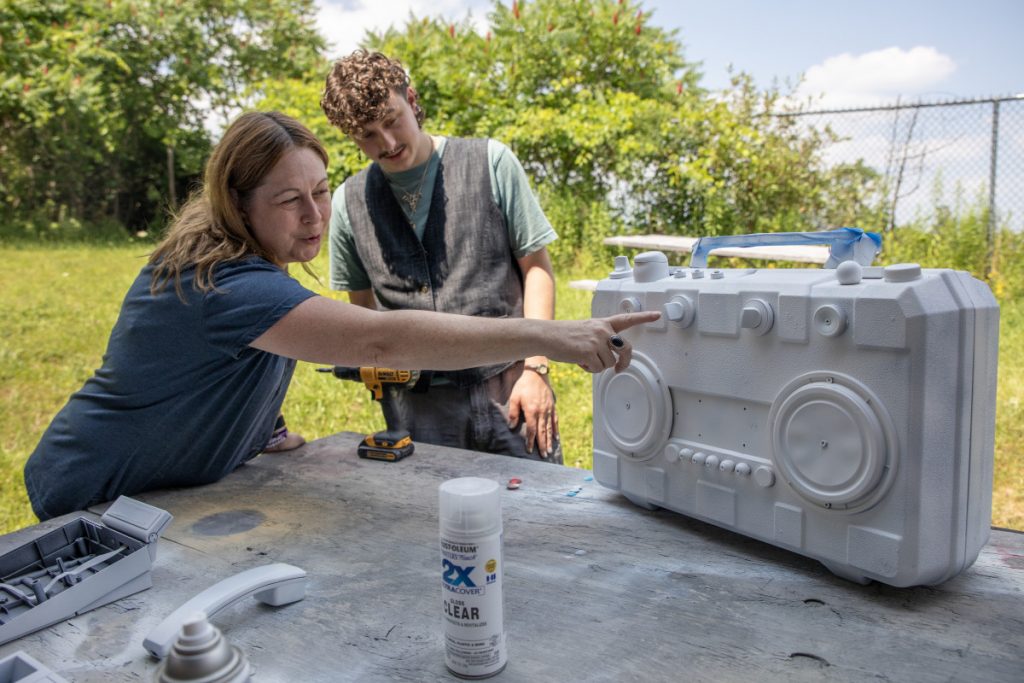
Prop Supervisor Hyla Sue Stellhorn and Head Prop Artisan Sebastian Tingle inspect a boom box prop they created for the Chautauqua Theater Company’s production of Best for Baby Monday outside of Brawdy Theater Studios.
SOPHIA ROOKSBERRY
Staff Writer
In the northwest corner of Chautauqua Institution, hidden in the sea of practice shacks next to Roe Green Theater Center, Chautauqua Theater Company’s props shop houses a four-person team and decades of creations. Hyla Sue Stellhorn has served as CTC’s props supervisor since 2013 and is currently working on one of the most intensive productions of her Chautauqua career.
As with any show, the props design of Best for Baby began with reading the script. Before the season took off, Stellhorn and her team read through Sharyn Rothstein’s play and identified all of the items they were responsible for, factoring in conversations with the set designer and director.
“We take our list and we try to find everything we have in stock that will work for the show, and then we can assess what we need to make and what we need to buy,” Stellhorn said. “Then, we do a huge shopping trip at the top of the season while we have a little bit of breathing room.”
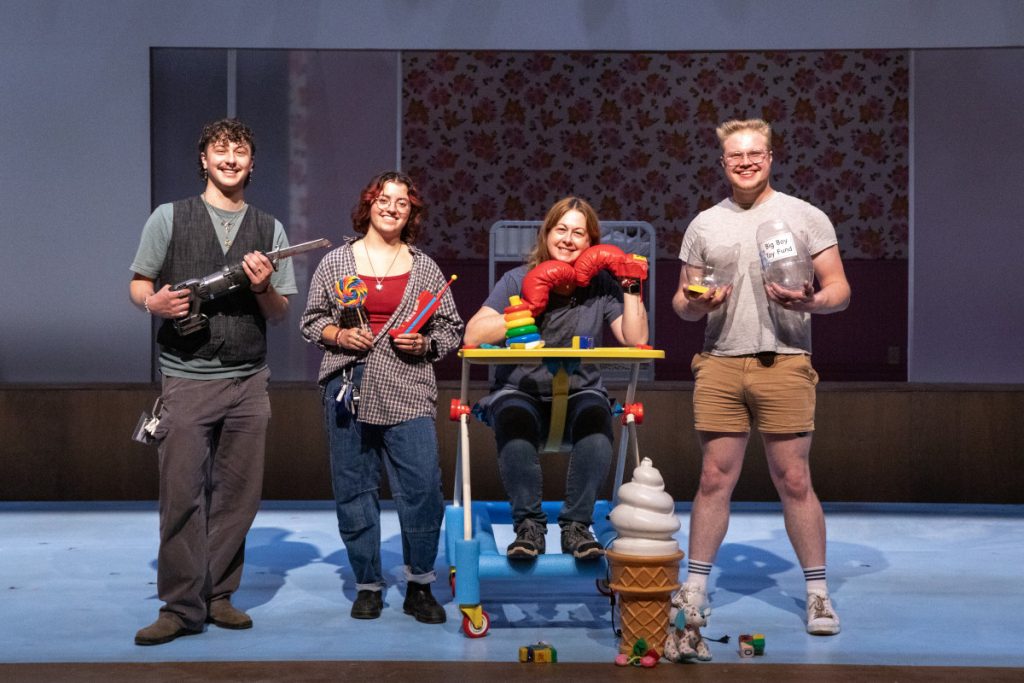
From left, Tingle, Prop Artisan Catherine Rouselle, Stellhorn and Assistant Prop Supervisor Donnie Woodard hold their favorite props from Best for Baby Monday in Bratton Theater.
The decision to build or buy an object depends on a number of factors. For mainstage productions in Bratton Theater, an important consideration is the size of the prop and its distance from the audience.
“Because we have such a small house, usually we try to buy something because the audience sees it up close and we want it to look realistic,” Stellhorn said. “When it comes to something that doesn’t exist, like a giant baby boombox, then it’s definitely a build.”
The boombox in question was made out of a large tool case and adorned with knobs from an old stove, coffee creamer lids and wooden beads. Halfway through the building process, Head Prop Artisan Sebastian Tingle had already constructed a convincingly infantile prop.
Another piece Tingle worked on was the baby walker for the play’s narrator, a personified corporation and man-child named Johnson (Brian Owen). The walker was constructed out of chair racks, a thrifted tray and industrial car straps, strong enough to hold an adult-sized baby and stimulating enough for any toddler.
While props like a toy boombox and triple-sized baby walker were built out of necessity, other prop pieces were built to preserve the historical accuracy of the play.
“This show goes … ’70s, ’80s, 1800s,” Stellhorn said. “We have like four different styles of Johnson’s baby powder from these different eras.”
These bottles of asbestos-riddled baby powder were designed by Prop Artisan Catherine Rouselle. While Rouselle was challenged by the extensive research her objects required, others were tasked to make props with a specific function through some trial and error. One of these objects was a breakable plastic jar full of baby toys, designed by Assistant Prop Supervisor Donnie Woodard.
“[Owen] has to be able to carry it … but then it also has to break on cue, and so it’s kind of a combination of stage trickery in terms of distance … and stage light,” Woodard said. “… It’s actually held together with two sets of magnets that snap together, and then selective pieces of scotch tape that hold it together.”
Although lots of work was done during the rehearsal process, the props team’s responsibilities do not end when the final object is placed on the table backstage.
“In tech week, we’re seeing everything on stage with costumes,” Stellhorn said. “We had … a yellow tablecloth that looked great in the rehearsal room, but now that we’re on stage, [the actress’] dress has yellow in it, you have two white actors, so the director is like, ‘We need something with more contrast.’ … We’re really just reacting to stuff as we see it under stage light for the first time and seeing what works and what doesn’t work.”
Despite the heavy lift of Best for Baby — described by Stellhorn as the equivalent of “a musical without music” — the team members managed to find their fun, whether by dressing as babies during load-in or entertaining each other on road trips to pick up pieces out of state. No matter the level of challenge, Stellhorn continued to enjoy the props designing process with the same outlook as when she worked on her first show in college.
“As soon as I started, I was hooked and I didn’t want to do anything else but props,” Stellhorn said. “It’s never boring. It’s always something different and we always have new challenges.”
The next challenge for the team is to relocate the props shop to the newly constructed Roe Green Theater Center. The next mainstage production of the summer bears a much lighter load for the props team, and Stellhorn is hopeful progress will be made as the season winds down and baby Johnson will be able to store his blocks and bottles in a new home.