

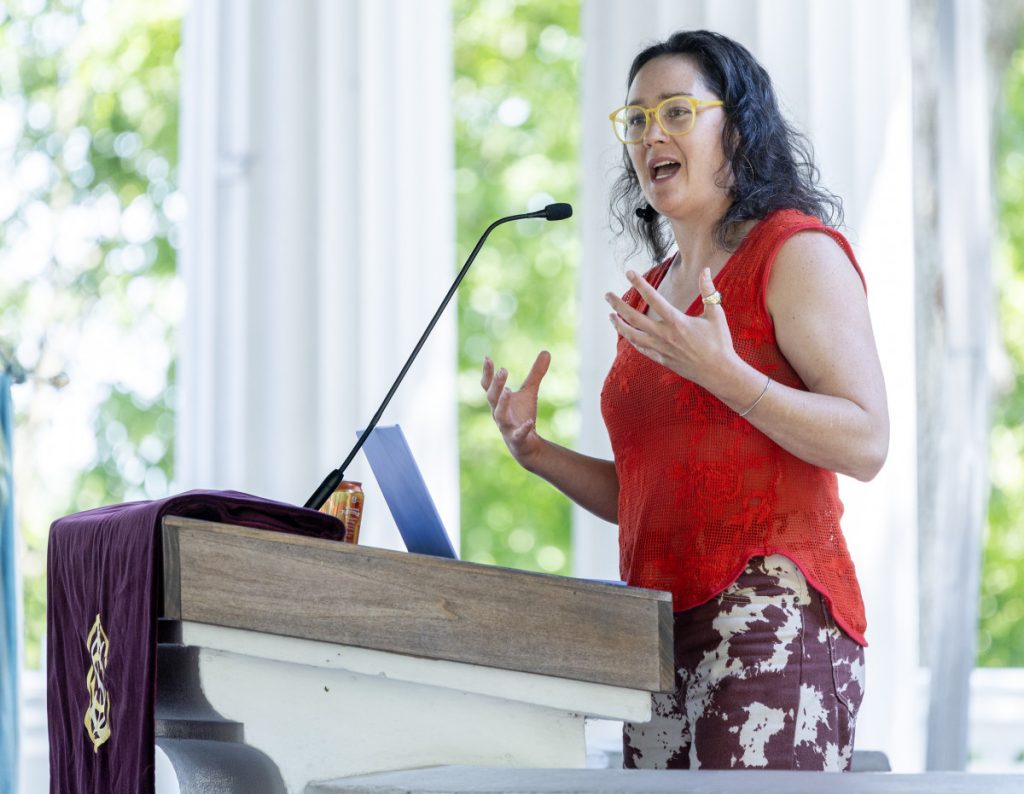
Author Tessa Hulls speaks about the experiences that inspired her memoir Feeding Ghosts, Friday in the Hall of Philosophy.
NORA SMITH
Staff Writer
Artist, adventurer and author Tessa Hulls began her presentation on her Pulitzer-winning graphic memoir and Chautauqua Literary and Scientific Circle Week Five selection, Feeding Ghosts: A Graphic Memoir, by defining what it means to be a river.
“When glaciers and snow melt off of the mountains, when they encounter a valley, they spread out in these beautiful bands that meander back and forth and conjoin each other and they’re these really complex systems and they don’t stay the same . . .” Hulls said.
Hulls drew parallels between the human experience and nature and said she considers herself a braided river. In her perspective, she moves through the world and her own work as a braided river because she doesn’t work in “discrete creative disciplines,” she said. This, she explained, is not limited to her alone; it can apply to anyone and anything.
“Every story, every life is a braided river,” Hulls said.
After reading a section from the prologue of Feeding Ghosts, Hulls emphasized the last line of the excerpt she chose. She said, “I will do my best to serve as your guide through this wilderness.”
Hulls said this “wilderness” is a prominent theme throughout Feeding Ghosts. She said the wilderness was something many readers don’t notice, but that it was why she set out to tell her family story in the first place. She hadn’t had any desire to make a book, but she knew something was broken and felt called to fix it.
“I knew I had to mend the fissure that had taken generations to build, and I began my work starting in the undifferentiated churn of the ocean,” Hulls said. “My job, which I’m using in the sense of task, duty, burden, obligation, commitment, was to find them out, where my family’s river met the sea and then follow every channel back up into the mountains until I reached the headquarters where this story began.”
She said each section of the book ends in water, emphasizing the book’s ending in which she breaks the fourth wall and tells readers, “We can’t end this inside, we have to go out to the sea.”
Reflecting on her first visit to Chautauqua, which she called a “utopia,” Hulls questioned the purpose of all the lectures she attended. She said many speakers advise that audience members should take what they hear at Chautauqua and carry it beyond the gates of the Institution; Hulls openly asked if the carrying forward of these conversations is actually happening.
In her perspective, lectures like these are meant to lead people to a place of avulsion. She said it’s crucial to acknowledge one’s privilege in a place like Chautauqua, and if one doesn’t, it can be easy to become victims to a narrowing perspective.
“I want to hold my teeth against the softness of your palms and lovingly, relentlessly and accurately say, ‘This place is a profoundly beautiful bubble,’” Hulls said. “We all want to believe these places that nourish us are sufficient on their own, and it’s painful to admit that something beautiful can also become insulating.”
Hulls ended her presentation by asking audience members to step outside the grounds and rejoin the outside world with a question.
“If what you have been exposed to this week has helped you feel the current of your own river, ‘What is the next river you intend to free?’” Hulls said.


