
LILY RESLINK
Staff writer
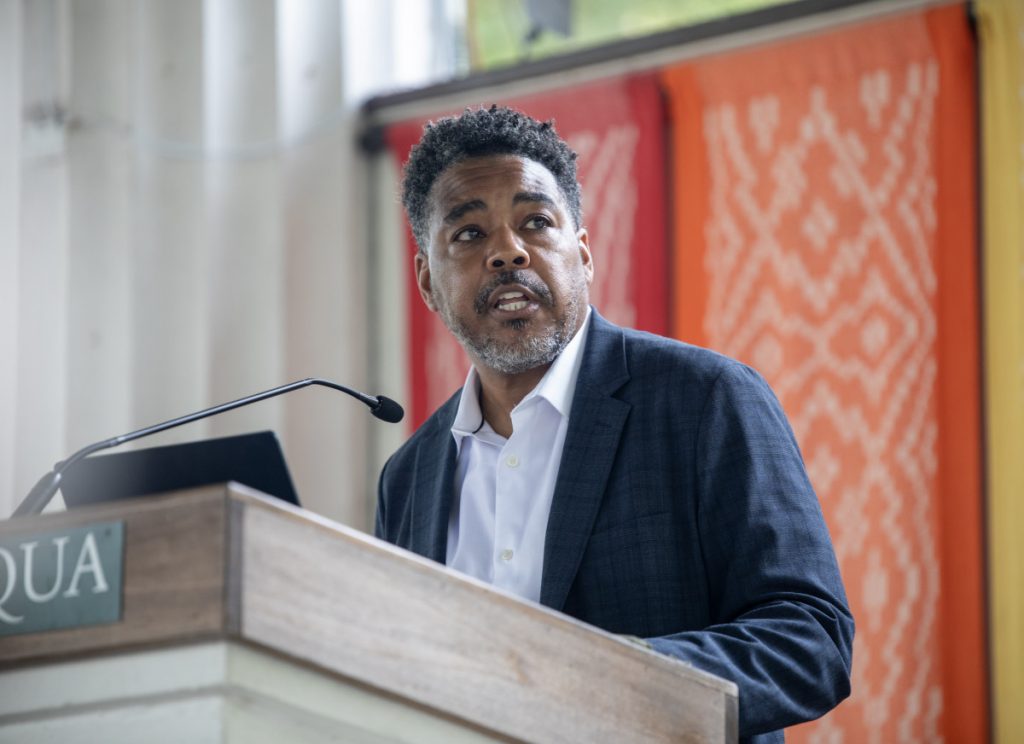
Before looking outward to make all decisions, religion scholar and leader in higher education Terrence L. “Kojo” Johnson argued for the positive outcomes of looking inward.
Critically assessing one’s own fundamental disagreements, deviating ideas and alternative interpretations, according to Johnson, is a starting point for social change toward outcomes that better serve disenfranchised members of society. In his Interfaith Lecture at 2 p.m. Wednesday in the Hall of Philosophy, Johnson cautioned against compromising one’s own critical perspective in favor of commonly-held beliefs and interpretations of Scripture in a lecture and mediation titled “Good Trouble in a Time of Moral Decadence and Deteriorating Rights.”
According to Johnson, one’s response to disagreement is the catalyst for “good trouble” — which he says is a model informed by spirituality and culture.
In an interfaith exploration of how traditions shape “civic responsibility, social engagement and human flourishing,” Johnson posed questions to the audience: “What does it mean to vote, advocate and disagree with moral integrity, historical precision and critical interpretive skills? How do communities maintain courage and compassion when everyone believes they are standing with God?”
Through historically outlining the concept of “good trouble,” he said “deliberative engagement, lament and justice-seeking hermeneutics” are spiritual practices with the ability to guide people through political uncertainty toward more meaningful human engagement.
Johnson brings scholarly perspective from his roles at Harvard Divinity School as director of Religion and Public Life and Charles G. Adams professor of African American Religious Studies. He was recently announced as the incoming Mary Lee Hardin Willard dean of Candler School of Theology at Emory University, where he will embark on this new leadership journey beginning in August.
Johnson said, as a concept, “good trouble” advocates for the inclusion of more diverse lenses.
“Pragmatically, good trouble is an ethical exercise in addressing the most pressing moral and political concerns facing our society,” Johnson said. He added that “good trouble” is rooted in Black religion’s tradition of political piety and protest.
Johnson used Maya Angelou’s 2006 address — delivered at New Birth Missionary Baptist Church in front of three living U.S. presidents and Atlanta’s elite political power brokers — to exemplify how tradition can inform one’s approach to social change in a productive manner.
“Dr. Angelou’s sacred speech act is a stark reminder of the dire need for institutions, such as the religious institutions and higher education, to stand tall and to acknowledge what civil society too often ignores: the cries of the people,” Johnson said.
Embodied in Angelou’s “didactic and dialogical” address, Johnson said, were “central characteristics of Black preaching.”
He explained how biblical scholar Allen Callahan’s “talking book concept” connects to “good trouble” by encouraging dialogical engagement with texts, rather than accepting one interpretation. Johnson pointed to the influence of Scripture on slavery as a prominent example — which he said also represents the impact of biblical interpretation on matters outside of Christian faith.
“The Bible was probably the singular most important text among the enslaved and served as a reference point in political debates long after slavery ended,” Johnson said.
Johnson also named abolitionist Maria Stewart as an influential initiator of biblical dialogue, who he said, in a public prayer, grounded her “theological imperative for waging a righteous war against African enslavement” in the Hebrew prophets and Gospel parables.
Johnson pointed to the “natural calamity and human-engineered cruelty” in the world that he said necessitates “good trouble.”
He quoted the late U.S. Congressman John Lewis – considered to be the originator of the term “good trouble” — who said that when one sees something that is not right, they must speak out against it.
Johnson called listeners to incorporate “good trouble” as a creative and courageous response to peril, which he said can take place in the form of “supporting and holding higher education and religious institutions accountable.”