ARIANNA NEVAREZ
Staff writer
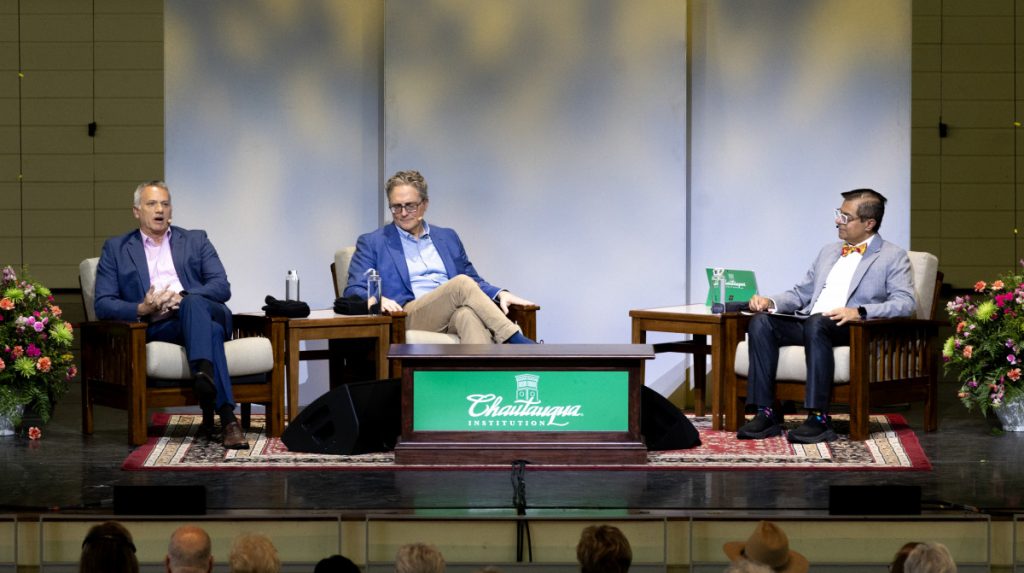
At 10:45 a.m. Wednesday in the Amphitheater, Ben Harris and James Pethokoukis analyzed the current state of the economy, possible outcomes of the midterms and remedies for national debt.
Harris is the vice president and director of Economic Studies at the Brookings Institution, where he focuses on public finance and macroeconomics and is widely published in academic journals, policy outlets and the popular press.
Pethokoukis is a senior fellow and the DeWitt Wallace Chair at the American Enterprise Institute, where he analyzes U.S. economic policy, writes and edits the “AEIdeas” blog and hosts AEI’s “Political Economy” podcast.
Because the economy was one of President Donald Trump’s main campaign points, the conversation opened with a discussion around the current state of the economy under his administration. Pethokoukis said the economy is growing but facing self-inflicted challenges. He also said the “back-and-forth policy” causes confusion and makes it difficult to forecast what the Trump administration is doing.
Harris said the “One Big Beautiful Bill Act” was an “incredibly sweeping bill,” raising the debt ceiling by $5 trillion. He also pointed to tax cuts and average tariffs as being at “unimaginable levels,” yet said the economy still sees growth.
“I agree that we learned a lot about resilience in the U.S. market economy, but in general, when you add up the various provisions and things that have been done, we probably cut back on long-term growth potential. And we have also introduced a lot of volatility, which I think will stay with us for a long time,” Harris said.
The conversation then shifted to artificial intelligence’s ability to grow the economy as well as its unintended consequences.
Regarding the U.S. job market, Harris said the claim that AI would take jobs has not yet been substantiated. He compared the growth pace of AI to Amazon. Amazon took 20 years to build and fully reshape commerce, and Harris said AI might take more time to fully develop. He also said people should balance concern about the tool with excitement about positive impacts on lives, such as longer lifespans and personalized medicine.
Pethokoukis said it is too early to tell what the effects of an “AI revolution” will be, but he hopes AI allows the economy to grow faster than it would have otherwise. He said CEOs are jumping to conclusions and making claims like “death will be optional within 10 years,” and believe AI will help them “absolutely change everything.” He said there are benchmarks of efficiency constantly being reached with AI, but these are happening more slowly than what AI CEOs imagined.
“I would say it borders on disappointment towards how quickly businesses are learning to productively use this technology,” Pethokoukis said. “I don’t think it’s costing jobs now. It’s probably creating jobs overall, especially through the data center stuff. … [AI] is not a junk technology that’s not going to work. The enthusiasm remains high, and I think it will have a tremendous impact, but too soon to tell.”
As the main topic for the week is the 2026 elections, the two economists discussed what would happen if Republicans maintain the electoral majority versus if Democrats win the midterms.
Harris said policy no longer matters as much as having charisma. He said it is “more important to describe the state of the world in a way that resonates with voters, rather than describing changes.” He cited the horseshoe effect he sees happening in the current political landscape, where the most extreme ends of either party begin to hold similar values, goals or priorities.
Pethokoukis said he sees the horseshoe effect in skepticism of trade policy. He also said the far-right end of the Republican party will not go away, and he expects extreme versions of policy from people like Trump, even when there are consequences.
“[The current trade model] has clearly been economically harmful,” Pethokoukis said. “It’s been harmful to our relationship with our allies, which also have national security consequences and it’s just been an incredibly damaging policy, so I would expect some sort of significant retreat.”
Harris said within the Trump administration, Democrats in the next two years will demonstrate how they might govern in 2029, but there is a difference in approach across the party, which might “look messy.” Overall, Harris said, bipartisanship is not dead in Washington, D.C.
When considering potential Democratic candidates for the party, the two drew a blank. Instead, they discussed “abundance Democrats” and considered the cost of living to be the number one issue in the next presidential election, along with the significance of the lens through which candidates view this issue from.
“Do you think we should cap the price of things, or build more of it and have more of it around? That’s going to be the central question around affordability, which I think will be monumental in politics,” Harris said, “Not just in 2026 or 2028, but beyond that as well.”
Regarding public opinion, the lecturers agreed there is a consensus around people being unhappy with the economy, yet data show low unemployment rates and a growing stock market. Harris said he worked with a Stanford economist to uncover the reason for public dissatisfaction, and he found that people dislike inflation; he also said partisanship fuels the fire, and economic news has become more pessimistic.
Pethokoukis agreed, saying inflation has become much more visible to the average person due to the time span in which it has occurred.
“Inflation surged over a short period of time; you can easily remember that period when prices were a lot lower … but that happened after a very long period, where we thought [inflation] was not a problem we had to worry about,” Pethokoukis said.
In looking toward the future of America’s fiscal path, Pethokoukis said it would take leadership and two candidates in the 2028 election with well-thought-out proposals to change the current trajectory of the national debt. On the other hand, he said that America is a nation of “risktakers,” and the country may be running an experiment unintentionally.
Harris said to remedy the system, the country must raise taxes and cut back on spending. He closed with discussion on former presidents’ policy agendas and how they’ve affected the economy.
“To a certain extent, this is democracy at work,” Harris said. “… The majority of Americans did not seem to care, so until we start prioritizing — until the electorate starts prioritizing this — it’s not going to change.”