Column by Mary Lee Talbot
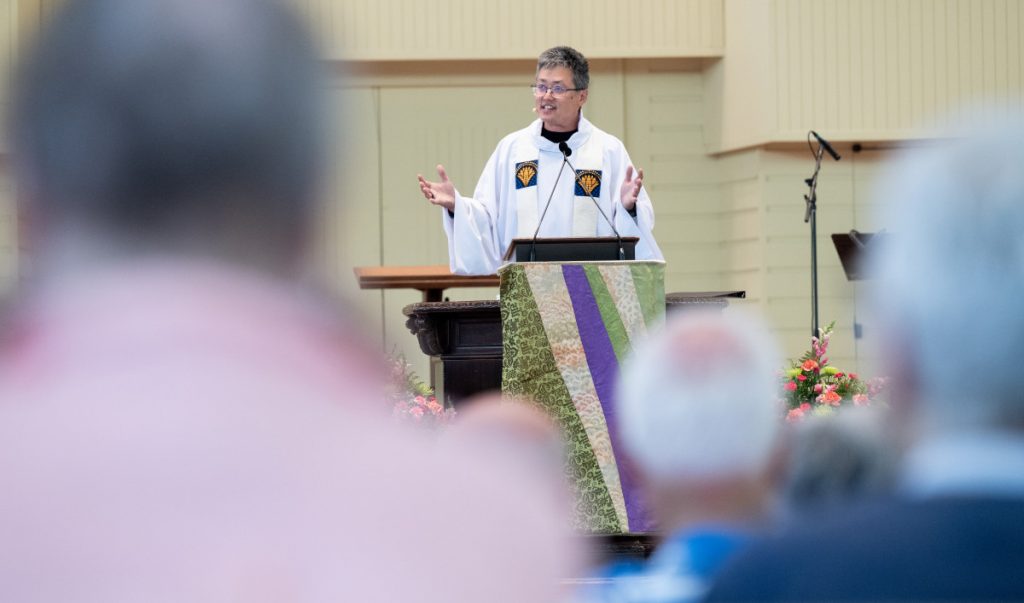
“Deuteronomy is one of those books that refuses to separate memory from the future, and it makes this bold claim that a forgetful nation is a fragile nation. If we forget, we welcome danger into the world,” said Michael Chan, Ph.D. Chan preached at the 9:15 a.m. Wednesday morning worship service in the Amphitheater.
His sermon title was “Back to the Future,” and the scripture reading was Isaiah 43:1–3a; 18–21. Chapter 43 is part of second Isaiah, a designation by scholars to denote that this part of Isaiah was probably written by a group of disciples of Isaiah.
Chan noted that Bryan Stevenson, a civil rights lawyer and founder of the Equal Justice Initiative, is someone who is doing the work of memory, reconciliation and moving into the future. He also recalled visiting the United States Holocaust Memorial Museum in Washington, D.C., Yad Vashem in Israel and Dachau in Germany.
“You have these experiences that, in some ways, bring you back enough into the encounter to recognize that these kinds of things can never happen again. They can never happen again. But it is more likely that they will happen if we forget,” Chan told the congregation.
Yet in Isaiah 43:18, the prophet tells the people of Israel to not remember the former things because God is going to do something new; God will make a way in the wilderness. But, this way in the wilderness is not exactly a new thing.
“The prophet says this with a wink because he is reminding them of their wandering in the wilderness when they left Egypt. Deuteronomy ends this decades-long wandering with the death of Moses and the people crossing into the promised land,” Chan said.
He continued, “The people in exile in Babylon are the next Exodus generation. There will be a homecoming. The new Exodus is happening now and Isaiah is making this seeable, but the people can’t see because of their despair. Hope was growing up right before their eyes, but they have to perceive it.”
Chan said you have to know where you are on a map to know where you need to go. “It may feel like their darkest hour, but they are at the end of their new Exodus. Remember your liberation and homecoming. The gospel of second Isaiah is, ‘You are going home.’”
Places like Chautauqua and Concordia College show us signs of new growth, Chan told the congregation. He quoted former Concordia President William Craft: “We have the great honor of being with [college students] in the midst of their moral awakening.”
Chan believes that the United States is in deep need of an awakening to its full heritage. He is a listener of Ezra Klein’s podcast and noted that in a podcast with Brian Stevenson, they talked about loving America honestly and how difficult that often is.
“The seeds of the future are in the soil of the past,” Chan said. “It feels like it is easy to give up and just get what’s mine, but texts like Isaiah remind us there is water in the desert.”
Chan was sitting on a porch in Chautauqua and thinking about stories of Americans who overcame adversity and were able to bring together both the grace and the trauma.
He said, “I think about the generation of independence which freed us from British rule and set us off on this path of liberty that we recently celebrated. I think of all of the women who fought just to get the vote. I think of liberated slaves who secured the freedom that they always deserved, and in the process, miraculously reclaimed Christianity from a despicable expression of that faith in the hands of their masters.”
Chan continued, “I think about how humanity first left the ground in a powered aircraft at Kitty Hawk in North Carolina. I think of the defeat of the Nazis in World War II. I think about Katherine Johnson’s work with NASA to help the United States win the space race. I think about marriage equality, think about the first Black president and I think about the long list of remarkable women and minorities who were first in their field.”
He concluded, “May these stories light our way as we cross over the river Jordan to our own land of promise.”
Robert Wilson-Black, director of the Department of Religion, presided. Sandra Cline, who is head usher at Roe Green Theater Center this summer, read the scripture. Owen Reyda, organ scholar, played “Cantique” by Jean Langlais for the prelude on the Massey Memorial Organ. The Motet Choir performed “The Spirit of the Lord,” music by Kevin Siegfried and texts from Isaiah 61:1–3 and Luke 4: 18–19. The choir was under the direction of Sonya Subbayya Sutton, interim director of Sacred Music, and accompanied by Reyda on the Massey organ. Reyda played “Prelude on McKee” by Robert McCormick for the postlude on the Massey organ. Support for this week’s chaplaincy and preaching is provided by The Edmund E. Robb-Walter C. Shaw Fund and The John William Tyrrell Endowment for Religion.