
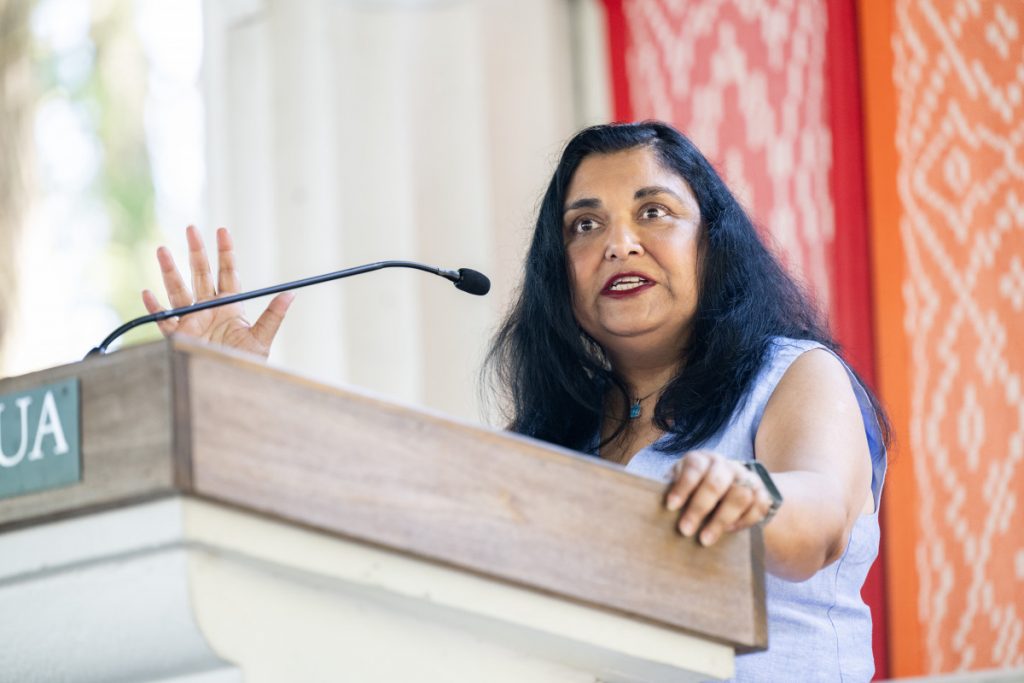
Manisha Sinha, Draper chair in American History at the University of Connecticut, speaks Tuesday in the Hall of Philosophy.
LILY RESLINK
Staff Writer
During her 2 p.m. lecture Tuesday in the Hall of Philosophy, Draper chair in American History at the University of Connecticut Manisha Sinha presented the ramifications and implications of what she calls “the second American Republic.”
“A lot of us, when we think about the history of American Republicanism, we think of it as an unbroken chain,” Sinha said.
As a Civil War historian, she said she wanted her lecture to instead convey that the Republic has been challenged, remade and refounded. She said the narrative around the Republic can be troublesome, but can also provide hope.
To introduce her lecture’s main argument, she quoted President Abraham Lincoln’s message to Congress a month before he signed the Emancipation Proclamation. The quote begins, “As our case is new, so we must think anew, and act anew.”
In this message, Sinha said Lincoln is saying the American Republic must disenthrall itself entirely from slave power to “refound our Republic and recommit it to the founding ideals.”
Her lecture traced historical instances that she explained link the history of slavery and emancipation to the history of American republicanism.
Throughout this history, she emphasized the influence of religious debates in shaping narratives about slavery and the path to emancipation.
“I think it is very important for us to look at this history of abolition — this forgotten history — and the ways in which they particularly use Christianity to make their case,” Sinha said.
She spoke about protestant sects and noted Quakers as the “ones who really came up with a concerted, religious critique of slavery.”
Sinha said, “Slave resistance, for me, did not lie outside the boundaries of abolition,” and clarified the scope of people she includes as a part of abolition.
“I am reimagining it as an interracial, radical social movement composed of ordinary Americans enslaved and free, Black and white, men and women,” Sinha said.
To explain religion’s complex role, Sinha connected what she called the “Christianization” of enslaved people to progress in abolition. As an example, she said enslaved people began to sue for their freedom.
“They used Christianization in particular, saying, ‘We are Christians, and therefore you cannot enslave us,’” she said.
She emphasized her view of emancipation “not just as a gift handed down to enslaved people,” but instead as a struggle they were an active part of. Sinha spoke about the Antebellum debate as another example, describing how its rejection propelled a greater challenge.
“Many, including some of the founders…, felt that maybe one way to solve the ‘race problem’ or the ‘slavery problem’ is to simply colonize all free Black people back to Africa, so that the only people left in the American Republic would be free white citizens and enslaved Black people,” she said. “That is the program that African Americans completely reject.”
This marks the second wave of the abolition, according to Sinha. As starkly different leading voices in this wave, she named pacifist William Lloyd Garrison and Nat Turner, who she said incited massacres of slaveowner families.
Sinha traced Lincoln’s evolution of abolition thought, beginning as a skeptic of abolition and eventually adopting abolitionist rhetoric.
“By being our first president to publicly endorse Black citizenship, I call him our first Reconstruction president, because that was in fact the agenda of Reconstruction.”
“Reconstruction is an extraordinary period when the foundation of our modern interracial democracy is being laid,” Sinha said.
She added that the era propelled valued American ideals, such as women’s suffrage.
“It’s an enormous expansion of American democracy, but I think it’s a cautionary tale that things can go backward so fast,” she said.
She said the American experiment was thwarted by a “campaign of violent terror” and some “pretty reactionary Supreme Court decisions at that time,” which Sinha said demonstrates how rights that have been won can be lost again. Sinha said, “It is a constant struggle to implement the values on which our Republic was founded.”