
LILY RESLINK
Staff Writer
Journalist, commentator and American Enterprise Institute senior fellow Naomi Riley bases her work on firsthand experiences in the communities she travels to, giving her a portfolio that ranges as widely as her travels across the U.S.
“You name the religious service, and I’ve probably sat in on it,” Riley said.
She said she thinks the U.S. would be less polarized if others did the same.
“I think everyone should hop in a car or a plane and go visit a community that’s very different from theirs, a religious community or otherwise.”
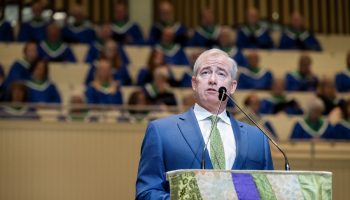
At 2 p.m. today in the Hall of Philosophy, Chautauqua can pick Riley’s brain during a moderated conversation on her experiences and written works on faith.
“I’ve visited communities of Latter Day Saints … and evangelical Christians, and traditional Catholic communities and Orthodox Jewish communities,” she explained. Riley said she thinks assumptions about religious groups based on social media or politicians happen too often. A goal of hers is “helping people to try to make sense of sometimes contradictory narratives that they’re hearing about the United States right now.”
She said visiting other communities to see their messages and rituals would give Americans not only a better understanding of each other, but a more positive one.
“The perspective that I’m bringing is not one faith or another. I don’t have a particular agenda here. I just want people to be able to see what I’ve seen as a journalist,” Riley said.
In planning her lecture with Chautauqua, Riley said the open-ended structure prevented constraint to any one topic and better suited the range of her work.
Riley said before the request to join the Interfaith Lecture Series, Advocates for Balance at Chautauqua invited her for the Monday lecture she delivered on the divide she sees between over- and under-parented children in the U.S.
Family affairs and child welfare is the focus of Riley’s work at AEI.
“One of the windows that I’ve had into the experience of faith in America is through organizations and families that do foster care and adoption,” Riley said.
According to Riley’s observations, learning from faith communities and organizations can help address social problems, such as the current shortage of foster families in every state.
“I think there’s really been a revolution … in the field of child welfare when it comes to how faith-based organizations approach this issue,” Riley said. She has seen faith-based organizations recruit, train and support foster care in a model she hopes will spread.
“It’s unfortunate that some of our religious divide has become a political divide, and vice versa,” Riley said. She said she thinks it is important for people to see practices of religion and faith as detached from political goals, and she intends to convey this message as a speaker.