
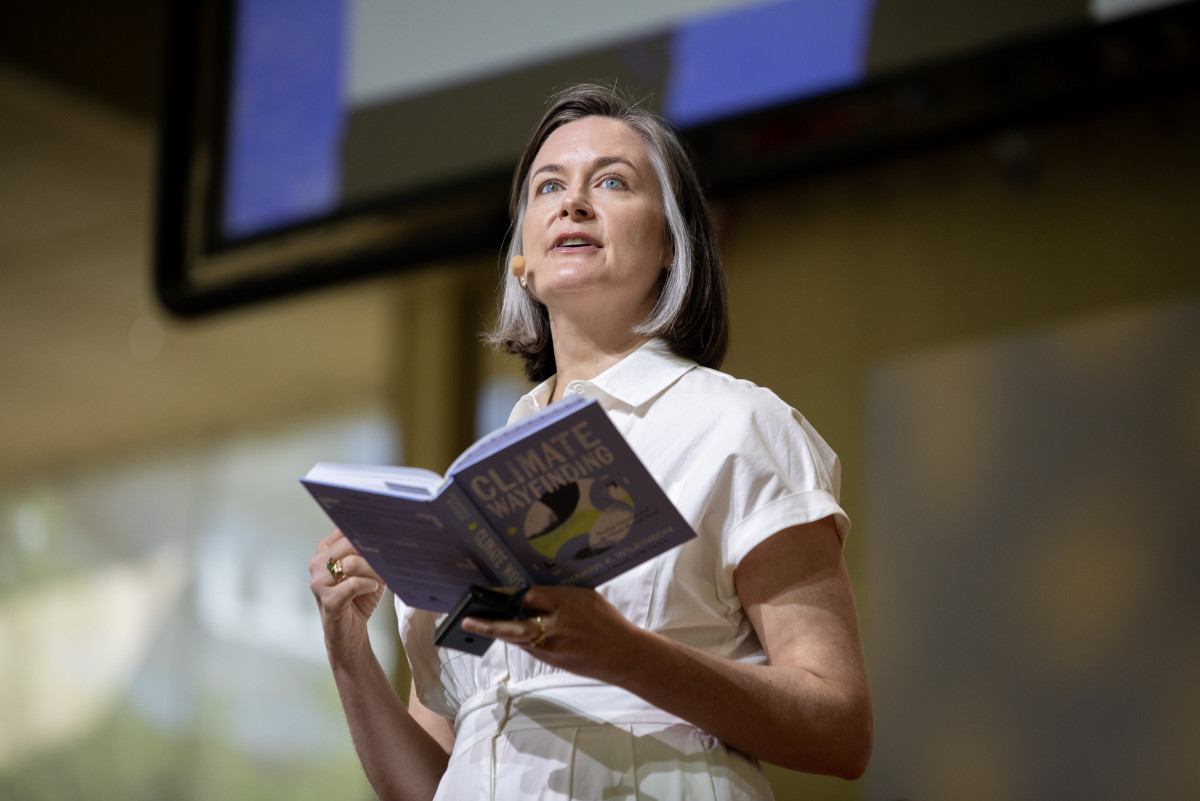
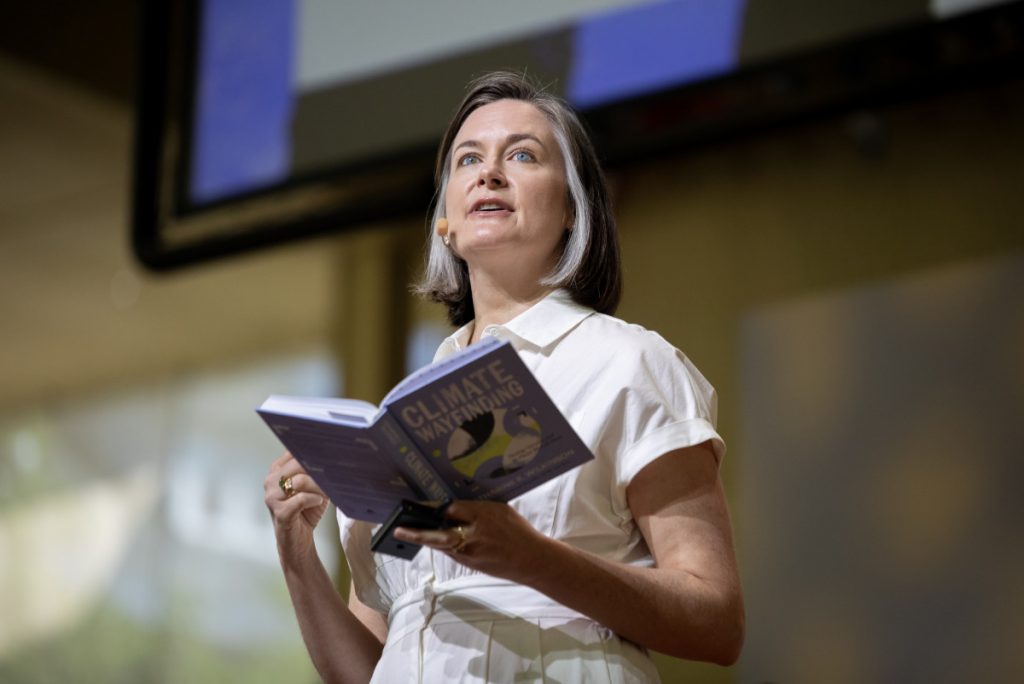
Katharine K. Wilkinson reads a passage from her book Climate Wayfinding that contains advice on how individuals can grapple with overwhelming climate crises during her talk Thursday in the Amphitheater.
ARIANNA NEVAREZ
Staff Writer
With a rise of information about climate change and people seeing that the “places we love are hurting,” Katharine Wilkinson said it starts to “feel personal.” She said “urgency and overwhelm will keep us stuck.” Instead of more information, she said society needs orientation.
“To be so small in the face of something so big is simply disorienting,” Wilkinson said. “We’ve been focused this week on waste, disposability, our climate and ecological crises, but of course those are entangled and run up against the swift currents of political change, authoritarianism, inequality, technological evolution that seems to be racing forward by the day. It’s no wonder we have a sense that the very ground beneath our feet is not as steady as it might have felt in decades past.”
At 10:45 a.m. Thursday in the Amphitheater, Wilkinson took the audience through the practice of Climate Wayfinding and the best way to answer the question, “What can I do?” in the face of the climate crisis.
Wilkinson is the author of Climate Wayfinding, the anthology All We Can Save and The New York Times bestseller Drawdown. She also co-founded and leads The All We Can Save Project, a climate leadership organization, which includes All We Can Save Circles and Climate Wayfinding programs.
Wilkinson said the question of what one can do is heavy to think about in the climate and environmental movement, and the conventional response of the movement is to give people a “punch list,” telling people to get an electric car, asking them to be educated about fast fashion and to throw away clothes and ensuring they’re going to vote in future elections. She said it can feel “too small for the immensity of what we are grappling with.”
Though the world is at a time when the majority wants to see more climate action from governments, Wilkinson said people are “not active” and can feel stuck, discouraged due to job loss or overwhelmed by climate issues.
Wilkinson said the realization of global fatigue helped her think differently about the question, “What can I do?” From reflecting on the different things that helped her, she created Climate Wayfinding as a way to “work our way together towards clarity, connection, possibility, action, renewal” to create a “deep, sustained, courageous climate engagement.”
There is a three-part approach to this process: looking inward with care, outward with curiosity and forward with courage, Wilkinson explained.
Wilkinson said more than half of young people around the world feel so worried about climate change that it impacts their day-to-day lives, at school and at home. She said as people look inward, these strong emotions are not wrong. Instead, people need to “be able to speak them, share them (and) work with them, so that they can be guides and fuel.”
Noting the importance of reflecting on emotions, Wilkinson said it doesn’t all have to be
overwhelmingly negative.
“It’s also about our gifts, our superpowers, the ways we each uniquely express life force,” Wilkinson said. “In Climate Wayfinding, we use both somatic and reflective practice that’s centered on the intersection of power and joy, paired lenses that we bring to discern our strengths, how we shine.”
Once the question shifts from “What can I do?” to “Who do I want to be to meet the challenges of this time?” Wilkinson said one can begin to look outward. In looking at solutions, she said people need to look for things they care about and are deeply invested in. She also said this is a place to “invite in the spirit of the artist” and be creative, “as we do that remaking of our world.”
Wilkinson said this is also something one can’t do alone.
“When you’re facing a planetary crisis, just like a personal one, it is absolutely best practice not to do it alone,” she said. “We need one another to cope, but we also need one another to get things done, so building our relational web is a fundamental part of climate action.”
Looking forward with courage, Wilkinson said she and the All We Can Save Project are tapping into “imaginative wisdom,” which she describes as thinking about “the future we want to move towards and the role we might play within it.”
Wilkinson also brought up the Climate Compass; she said “inbuilt within us (there are) capacities for orienting, for navigating, for sense-making and storying, for sending ourselves from where we are to where we want to go.”
Wilkinson invited the Amp audience to engage in an exercise to express what they feel with joy and power through body movement or posture; she said she wanted to give the audience a sense of Climate Wayfinding, which she said is a lifelong process.
“It is a fundamental process we are called into as our home planet trembles with so much change, with so much loss, and also still with possibility. As the landscape shifts and we evolve and our questions take new shapes, we have to keep coming back to the crossroads, to the liminal space, and keep working with the questions again and again,” she said. “Sometimes we find ourselves back at the crossroads because of external conditions.”
In closing, she talked about the impact of losing her father to Alzheimer’s disease, which includes memory loss. She said this left her with “a raft of new wonderings about home, about meaning, about what to do with this fleeting and incredibly precious time we have in these bodies.” She then read a passage from the last chapter of her book, Climate Wayfinding.
“I cannot possibly prove it, but I know we are all caught in Earth’s net of unstinting, unequivocal love,” Wilkinson said. “Our deepest belonging sources from it. Our deepest learning resides there, and our deepest invitation is to participate in the exchange. I long for climate healing, motivated not from wanting to fix something, but from wanting to love something.”