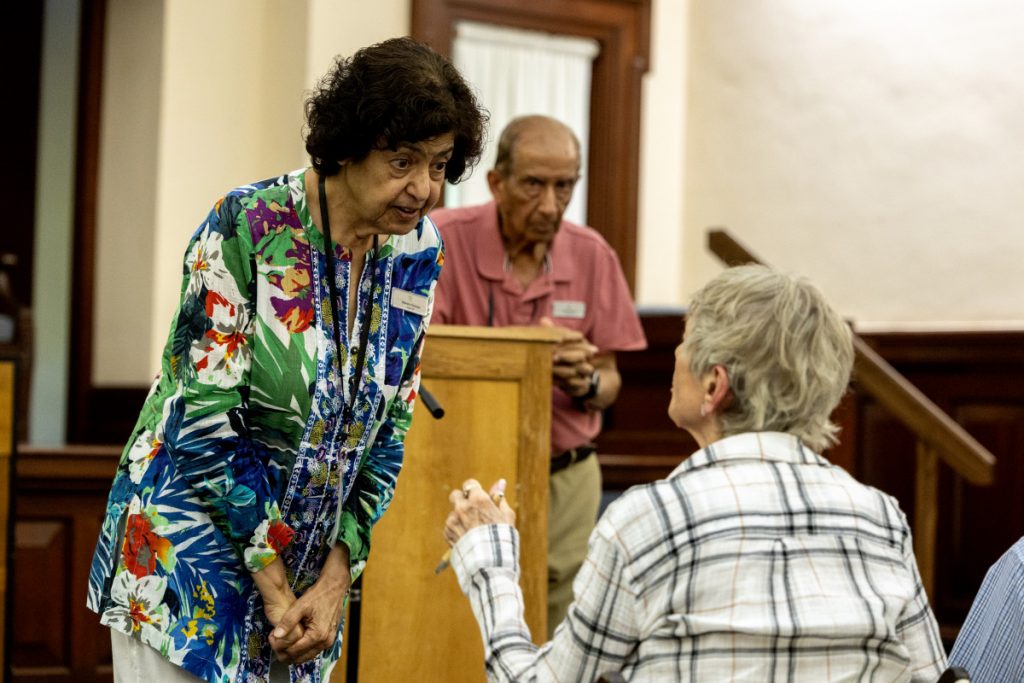
Author Sabeeha Rehman listens to a question from Julianne Curtis about the interpretations of Jesus in the Quran and the difference between he and the prophet Muhammad Monday during an Islam 101 session titled “The Quran and What it Says About Other Faiths” in the Hall of Christ.
LILY RESLINK
Staff writer
Khalid and Sabeeha Rehman, who have taught Islam 101 at Chautauqua Institution for 10 years, want people to think of them as their “Muslim next-door neighbors sitting on a stoop and having a conversation,” Khalid said. The couple is dedicated to spreading a foundational understanding of Islam to anyone interested in learning.
The Rehmans said they have come to Chautauqua since 2012 and, prior to Islam 101, they were connected with the Department of Religion during Joan Brown Campbell’s tenure as director of Religion.
They said they bring no background in religious scholarship; Khalid explained they both have healthcare backgrounds. “So we are not Islamic scholars. We have no degrees,” he said. “No credentials,” Sabeeha added with a laugh. Rather, they center the course around their personal experience as Muslims and adapt the course content based on feedback and common questions.
At 3:30 p.m. today in the Hall of Christ, the Rehmans will conclude their last week of Islam 101 for the summer season with the course’s final installment, “Islam in America.” Today’s topic, they said, incorporates their journey since coming from Pakistan to New York 54 years ago.
“We had to struggle to bring faith to our children and then also started to assimilate and incorporate the American culture,” Khalid said. Khalid said this concluding topic for their course allows them to explore how Muslim ethics apply to topics relevant in the modern U.S. but not addressed in the Quran, such as organ donation and LGBTQ+ support.
The Rehmans began Islam 101 in 2016, inspired by the lead up to the 2016 election. Khalid thought an educational course on Islam might help address concerns relating to then-presidential candidate Donald Trump’s language toward Muslims.
Khalid told Sabeeha he thought they should write to Maureen Rovegno, former director of Religion, to propose a course on Islam as a response to the growing interest in it due its presence in U.S. politics.
Because Sabeeha was already in communication with Rovegno, Khalid prompted her to initiate the pitch. Sabeeha said she thought the pitch was audacious, but Khalid ultimately took the proposal into his hands and created the same five-day outline they still use today.
To Sabeeha’s surprise, Rovegno said yes, and the course was underway.
For their first class, they said, they thought it would be sufficient to arrive 20 minutes early to the Hall of Missions in order to set up a few chairs. When they got to the venue, Sabeeha said there was a crowd.
She remembers someone telling her, “You can’t go in, the place is full.” She responded, “I’m the speaker.”
“Nobody knew who Khalid and Sabeeha were,” Sabeeha said. “This was the Chautauqua spirit of learning. They wanted to learn, the topic interested them and so they came.”
The couple said each day of the course offers an opportunity for them to “demystify” a part of the Islam faith.
Day one begins the course with an overview on “The Quran and What it Says About Other Faiths.”
Day two is “Family Life & Women in Islam,” which the couple said covers marriage, divorce, adoption, abortion and rituals.
Day three is “Shia-Sunni Divide & Religious Hierarchy,” in which Sabeeha said she represents the Shia and Khalid represents the Sunni. They use a format that engages the audience as “the judge and the jury” in an interactive mock trial.
Day four covers “Shariah” — the body of religious and secular law drawn from Islamic tradition — something that Sabeeha called “very misunderstood.”
Khalid said day five, today’s installation, brings anecdotal explanations to “Islam in America, and American Muslim Identity,” including an exploration of what it means for the Rehmans’ children to “practice Islam in an American way, not the Pakistani way.”
The two end each class with an open Q-and-A. Participants can also leave their email to receive digital copies of the Quran and educational materials the couple has developed over time.
Khalid said each year, at least 200 people request these materials.
Because the course’s high demand during the first year, Rovegno proposed that, for the next summer, the Rehmans instruct multiple weeks of Islam 101 and use Hurlbut Church Sanctuary as a venue.
“We came for four weeks, and the church filled up,” Sabeeha said. She said she saw word-of-mouth invitations succeed in growing class attendance.
This year, Sabeeha said attendance has ranged from 40 to 100 people. The couple said they worked with Director of Religion Robert Wilson-Black and the department’s administrative assistant Carolyn Snider to conduct an official survey this summer.
Sabeeha said the 200 completed surveys processed so far have been “very generous indeed,” with over 90% saying the class is excellent.
Sabeeha said “at least 75% (of people) that have returned their survey say this is the first time that they are listening to something about Islam.”
Because many participants are new to the content of Islam 101, it is meant to be easy to understand, according to Khalid. “There are no slides, there are no data, there are no statistics.”
Through the class, Khalid said they have made friends and connected to opportunities for teaching Islam 101 courses across the nation.
Sabeeha said the couple offered to talk to any community that invited them, and they would pay out of their own pockets to do so. This offer came at the time of Trump’s election in November, when she said she noticed anti-Islamic actions “became very much part of the news cycle.”
By plane, bus and train, the couple said they traveled to more than 100 U.S. cities and have given around 250 talks.
Khalid acknowledged the distinction between the scholarly religion lectures at Chautauqua and the Rehmans’ more casual approach, characterized by banter and a “very folksy point of view.”
After a session, Khalid said a gentleman who became familiar with their classes through Chautauqua made a point to express his disappointment that their banter was particularly lacking that day.
“We inevitably end up contradicting one another, arguing with each other,” Sabeeha said. From what audiences have shared about finding value in watching the couple openly disagree, Khalid said the two have realized that this less “scholarly” approach holds its own unique educational value.
“People have told us that they just love the fact that a woman is challenging her husband in public,” Sabeeha said.
Khalid reflected on how their representation of a marriage between Muslims might be challenging preconceptions.
“I think, subconsciously, they see a Muslim woman who’s not covered (by a traditional Muslim head covering) taking charge and pushing the husband around a little bit … and it gives them a different impression of what they think Muslim is and what a Muslim woman is,” Khalid said.
In the ’80s, the couple contributed to organizing the addition of a mosque on Staten Island. It was then Khalid began to encourage Sabeeha to write a book sharing the stories of her trailblazing efforts.
“And of course, life got in the way,” Sabeeha said.
In 2010, she said their 8-year-old grandson was detained at an airport because he had the same name as a terrorist on the No Fly List.
Sabeeha said amid their family’s frustration, Khalid encouraged her to just tell the story so it may reach people outside of their usual interfaith dialogues. Without academic discourse or references, he said to let readers learn about Islam by getting to know her.
She recounts these stories in her 2016 book, Threading My Prayer Rug: One Woman’s Journey from Pakistani Muslim to American Muslim.
The book also documents the couples’ experience with the Staten Island mosque they helped to organize.
Although the men who formed the mosque’s leadership ultimately did not allow Sabeeha to run as a board member for the mosque, Sabeeha said her takeaways are positive because of the supportive community.
“People from all faiths, from all communities were there standing by us, supporting us, educating us,” Sabeeha said.
She said today, it is common for women to be a part of mosque leadership. “I lost the battle, but we women won the war because it started a movement.”
From this experience, Sabeeha said they learned “this can happen only in America where there is freedom of religion, there is freedom of choice, there is freedom of expression and that the hearts of the American people are so open, they want to learn, they want to know.”
Of her family’s story that has led them to this point as Islam 101 instructors, Sabeeha said, “that’s one of the key lessons: … this is the American experience.”