
Column by Mary Lee Talbot
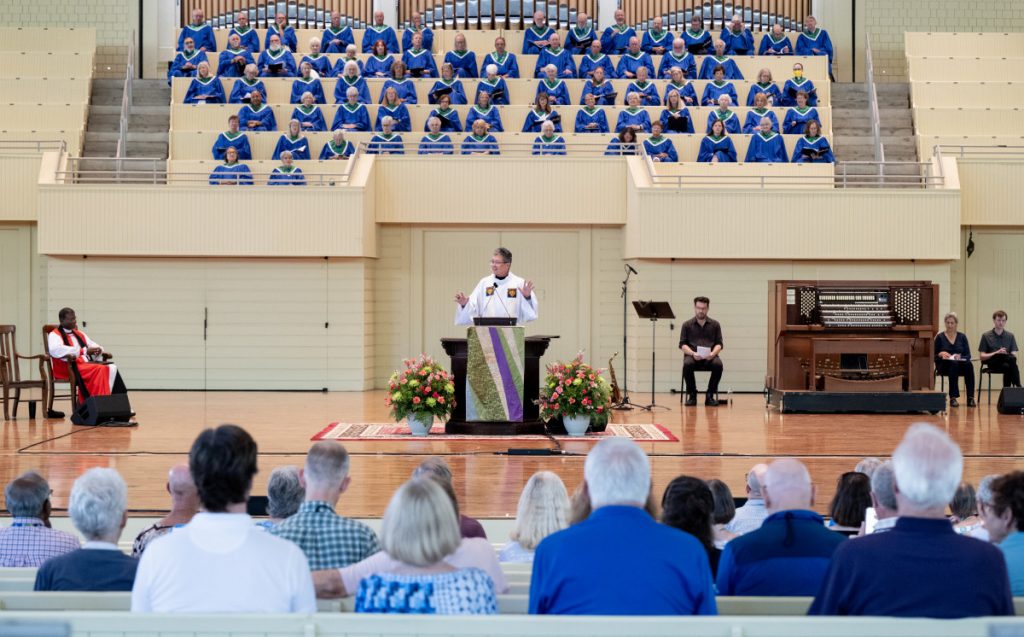
“In the Hebrew Bible, sin has cosmic consequences; blessing and sin are cosmic categories. The moral web of creation is like a spiderweb — there are ripple effects,” said Michael Chan, Ph.D. He preached at the 9:15 a.m. Tuesday morning worship service in the Amphitheater. His sermon title was “Remembering Our Way Forward.” The scripture reading was Micah 6: 1–8.
Chan reminded the congregation that Deuteronomy 24, the text from Monday, tells people why they should care for widows, orphans and foreigners. The Israelites’ memory of being slaves in Egypt is linked to the mandate to shield people who are experiencing precarity, who are vulnerable. “If we forget our past, it is harder to show compassion,” he repeated from previous sermons. “Deuteronomy shows us that laws are part of our history, and the future runs through history.”
According to Chan, the prophet Micah is within the tradition of Deuteronomy, pointing people toward justice and the way of the good life. Micah 6: 1–8 is a poem in three movements, he said. The first movement is a lament from Yahweh, a disputation with the people. The people then confess to sin and ask what can be done, and the final movement is a statement of the good life.
In verses one and two, Yahweh summons the whole cosmos to hear the case against the people. In verse three, Yahweh asks, “What have I done to you?” Chan said, “If that question is in the mouth of the biblical God, I want to know more about what’s happened. This is God who feels anger and sorrow at the same time. God wants them to look at real pain and know that God is touched by suffering.”
Verse five is a reminder of events that are recalled in the Book of Numbers. King Balak wanted Balaam to curse Israel, but he couldn’t do it. Instead, he critiqued the king and provided a critique of royal power.
The voice of the people is heard in verses six and seven. They have a moment of recognition that they have done something wrong but don’t know how to make things right. They don’t believe that burnt offerings would be enough. The prophet speaks in verse eight: God has told you what to do — do justice, love kindness and walk humbly with God.
“The message is that worship devoid of a moral life, of kindness, is empty and harmful,” said Chan. “The people should live a life of justice, of caring for the widow, orphan and foreigner. They should also practice hesed, a deep loyalty beyond what is required as in the person of Ruth.”
Chan continued, “This is a liturgy that begins with an accusation, ‘what have you done?,’ moves to acknowledgment of what was done wrong, followed by the question, ‘what should we do?’ The last part is reconciliation, with guidance for how to move into the future.”
The gift in these verses is a description of how to move through to the moment of reckoning. It teaches us how to listen to the pain and acknowledge the wrong that was done. Even though nothing can be done to fix the wrong, it must be acknowledged. Forgetfulness is a problem, which is why the wrong must be acknowledged to move forward in a way that involves hesed, kindness.
Chan said that the present cultural amnesia in the United States, with people being pressed to choose a side that is either all uplifting or all tragic, leads to a very fragile country.
Martin Luther King, Jr. frequently used the verse from Micah 6: 8: “He has told you, O mortal, what is good and what does the Lord require of you but to do justice and to love kindness and to walk humbly with your God.” King also quoted Amos 5: 24, “But let justice roll down like waters, and righteousness like an ever-flowing stream.” This is a vision that all the Abrahamic faiths share.
The Rt. Rev. Eugene Taylor Sutton, senior pastor of Chautauqua, presided. Deborah First, a winter resident and member of the board of the Quaker House, read the scripture. Owen Reyda, organ scholar, played “Rhosymedre” by Ralph Vaughn Williams on the Massey Memorial Organ for the prelude. The Motet Choir, under the direction of Sonya Subbayya Sutton, interim director of Sacred Music and accompanied by Reyda on the Massey organ, sang “Will You Come and Follow Me,” musical setting by Tom Trenney and text by John Bell and Graham Maule. Sutton played the postlude “Concerto, BWV 595” by Johann Sebastian Bach on the Massey organ. Support for this week’s chaplaincy and preaching is provided by The Edmond E. Robb-Walter C. Shaw Fund and The John William Tyrrell Endowment for Religion.