
ROCCO PRIOLETTI
Staff Writer
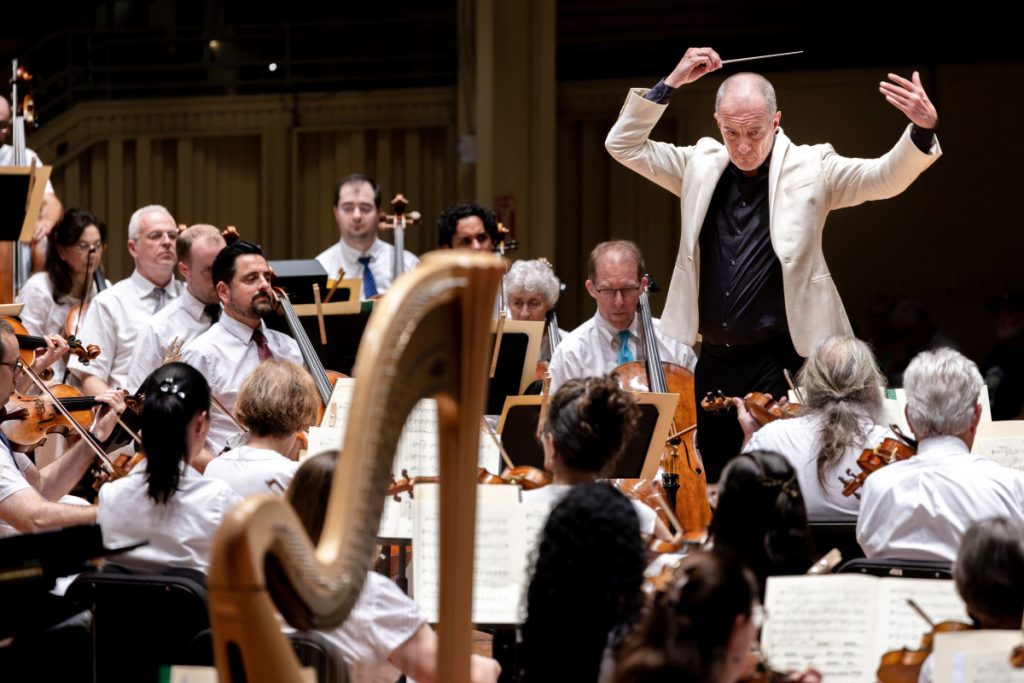
At 8 p.m. tonight in the Amphitheater, the Chautauqua Symphony Orchestra, conducted by Music Director Rossen Milanov, welcomes concertgoers to “An Evening of Brahms.” However, behind the show’s curtain, another composer looms heavily throughout the two pieces.
Milanov saw a direct connection between Brahms and Robert Schumann — a composer whose Third Symphony is still on the conductor’s mind shortly after the CSO performed Schumann’s piece July 7.
“Schumann was the one that, literally, put the name of Brahms (on the map) as a composer to watch in the middle of the 1850s,” Milanov said.
The CSO will conclude their evening of Brahms with his penultimate Third Symphony — a piece which, for Milanov, expresses the “musical friendship” between the two composers. To those with a keen, attentive ear, the piece is embedded with quotations from Schumann.
“He brings [out] the very first theme, that we hear from the first movement in a very softened [way] … almost like an idea that is traveling in space at the very end of the last movement — which is quite unusual,” Milanov said. “And then, he combines all of that with this very solemn chorale, as if it was taken from the fourth movement of the Schumann Symphony (No. 3).”

Illustration by Laura Quisenberry / Design Editor
Despite the influence and significance Brahms saw within Schumann, the piece undeniably stands on its own as an opus.
“Symphony No. 3 by Brahms — it’s a universe on its own, and it’s certainly a late Romantic masterpiece,” Milanov said. “It’s a piece that, probably, is one of the most extroverted [symphonies], compared to the other three that he wrote because the ending is very serene — very, very beautiful.”
The CSO will open the program with Brahms’ Concerto for Violin and Cello. The performance spotlights CSO concertmaster and violinist Sharon Roffman and principal cellist Jolyon Pegis.
Milanov described the interplay between the solo violinist and cellist as “a conversation, not a competition” that develops the double concerto into a texture-rich world of its own through their shared inspiration.
During his early years, Brahms was engrossed in the folk tradition of Hungarian csárdás music, a dance-centric style that never left the composer’s fascination throughout his career. Brahms returns to this inner world throughout the concerto’s closing remarks.
“So, that last movement of the concerto is, probably, his last time when he visits this utopic land where everything’s permitted, you know?” Milanov said. “The land of passion, the land of exuberance which, probably in his own personal life, he didn’t really have a chance to experience. So, he had to transport himself into that dream place where he was free.”
Milanov casted the double concerto symphony pairing as being a particularly irregular representation of the genre.
“[Brahms’] two piano concertos, obviously, are masterpieces. And, of course, the violin concerto is one of the top [pieces] of the repertoire for the instrument,” Milanov said. “So, this is a little bit odd having a double concerto and, probably, the symphony that is the least performed of the four — the third one.”
Still, the idiosyncratic program provides an interesting and unique perspective into the composer’s late works.
“So, it would be Brahms being seen through a little bit [of a] different lens,” Milanov said.