JENELL TAYLOR
Staff Writer
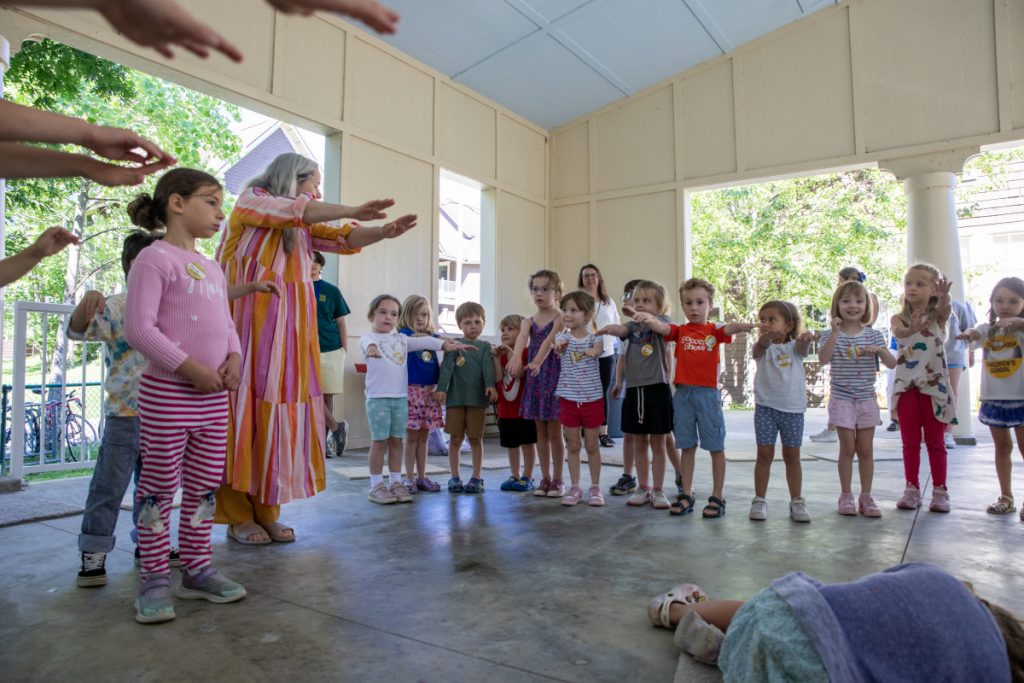
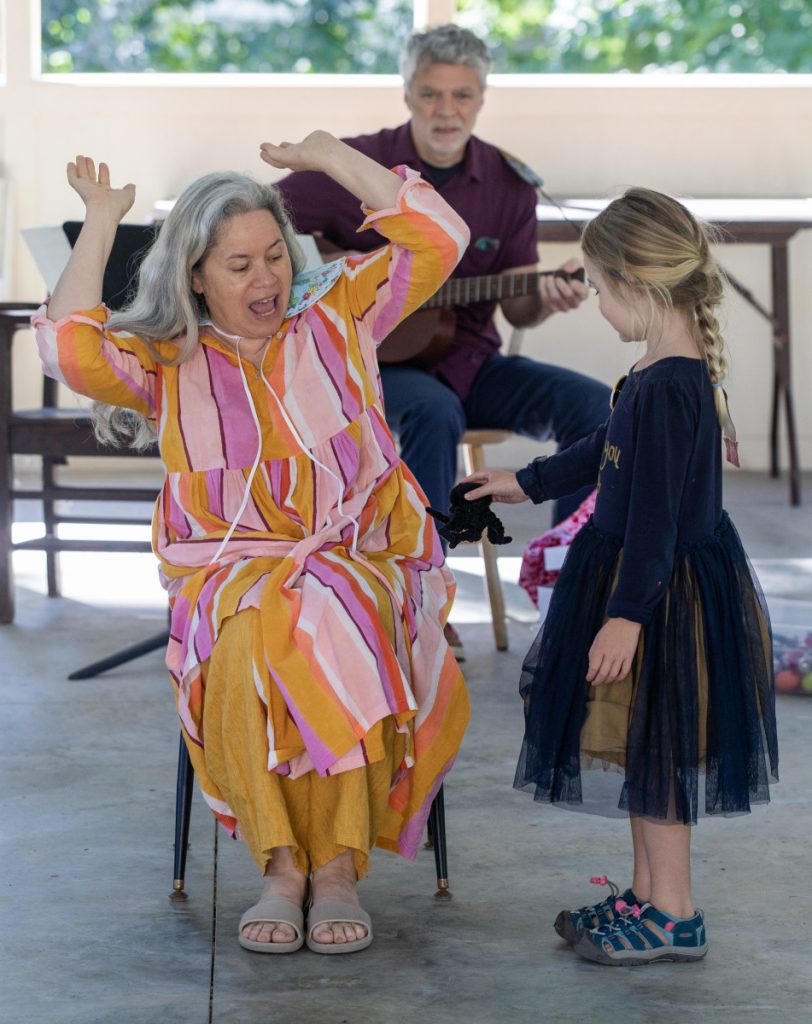
Thursday morning, musician and Chautauqua County native Natalie Merchant visited Chautauqua’s Children’s School to engage with students in an interactive sing-along event. Held outdoors in the Jessica Trapasso Pavilion, children ages 3–6 excitedly gathered in a large circle as Merchant led them in song.
The activity was sectioned into three parts, each corresponding to the Children’s Schools’ groupings: ages 3–4 in Group One, 5-year-olds in Group Two and 6-year-olds in Group Three.
Joined by her guitarist, addressed as Mr. Eric, Merchant began the first session with the song “John the Rabbit,” a traditional call-and-response song about a sneaky, carrot-stealing rabbit.
Ensuring she made eye contact with each and every child as she looked around the circle, all faces were focused as she described the activity’s rules. “When I say rabbit, you say ‘yes ma’am,’” Merchant said. A thunderous chorus of “yes ma’ams” ensued shortly after.
Amid the children’s full-bodied laughter, Merchant raced around the ring in a lively game of duck, duck, goose, where the kids named all of the sea creatures they could think of using the song “Charlie Over the Ocean.”
“Charlie over the ocean/Charlie over the sea/Charlie caught a starfish/He can’t catch me,” echoed the chorus.
Groups Two and Three saw similar songs and activities, all of which were supplemented with props. Capes, tiny crowns, rhythm sticks and plastic pastries kept the children actively engaged while Merchant guided the sessions.
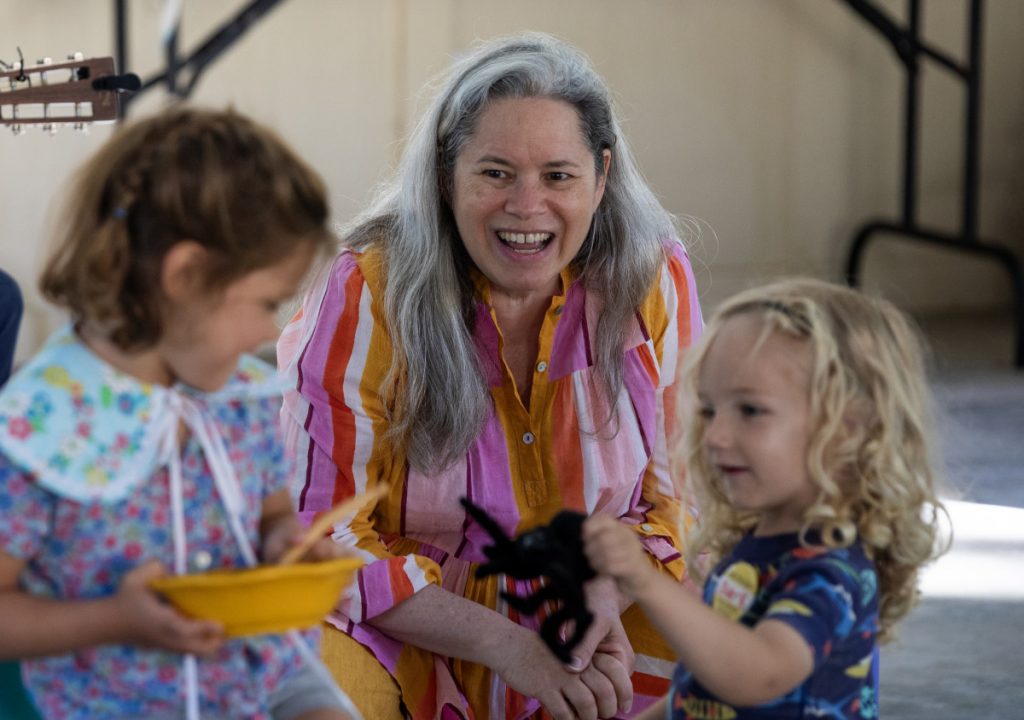
She used the songs to call the children to reflect and think about their own lives and experiences. In the poem “The Queen of Hearts,” a knave steals the queen’s tarts, is caught and swears to never steal again.
“And then the knave brought back the tarts, and vowed to never steal again. Do you know what it means to take a vow?” Merchant asked the 5-year-olds of Group Two. Making an X across her chest, she said, “A vow is a promise — cross your heart and say ‘I will never do that.’”
The children recounted their own instances of misbehavior, with one child describing how she went against her mother’s wishes and jumped into a pool without her floaties. In the end, all of the kids agreed to make an effort to follow the rules and be honest.
The games that Merchant played with the children were lighthearted and fun while being rooted in practical skills such as active listening, turn-taking, sharing and word association.
Merchant sang a goodbye song at the end of each session that acknowledged the sadness of saying goodbye — especially for kids — but promised that goodbye is not forever.
Afterward, Merchant quieted her energy to match the atmosphere of the nursery that oversees the school’s 2-year-olds. She sang lullabies to the kids as they listened and had a pre-nap Nilla Wafer snack.
Merchant gave the toddlers their own goodbye song, singing “It’s time to go home/It’s time to say goodbye/I had so much fun/And you had so much fun/And now we say goodbye, goodbye/See you again.”
In a post-sing-along interview, Merchant reflected on the experience and detailed how vital it is for kids to feel important and heard. She said society tends to overlook them and underestimate their emotional capacity and intelligence.
Merchant described how one child from Group Three gave her a hug at the end of the session, and how much that moment demonstrates why she does the work that she does.
“She said, ‘I write songs, too, and play the guitar,’ — and she was only 6 years old. I could tell that she was extremely gifted and music is really important to her,” Merchant said. “I always get more out of the experience than the kids do, probably, because I get encouragement and hope.”
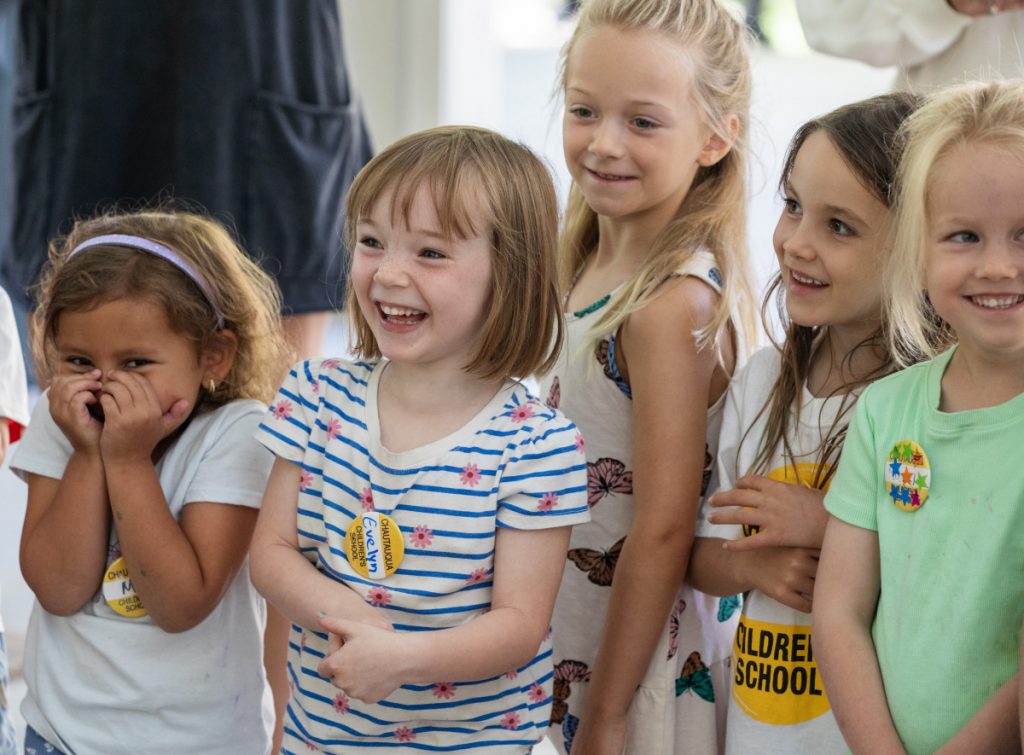
“I don’t know if they’re looking for hope when they wake up in the morning, but I am,” she said. “And they gave that to me today.”
The fact that children are the world’s future is a beautiful truth for Merchant, but she said their future success is directly linked to the positive acknowledgment they receive now.
“It’ll be their world in 10, 15 years, and they’ll be making the decisions and effecting all the change that’s going on,” she said. “It’s important that we all pay attention to kids, whether they are ours or not.”
Merchant said she believes it is damaging for children to be exposed to concepts beyond their understanding; she said it’s incomprehensible that children might feel the need to numb themselves digitally to be able to survive the level of cruelty that exists in the world today.
“We need to talk to children, and we need to model healthy behavior: talking to each other, putting our devices down,” she continued. “Kids are getting exposed to things that they don’t have the experience of — I mean, [adults] don’t even understand the cruelty in the world.”
“It must be incomprehensible to children,” she said.
Merchant talked about how she witnessed militaristic conflict as a child, noting the tail end of the Vietnam War and The Troubles of the 1960s.
“When I was a child, the Vietnam War was happening, and there was a civil war going on in Ireland,” she began. “For instance, I remember seeing a crowd control — the British were trying to control a crowd in Belfast, and a child was hit with a rubber bullet.”
She recalled witnessing coverage of these major news stories at a young age and feeling profoundly affected by the experience.
“It was on television at my grandparents’ house, and I just had no capacity to understand that,” Merchant said. “I probably saw that when I was 6 — these kids’ age — and I can still remember what it felt like.”
In Merchant’s perspective, children can be overwhelmed by information and can benefit from less stimulation.
“I just feel like children are being bombarded, and I think they need more gentleness, more peace, more quiet.”
She highlighted the importance of empathy and learned autonomy for children’s development, and how she modeled that for her own child.
“When my daughter was a child, I never treated her like the baby — I never treated her like the toddler,” she said. “I treated her like the person that I loved and respected.” She then reiterated how crucial it is to “treat children like individuals with sovereignty.”
Merchant said she believes that every person has a responsibility to this world and its future. She said children are in a vulnerable position because of their sustained reliance on the people around them, but as human beings with hearts that feel, the mission should be to protect and nurture society’s unique and impressionable young minds.
“There’s so much that every single person can do,” she said.
Above all, Merchant urged people to take action. She said volunteering and donating supplies to local and national organizations that support children and families such as Head Start — which has programs in all 50 U.S. states — is just one way to show care.
“We have this wonderful network that’s nationwide,” she said. “It’s in every state and every community — all you have to do is call them up and say, ‘Do you need help?’”