
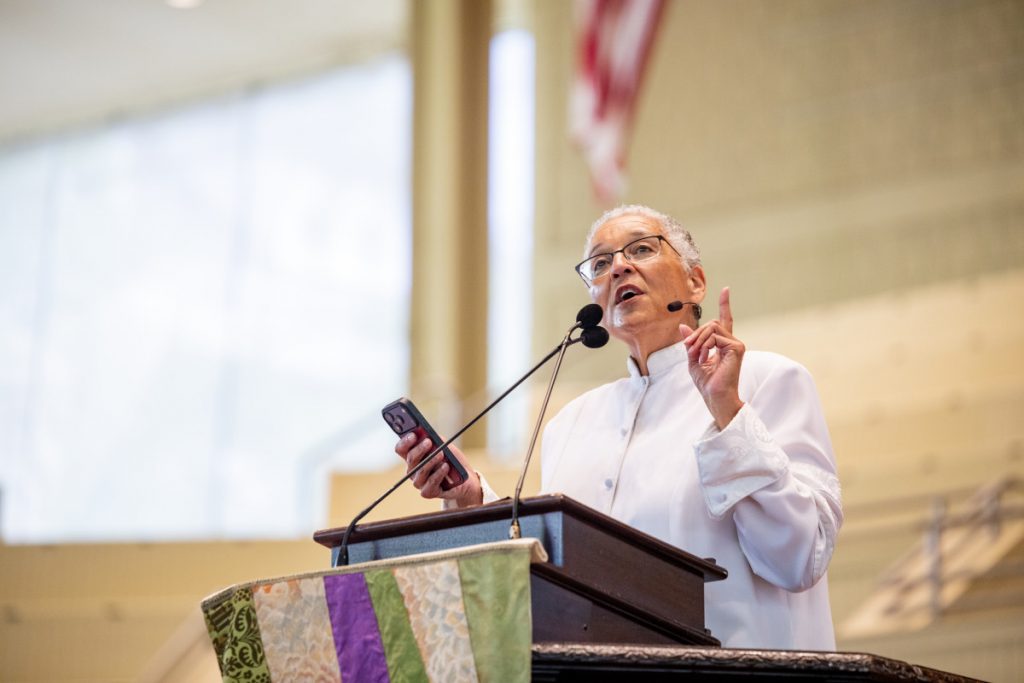
The Rev. Zina Jacque delivers her sermon “Look Me in the Eyes” Sunday in the Amphitheater.
MARY LEE TALBOT
Staff Writer
This week, the Rev. Zina Jacque, Ph.D., has preached about artists against the odds. On Sunday, she spoke about Hayv Kahraman, who invited people to look others in the eye. On Monday, she brought forward Theaster Gates, whose sculpture, “Gibraltar,” reminded the congregation that what is broken is only interrupted. On Tuesday, she highlighted “Trans Forming Liberty” by Amy Sherald to show someone who stood against being tested because she knew what she stood for and on.
“They did so with what was only in their hands. Today we will talk about one after God’s own heart, David, who used what he had in his hands. So what is in your hand?” Jacque asked the congregation. She preached at the 9:15 a.m. Wednesday morning worship service in the Amphitheater. Her sermon title was “What’s in Your Hand?” and the scripture reading was 1 Samuel 17:24–33.
David was the youngest of the eight sons of Jesse, and he got the dirtiest jobs. “He was out with the sheep and he slept with them, ate with them and bathed about as often as they did,” Jacque said. It was not a life anyone would choose, and while his brothers were out fighting the Philistines with King Saul, David was out in a field.
One day, David was sent with provisions for his brothers and he heard people talking about the new fighter the Philistines introduced, Goliath. David saw that the people of Israel were afraid, and he asked why they doubted the Lord their God who had brought them out of Egypt, through the Red Sea and into the wilderness.
Eliab, David’s oldest brother, spotted David in the crowd and thought he was there just to watch the battle. Eliab told David he was in the wrong place for the wrong reason. David ignored him and went to Saul to tell him that he, David, would fight Goliath. Jacque said, “David told Saul that he had been fighting lions and tigers and bears, oh my! Saul told him he was not ready, but David saw it differently.”
She continued, “David had experience in his hands. He knew how to fight things that were bigger and stronger than he was. He had a possession in his hands, his slingshot, which he knew how to use as an offensive and defensive weapon. He had testimony in his hands, that the God who had kept them before was with him in his heart, belly and head. He defeated Goliath with only the things in his hands.”
Jacque’s featured artist for this sermon was Arthur Mitchell, who in 1955 was the first Black male principal dancer at the New York City Ballet. Within a year of his arrival at that station, the famed George Balanchine choreographed a ballet for Mitchell. He danced with a white ballerina whose name was Diana Adams, and when the audience refused to see this Black man put his hands on this white woman and lift her above his head, when they refused to sit and watch the ballet, Balanchine would not change a thing. Mitchell danced that role with white partners around the world.
But American television refused to show it until 1968, on “The Tonight Show.” “The Tonight Show” did a revolutionary thing and showed how Mitchell used what was in his hands. But on April 4, 1968, Martin Luther King, Jr. was assassinated, and Mitchell looked at what was in his hands and he knew what he needed to do.
“Mitchell walked away from NYC Ballet and went back to Harlem in a church garage and began a ballet school with 30 students,” Jacque said. “Black people asked, ‘Why are you bringing up classical dance that has been held over our heads as something not for us?’ Mitchell had a story, a history and a testimony that Black excellence is not an anomaly but long overdue.”
Jacque continued, “He took what was in his hands and silenced the ballet world. He taught those who had never experienced the beauty of ballet in their bodies. Both David and Mitchell used what was in their hands. The world needs people who will stand against the odds, who are not looking for anything but what the creator put in their hands.”
She told the congregation, “The world needs people who will stand against the redlining of hope that decides in advance which zip codes get to dream. The world needs people who will stand against the weaponized version of our nation’s history that insists slavery was somehow a mercy because it taught slaves a trade. The world needs those who will stand with what is in your hands and understand that the manufactured scarcity that tells a community there’s not enough talent, not enough discipline, not enough readiness. This is a lie: all there is is not enough opportunity.”
Whatever is in your hand was placed there by the creator. It is not what you wish you had, but what you have right now that is the proof of the power and testimony of God. “It is not there by accident or as a place holder. It is yours to use,” she said.
The spiritual practice Jacque suggested was to go home and trace your hand on a piece of paper. “Write, very specifically, what is in your hand. What is not transferable. Then put up the drawing and see it,” she said.
Jacque continued, “Look for an opportunity to apply it. This week has taught me something: that the definition of an artist is one who interprets, observes and reimagines the world. Observes, interprets and reimagines the world in a way that others can encounter. Observe, interpret, reimagine the world and provide a way for others to do the same.”
She concluded, “I’m just foolish enough to believe that if God brought you to Chautauqua, God will not waste what is in your hands. I am just foolish enough to believe that you are not here by accident but by providence. I’m just foolish enough to believe that if you trace your hand and place before God, in writing, what God has placed in your hand, God will honor it and use it and you. Now God, make us restless until we use, discomfort us until we obey you, then do what only you can do through us because of you, because of what you’ve placed in our hands, bless the world.” The congregation applauded.
Robert Wilson-Black, Ph.D., director of the Department of Religion, presided. The Rev. Lawrence A. Malakie, who leads one of the CHQ Dialogues and started two counseling centers over 35 years, read the scripture. Sonya Subbayya Sutton, interim director of Sacred Music, played “Air Tendre,” by Jean-Baptiste Lully, for the prelude on the Massey Memorial Organ. The Motet Choir sang “How Can I Keep From Singing” by Robert Lehman a capella under the direction of Sutton. The postlude was “Cat’s Fugue, L. 499” by Domenico Scarlatti, played by Sutton on the Massey Organ. Support for this week’s chaplaincy and preaching is provided by The Robert D. Campbell Memorial Chaplaincy and The Jackson-Carnahan Memorial Chaplaincy.