
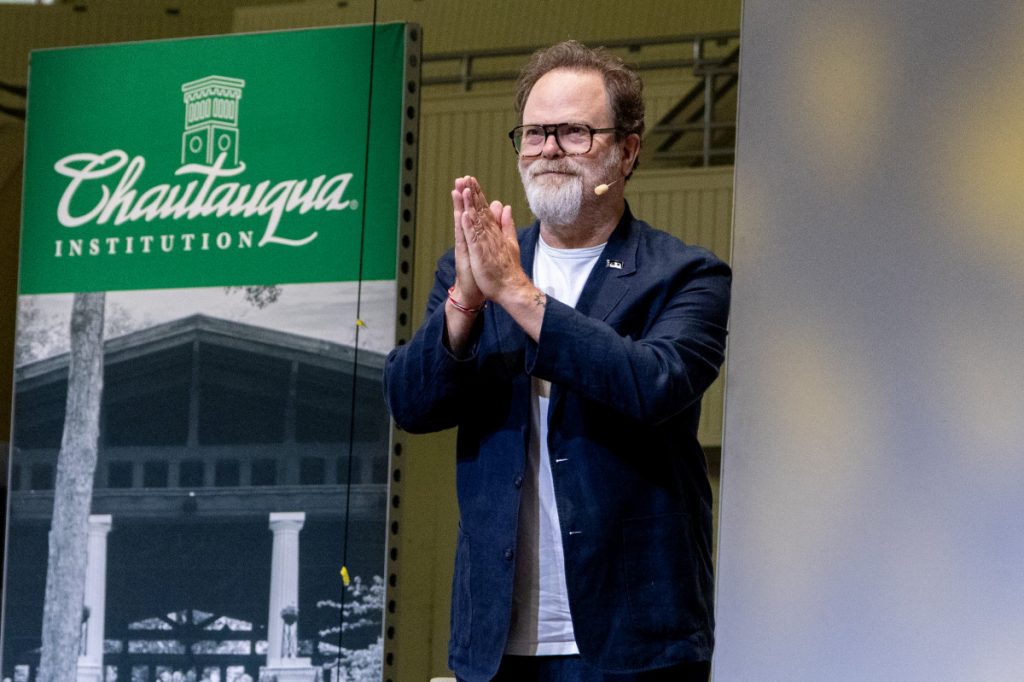
Climate Basecamp Co-founder and author of ‘Soul Boom Workshop: Spiritual Tools for Modern Living”’ Rainn Wilson speaks about his spiritual journey and offers insight into how to address environmental issues Friday in the Amphitheater.
ARIANNA NEVAREZ
Staff Writer
Rainn Wilson started his book and lecture with what he called “the big question”: “Why the hell is the guy who played Dwight writing about spirituality?” To answer, he said he has a “secret inner Oprah.” On a more serious note, Wilson said he grew up in the Baha’i faith and came back to “spirituality not out of virtue, but out of necessity.”
At 10:45 a.m. Friday in the Amphitheater, Wilson shared his journey from spirituality to climate work and provided his perspective on how climate communicators should move forward to effect change.
Raised in the Baha’i faith, Wilson said exploration of different spiritual ideas was “part of the fabric of his youth.” Once he moved to New York City to become an actor, he wanted to distance himself from the religion. Then, Wilson said he found himself experiencing mental health issues.
“When I was beset with anxiety, with panic attacks, with depression, with addiction issues, I did the only thing I knew to do from my childhood, which was to explore a spiritual path toward some kind of wellness and understanding,” Wilson said. “… There were spiritual tools for modern living to be found in the world’s great faith traditions, and these handholds helped me a great deal. It didn’t fix me, it didn’t solve all my problems, but it helped me get through the ’90s and build a career and build a marriage and have a life and not completely fall apart.”
After sitting with the spiritual ideas, Wilson said he decided during the COVID-19 pandemic to put them into a book, which later became Soul Boom: Why We Need a Spiritual Revolution. He said he integrated the Baha’i faith into his book.
In Wilson’s book, he analogized his favorite 1970s television shows, “Kung Fu” and “Star Trek,” to explain twin spiritual processes. He said the Shaolin monk in “Kung Fu” is on the side of “seeking to become more wise, more connected, to share that wisdom with other people, to work on ourselves as we go through an incredibly turbulent and violent and chaotic world.”
Wilson then went on to call “Star Trek” “one of the most spiritual … mythologies in all of storytelling history.” He said the show is set in a time where all of the problems that plague society have been solved, from racism to climate issues.
“Humanity, as a whole, gets to fulfill its destiny and move forward, and that moving forward involves, in this case, seeking out new life and new civilizations,” Wilson said. “But most importantly, we can rise to that for which we were created, something greater than worrying about ourselves and bickering and tearing each other up. These are twin spiritual processes.”
Wilson expanded on the concept of twin spiritual processes, describing how people can change internally and change the world.
He said there is “an obligation to become more spiritually connected” to “become more connected to God, to nature, to a higher power,” and this is “one path that we take towards personal transformation.” Running alongside this path is its twin, which Wilson said is about “making the world a better place and about giving back to our communities.”
At the end of Wilson’s book, he said there is a chapter that acknowledges the myth that views humanity as a warlike species, and says humans are “inherently aggressive” or succeed through being the “most violent and warlike.” He said there is some truth to this, but there is more to the story.
Instead, Wilson said scientists and historians see that “civilizations that thrived truly were the ones that were able to cooperate.” He said by going through life with a mindset of individuality and thinking society is full of “hyper aggressive warrior scumbags,” the world won’t be able to move forward.
“People actually used to talk about world peace as something that could be achieved, and we’ve kind of stopped talking about that, maybe for a good reason, but we need to dream,” Wilson said. “We need to think big.”
During the COVID-19 pandemic, he realized he was only contributing to the climate initiative by “sending out angry Tweets in [his] underwear to climate change deniers.” He also said the act of protesting has become too easy for people. Alternatively, he said people should try building something.
“It’s too easy to show up to a march for a couple of hours,” Wilson said. “It’s hard to build something. It’s really, really hard. Some of you have tried it, perhaps in your communities, at your churches, in your cul-de-sacs, in your neighborhoods, because this is where social transformation is going to start. It’s going to start at the grassroots. It’s not going to start in Washington, D.C. The system is too broken.”
As Wilson began his journey in climate communication, he met Gail Whiteman, an environmental researcher and professor of sustainability at University of Exeter, and formed Climate Basecamp, now Project Basecamp, with a mission to “speak science to culture.” Wilson said the name change came after he realized that climate communicators have been making the mistake of “preaching to the choir.”
He said there is a “movable middle” that advocates need to try to reach, and the project is trying to find those people with humor and online content.
“This is about taking something and just putting it into cultural conversation in such a natural, humorous, light, fun, accessible way that it just becomes part of our reality,” he said.
Wilson said the issue of climate change has felt “beyond us as individuals.” He said young people need to educate themselves about the issue. Through immersion, Wilson said he hopes the next generation finds something to “spark” and “inspire” them. He said people have found their niches, and climate activists shouldn’t pit issues against one another.
Wilson said in closing that there are many ways to approach and address the issue of climate change, but it is important to bring both sides of the political spectrum into the conversation and refocus on what is “sacred.” He said what is sacred can mean different things to different individuals, from science to Scripture.
“Either way, in God’s glorious creation, which includes the awe, majesty and beauty of science, there is something sacred to be found that can bind both political sides together and create a precious point of unity,” Wilson said. “… A wonderful way to work is to focus on what is sacred that we feel in our heart, that we can unite behind, and some of that, most of that, a lot of that has to be our beautiful, miraculous, unrepeatable miracle of the universe, which is planet Earth.”