ROCCO PRIOLETTI
Staff Writer
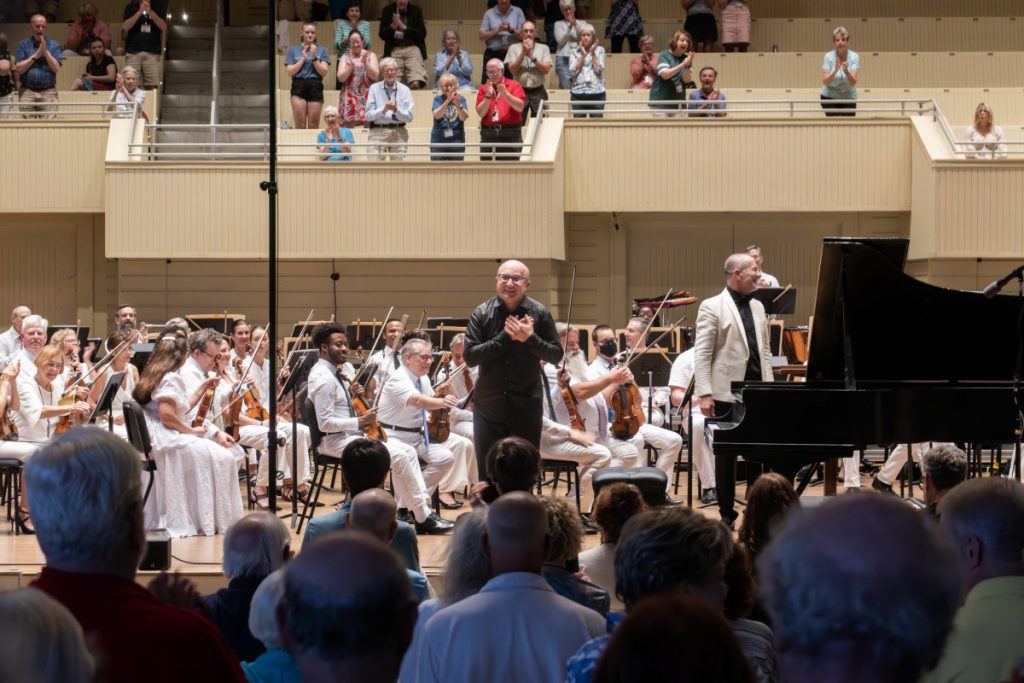
Beloved pianist Alexander Gavrylyuk is no stranger to Chautauqua; the performer has graced the Amphitheater stage many times for many different performances. At 8 p.m. tonight, he will return alongside the Chautauqua Symphony Orchestra ahead of his upcoming recital program on July 15 as the Institution’s artist-in-residence.
Tonight’s program opens with “Orpheus’ Comet,” a contemporary composition by Bulgarian British composer Dobrinka Tabakova. The CSO will conclude the evening with Robert Schumann’s Symphony No. 3, “Rhenish.”
In between the two bookended pieces, Gavrylyuk will take center stage during the program’s performance of Pyotr Ilyich Tchaikovsky’s Piano Concerto No. 1.
“It’s such a dear piece to me; I’ve grown up with it in a way,” Gavrylyuk said.
Gavrylyuk was born in Ukraine; he lived there until he moved to Australia at age 13.
“I have lots of memories from my childhood: connecting with the nature, with the folkloric music, with literature and with visual arts,” Gavrylyuk said. “For me, Tchaikovsky’s music was very relevant for that part of Ukraine.”
However, Gavrylyuk noted that part of Ukraine that Tchaikovsky conjures is from a “different time altogether” — before tragic political events and the politicization of music.
Gavrylyuk saw Tchaikovsky’s Piano Concerto as connecting narratively to his upcoming solo recital, but on a “grander scale.” The July 15 program invokes themes of childhood memory and the journey of innocence.
“One can see the innocence in it. But, it’s never innocence without the struggle. So, there’s always the shadow behind us, and there’s always beauty,” Gavrylyuk said. “But, beauty is pressure. There’s always this kind of duality about his music: the search for the answer, for the light, for the liberation, so to speak.”
Still, Gavrylyuk clarified that the universal emotions conveyed in Tchaikovsky’s music allow for listeners to each have a unique connection, no matter how disparate their individual experiences may be.
“It’s very universally available music. It’s music that communicates disregarding race, disregarding nationalities and religious views, so to speak,” Gavrylyuk said. “… The beauty is that we can relate to it in such a variety of ways, and then connect as human beings on the deeper, inner-emotional level.”
For Gavrylyuk, Chautauqua has the same ability as music to unite people and create a space where difference is welcomed.
He noted his long-standing admiration for the philosophy behind the Institution: “… this idea of sharing knowledge, sharing passion, sharing music and art without prejudice — and coming together to express different points of view in a harmonious and constructive way.”
Gavrylyuk expressed his sadness, detailing that he unfortunately will not return to perform at the Institution next year. Still, Chautauqua remains integral to the pianist’s foundation.
“It’s a relationship which is as strong as my relationship with my childhood,” Gavrylyuk said. “I mean, Chautauqua — (I’ve) grown up there also. And, I’ve sort of grown to put my roots down in this incredible environment.”
Gavrylyuk noted his appreciation of Chautauquans’ continued support.
“I just wanted to express my gratitude to the Chautauqua community for the unforgettable and moving moments every single time I come there,” Gavrylyuk said. “The connection with the audience, with the people there, the passion that we all share — I know this is absolutely priceless, and I’m extremely grateful for them.”