Column by Mary Lee Talbot
“What does it mean when someone demands that you look them in the eyes? What does it mean when someone challenges you to take the directionality of your gaze and lift it by implication, seeing who they are?” the Rev. Zina Jacque asked.
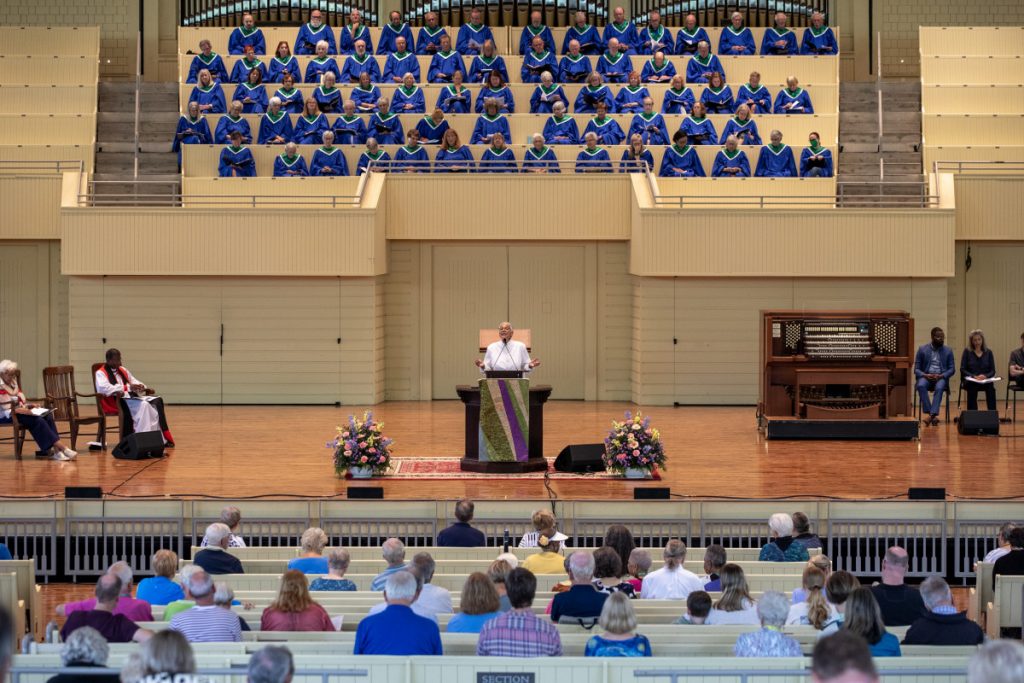
Jacque preached at the 10:45 a.m. Sunday morning worship service in the Amphitheater. Her sermon title was “Look Me in the Eyes.” The scripture reading was Numbers 27:1–7.
In preparing her sermon series for Week Five at Chautauqua Institution, Jacque took seriously the theme “Art and Artists against the Odds.” She said, “We are being invited, with art and artists, to come in and strengthen ourselves and to bring ourselves to a new level of awareness.”
Printed in the service bulletin, there was a photograph of a painting by Hayv Kahraman, a Kurdish-Iraqi artist whose family had to flee Baghdad during the First Gulf War. Her family first went to Sweden, then Kahraman traveled to Italy and then to the United States. Her work has been exhibited at Rice University, the Frye Museum and the Institute of Contemporary Art San Francisco. The photo in the bulletin was from the exhibition “Look Me in the Eyes,” at the ICA San Francisco.
At its core, to look someone in the eyes requires one to be present in the moment — to not look away, but instead to see what is before oneself as best as one can. Jacque said, “Look me in the eyes is an affront to erasure, a challenge to dishonesty, an argument against pretense. It is an invitation to a deeper awareness and a call to a basic action of acknowledging the humanity of the other.”
Numbers 27:1–7 is the story of the daughters of Zelophehad. He had died in the wanderings of the Israelite people after the Exodus. He left no sons but five daughters: Mahlah, Noah, Hoglah, Milcah and Tirzah. At a time when inheritance went through the male line, they stood before Moses and claimed their birthright.
Jacque said, “They looked up and saw clearly that they were about to be denied. So they stood up against the social mores of the time and spoke up.” They looked up, stood up and spoke up in an open public space, in the light of day, where they could clearly be seen. They challenged Moses, saying, “Look me in my eyes and tell me I should lose my inheritance.”
Jacque continued, “It just makes me want to shout because God said they were right. Heaven sided with the ones about to be overlooked. And nothing would be the same.”
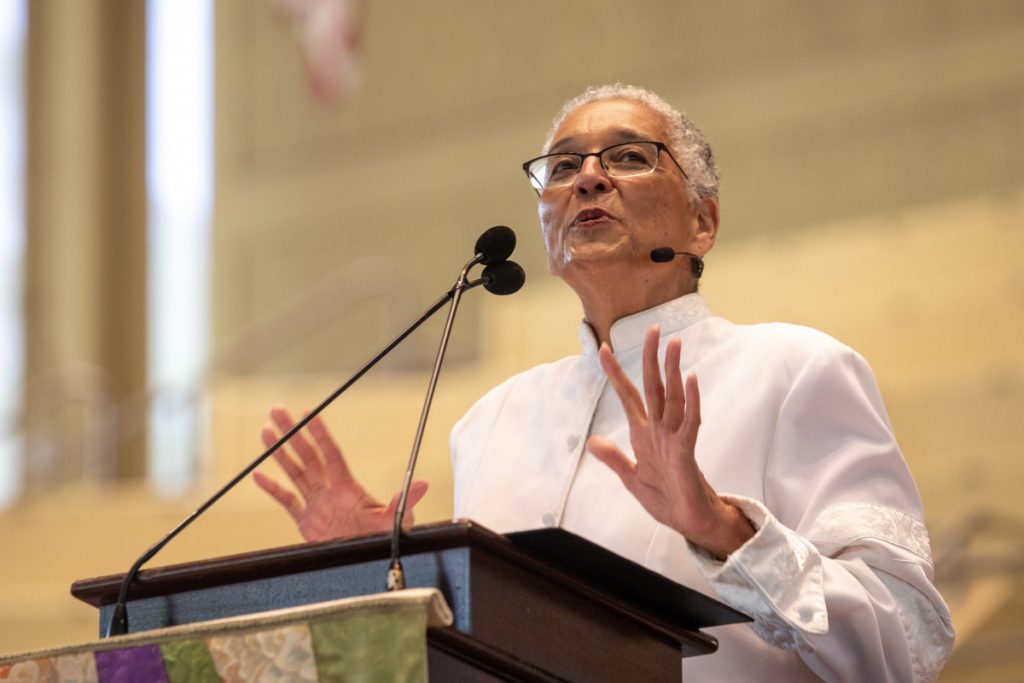
As much as individuals might want to be the ones in the painting or in the story, they are not the ones demanding justice, Jacque told the congregation. Chautauquans are the ones called to look the other in the eyes. “We are the ones being called to meet the gaze of those we have dehumanized, those we have defamed, who have been denied the right to life and life abundant. We are the ones being called to look them in the eyes.” The congregation applauded.
She continued, “We have to look in the eyes of the ones we have othered. We have to look with honesty and integrity, to seek each other in our gaze. When we don’t, we make monsters possible. The biggest horrors start when we look away and say the other is not human enough.”
Looking away ruins people’s own souls, she said. “We ruin our own souls and fail ourselves. To not look is to not see, and we become incapable of wonder and mercy. We are made to see each other, and if we don’t, creation goes dark and we silence the voice of God.”
God speaks through faces, Jacque said. She told the congregation that when people look away from one another, they are not just failing themselves, they are refusing to hear the one who made them. “Jesus said the eye is the portal that lets the light in so darkness has to flee.”
Jacque designed a spiritual practice for each day based on her sermon. The spiritual practice for Sunday was to look into another’s eyes. “Look into the eyes of someone whose politics you don’t care for, who loves someone you don’t like. Understand how they see the world. The other practices are not possible if we don’t look.”
Zelophehad’s daughters looked up at a system that would have swallowed them whole and they demanded to be seen. Jacque continued, “The one who loves you, who calls you, whose salvation makes us whole is calling us to do the same. Not with ease, not in simplicity and not because it is comfortable, but because it is necessary and because it is what we were created to do. To look into one another’s eyes now. The week has begun, and baby, now it is your turn.” The congregation applauded.
The Rt. Rev. Eugene Taylor Sutton, senior pastor of Chautauqua, presided. Veronica Biggins, a member of the Chautauqua Institution Board of Trustees, participated in the service. Owen Reyda, organ scholar, played Voluntary in D by George Dyson for the prelude on the Massey Memorial Organ. For the anthem, the Motet Choir, under the direction of Carl Dupont, sang a capella “Hope,” by Ysaye Barnwell. Dupont teaches applied voice and African American Art Song Composers at the Peabody Institute. His extensive opera career has taken him across the United States and Europe. He has directed the Washington National Opera Institute since 2022. The offertory anthem, sung by the Chautauqua Choir, was “Wade in the Water,” a spiritual arranged by Moses Hogan. Dupont conducted the choir and sang the verses of the anthem. The featured soloist was Michael Wallace. Sonya Subbayya Sutton, interim director of Sacred Music, played Charles-Marie Widor’s Toccata, Symphony 5, for the postlude on the Massey Memorial Organ. Support for the preaching and chaplaincy is made possible by the generous support of The Robert D. Campbell Memorial Chaplaincy and The Jackson-Carnahan Memorial Chaplaincy.