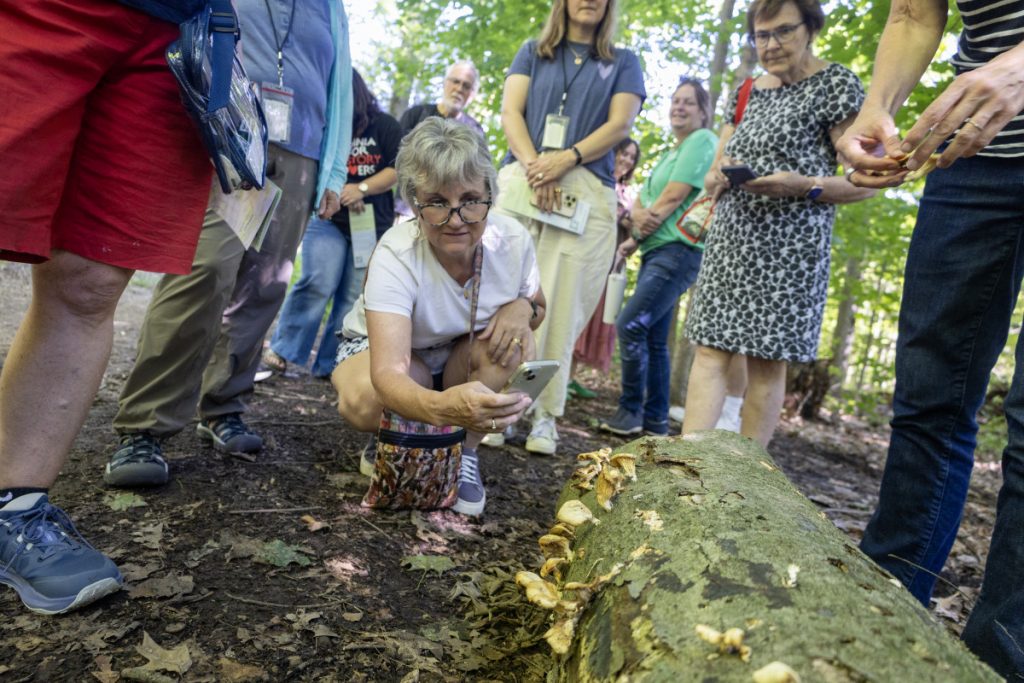
Chautauquans gather as Chris Malanga takes a photo of fungi to log on the iNaturalist app during the Bird, Tree & Garden Club’s Mushroom Walk Aug. 4.
JENNA OUTCALT
Staff Writer
Ever since Lynda Acker was a child, she knew exactly what she wanted to do in life.
“I’m the only person I’ve ever met who declared her major at age 5 and stuck with it,” she said. “I wanted to be a biologist.”
Through a career spanning biology, pharmaceuticals and academia, Acker said her first love has always been nature. Now, she’s still finding ways to interact with nature — this time, by logging her surroundings on the app iNaturalist, contributing to a database of nature at Chautauqua Institution.
The Bird, Tree & Garden Club is leading a “bioblitz” through the end of August in which Chautauquans are encouraged to log organisms they see around the grounds in iNaturalist, which will log and help identify different species.
iNaturalist is a community science app that allows users to upload pictures of organisms. The app attempts to identify the organism and tells the user how confident it is in the identification. Then, the picture is logged for the community to review and, if necessary, help identify. The information can be used by scientists, conservation groups or curious Chautauquans who want to learn more about the area.
Chautauquans have logged more than 150 observations since the beginning of August. Acker said she has logged more than 20 organisms in the app so far and is learning more about her surroundings.
“Some of the organisms that I was looking at were invasive — plants, primarily, and those were located down near the ravine,” she said.
Acker said she enjoys sharing the bioblitz with her fellow Chautauquans. She said they seem intrigued, and she hopes it leads them to “appreciate the diversity that we’ve got here in animal and plant life and fungal life.”
“People just really perk up, because everybody wants to know more about their surroundings, and to have something that works as well as iNaturalist does and gives good information almost immediately, it’s an instant gratification kind of thing,” Acker said.
Acker said she would love to see the bioblitz continue in the coming seasons, even expanding to the whole summer. She said that once people are familiar with their environment, it becomes second nature to care about it.
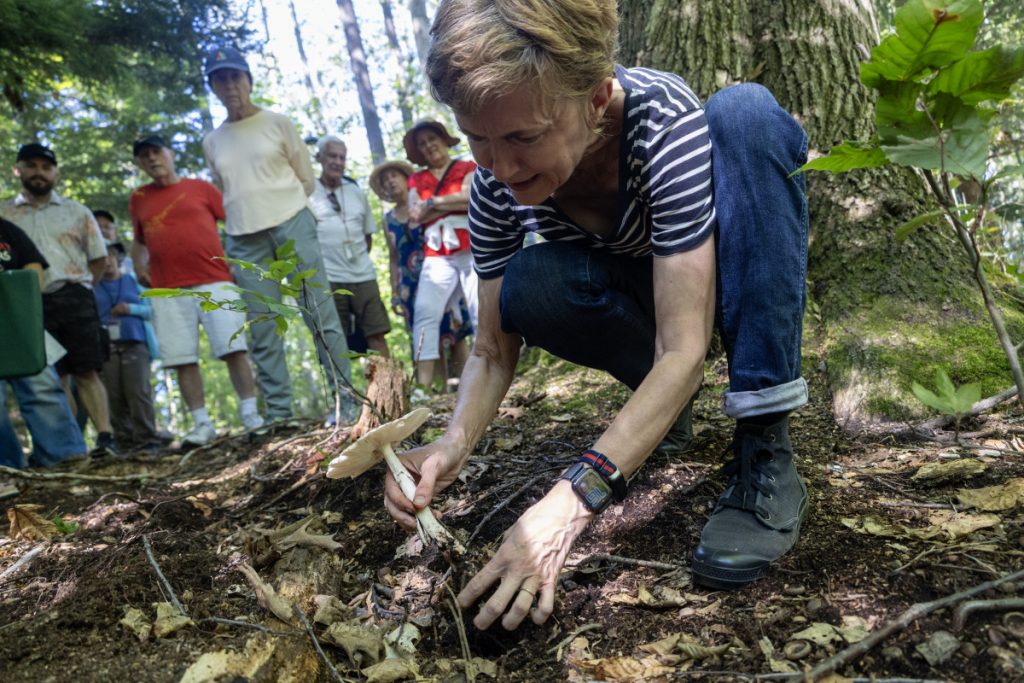
Mushroom enthusiast Sigrid Jakob examines a mushroom while leading the walk.
“Often we go through our lives not looking down, and we don’t fully appreciate what’s living all around us, but once we start to learn about life cycles, we start to learn about the differences among organisms and how they’re adapted and co-evolved with other creatures in a given environment, the whole thing becomes so fascinating,” Acker said. “You see the interdependence of that web.”
Acker explained that understanding how organisms affect one another can shed light on the potential consequences of environmental actions, such as selectively exterminating species.
“There are some [species] that we don’t particularly like to have around, but there’s a really great argument for not going out and selectively killing something, because chances are, you’ll be affecting a lot more than that organism in a very detrimental way,” she said.
Acker said humans are as much a part of the ecosystem as other organisms.
“I think it’s so easy, especially now in today’s climate, to disrespect nature, to say, ‘Oh it’s just a worm, it’s just a tree, it’s just another flower,’ ” she said. “But we are so interwoven in that web as a species that they’re critical to our survival just like we are to theirs.”
Acker said the love of the environment “gets into your soul as a Chautauquan.” As a biologist, she said she notices all kinds of interesting organisms in the South End Ravine.
“I’ve taken my kids there,” Acker said. “They both went through [Boys’ and Girls’ Club], and one of our things we love to do as a family is go to the ravine and look for crayfish under rocks.”
Acker, who also designs gardens and organizes a monarch festival every fall, emphasized the importance of teaching children about the environment.
“They’re the ones who are going to make a difference later on. They are voters of the future,” she said. “They are people who are going to be able to take care of the planet.”