

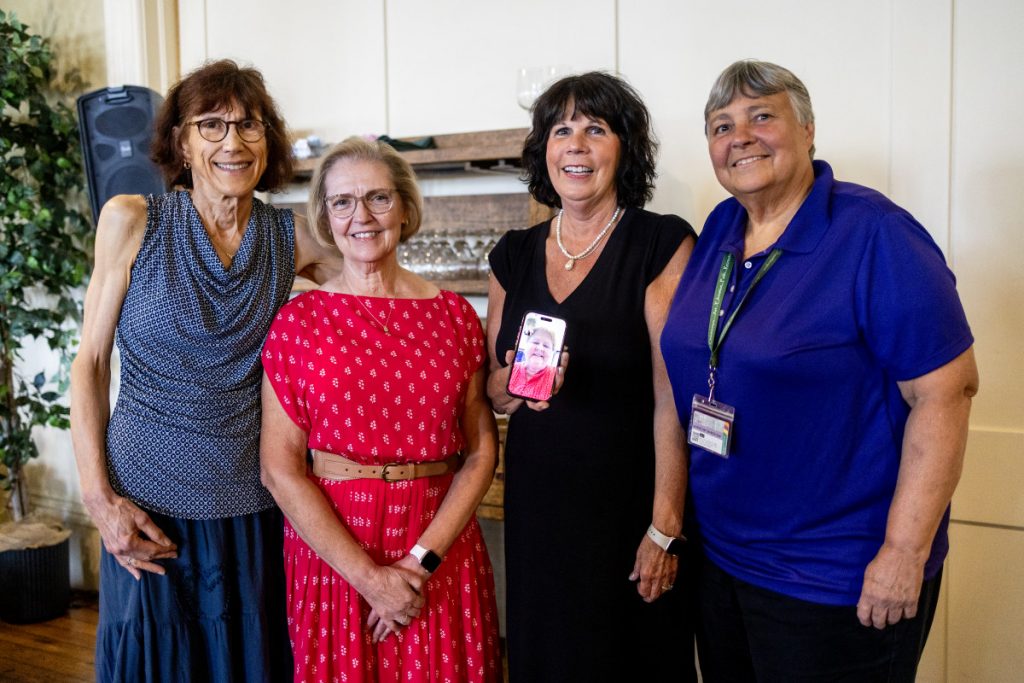
Former Athenaeum Hotel Restaurant waitresses Nancy Timko, Lorri Shuber, Linda Liebold (on the phone), Karen Graham and Beth Kromer stand together in the Heirloom Restaurant in what used to be called the Red Room Aug. 11 in the Athenaeum Hotel. The group of five met while working at the hotel in the 1970s and return to the grounds for an annual reunion.
HEIDI WARREN
Contributing Writer
In 1979, Beth Kromer saw an elderly lady standing by the lake, wistfully staring across it.
Kromer, then age 22, struck up a conversation and discovered the octogenarian had been an Athenaeum waitress in her youth. Back in the 1910s, staff made a game of swimming all the way across the lake. This struck a chord with Kromer, who was in her fifth and final year as an Athenaeum employee. As her swan song, Kromer decided that on her last day, she would honor the lady by duplicating the feat.
“It was to be my finale,” Kromer, now 70, said. “I thought I was never coming back.”
Except the 4:30 a.m. stunt didn’t go exactly as planned. She talked a friend into swimming with her, and they had a stockroom boy paddle in a canoe for safety against watercraft. They made it to the Dewittville side. However, it was incredibly foggy. On the return trip, they ended up in Mayville. The boy hitchhiked back to the Institution to find a ride for the exhausted girls.
Kromer thought she was dead meat. Her companions were the only ones who knew of the stunt, and she was an hour late to her shift. Kromer always served James R. Bussey, the hotel manager, and Robert Mack, the assistant manager, breakfast.
“I thought he would be livid,” Kromer recalled. “Instead, Mr. Bussey was practically handing out cigars because he was so proud!”
Her coworkers, including Karen Miller Graham, Nancy Timko, Linda Liebold and Lorri Shuber, were worried sick.
“We were in a panic looking everywhere for her,” Shuber said.
These ladies had a good laugh reminiscing about their hijinks while imbibing “Chautauquapolitans” on the hotel porch recently. Liebold, of Paden City, West Virginia, joined via FaceTime.
In the 1970s, no legal alcohol consumption was allowed, though bellhops reported plenty of bottle clanking from departing guests’ luggage. The women also made many pitchers of sangria in their sweltering attic dorms — dubbed The Tower — and consumed it on the hotel’s roof. A cigarette while sunbathing may or may not have been smoked from the top of the building; however, fears of burning the whole place down cut the shenanigans short.
Timko, a retired corporate trainer, was quick to add that they were and continue to be “solid citizens.” The drinking age was 18.
If the bathroom window was accidentally left open, the Chautauqua Butterflies would happily join them. Male staffers donning linens as capes while carrying the hotel’s yellow and white styrofoam ice buckets came to the rescue.
“Na, na, na, na, na…Batmen,” the boys would sing, referencing the theme song of the 1960s cult television show “Batman.”
The rooftop landing is where they stretched the cord for a single rotary phone. It was shared by 24 girls who lived on two floors and was the only place a moment of privacy could be occasionally enjoyed.
“It was the best view of the lake in town,” Graham said.
In their day, no food or drink was served outdoors. The steps leading to the lake were not yet built, and the Chautauqua Women’s Club/south end of the porch was for staff only. Uniforms were stored, and they hand-washed and polished silverware there, hence the name “silver porch.” The burnishing machine, which removed tarnish and scratches, was the least favorite of their side work.
Popular television personality The Amazing Kreskin rubbed a silver spoon and snapped it in half, ostensibly using his mind; the famed mentalist was born as George Joseph Kresge and died in 2024 at age 89. When the women informed their direct supervisor, hostess Margaret Bruce, she hid the spoon and forbade them from telling Mr. Bussey.
“She was militant and ran a tight ship,” Shuber, who became an English literature professor, said. “A total perfectionist.”
Timko said Bruce was in the United States Navy during World War II. Kromer noted she wore cat-eye glasses and was always dressed to the nines, with nary an imperfection in sight. She expected the same from her staff and kept the waitresses’ pink uniforms starched.
“But we loved Mrs. Bruce,” Miller, an elementary school teacher who kept a correspondence until Bruce’s death, said. “She would be so proud of us.”
Many famous people graced the hotel. Bandleader Mitch Miller, Pearl Bailey, Margaret Mead, Peter, Paul and Mary, Maria von Trapp — while no Julie Andrews — and Margaret Hamilton were some of the favorites.
Von Trapp was incredibly sweet and not wasteful, sending back meal portions deemed too large. Liebold, a speech pathologist, said she just scraped half the food off. Actress Hamilton left Graham a thank-you card, signing as her signature role: WWW (Wicked Witch of the West) and drew a broomstick.
Off-duty staff were never allowed in the lobby or parlor, unless working events like a ball with a live band or a Welch’s family wedding, where they served sparkling white grape punch.
The women were never so happy to work so hard for so little money, they say.
“It simply was the best time of my life,” Graham said. She began seasonal stints as a salad girl in 1973 and ended as an assistant hostess in 1979.
Waitresses had to have at least one year of college completed, be currently enrolled in school, up to and including advanced programs or be a recent spring graduate. Staffers were charged for room, board and “apprenticeship” fees. In 1978, their roughly $112 paycheck for 44 hours netted about $30. Plus, they had to purchase their own $27.50 gate pass.
They set up, served and cleaned for three meals a day, six or seven days a week — always on call. Initially, they had a rotating day off, but as the season drew to a close and people quit, that privilege was lost.
“We put fresh flowers and a different hand-written Bible verse or inspirational quote on each table daily,” Shuber said.
Tips were the real paydays, netting roughly $800–$1,200 for the summer. A waitress’s station made all the difference. Kromer’s older sister and former employee Amy Kromer said the “transient” tables saw the best action. Senior servers generally got first pick.
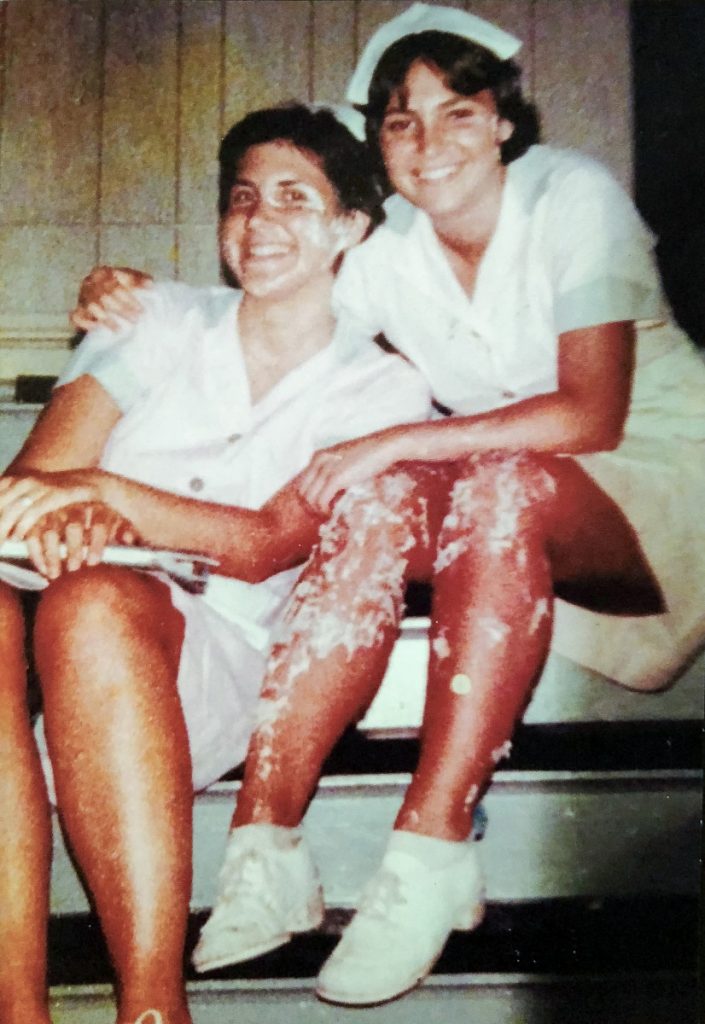
In their Athenaeum waitress uniforms, Nancy Timko, left, and Beth Kromer after serving cake on Old First Night in the Amphitheater in 1978.
“I always made the most money,” Kromer gleefully said, serving non-hotel guests. There was no tip pooling then.
Generally, Graham said, patrons would tip $1 day. So a room with two guests would leave $14 at the end of a week.
The Red Room was second choice; it was mostly for VIPs and event dining for groups of around 30. It was located behind the current lobby bar, which was the coat check and where spare dinner jackets were stored for men, as a strict dress code was enforced for the dining room.
Hotel guests filled most sections and had designated seats. Diners picked an appetizer, entree, drinks and two desserts. Kromer said the hotel was known for its extra desserts, especially fresh figs and prune whips.
The biggest rewards were not financial, they said. A sisterhood was formed by living and working together. It was also a time of firsts: making friends from different backgrounds, operas, plays and hearing the symphony play George Gershwin’s “Rhapsody in Blue.”
“We helped and supported each other,” Timko said. “I think the Institution is missing out by not offering housing for young workers anymore.”
Liebold laments that loss, too. “We bonded in a way that I can’t even explain,” she said. “When Karen reached out to me after 30 years, we chatted for hours like we saw each other yesterday.”
It was a formative time, and the women changed each other’s worlds. Kromer says she never would have gone to law school without a push from her roommate. “It expanded our worldview,” she said.
Shuber says they learned a lot about themselves as well. “You learned perseverance from hard work and long shifts every single day. It was exhausting.”
They all agree that they would not have been successful alone. They played too, regardless of how tired they were every night. The now-closed College Club was the epicenter of entertainment on the grounds.
In their signed contract was a 12:30 a.m. curfew, and they were obliged to stay the full season, or automatically receive a negative reference to whoever referred them for the position. If one broke curfew, employees were given a week of “elevens,” an 11 p.m. curfew. A second infraction meant firing.
They beat the system by bringing wigs from home and using special pillows to create bodies under blankets to fool “flashlight lady” Jeannie Leland. They snuck back in via the fire escape. Although many other girls got in trouble, Graham suspects Leland was “not trying very hard to catch us.”
Many of their peers were also recruited from the Pittsburgh-based Coalition for Christian Outreach.
“Mr. Bussey thought he was getting the cream of the crop,” Kromer, an attorney, said. It was difficult to contain her amusement.
Their experiences spawned loyalty. All the women are regular patrons. “You would not believe how many of us former waitresses return year after year,” Graham said.
Some of their most special memories are of serving birthday cake from the choir loft during Old First Night. Covered in frosting, they always jumped in the lake afterward in their uniforms.
The women worked with Linda O’Connor, now Spaulding, now a year-round resident on South Avenue. In 1970, Spaulding began as a front desk clerk. Eight seasons later, she met fellow employee Douglas Spaulding.
“We knew something romantic was going on with Douglas … when we came back next summer, they were engaged!” The couple married in the autumn. Douglas died 13 years ago at age 79.
“We called it ‘Wrinkle City,’ ” Spaulding said, who has kept in touch with “the girls.” “But we’re the old ones now.”
Spaulding has many fond memories of the hotel, including living in its basement, also known as the dungeon. Walking along South Terrace Avenue, the lower windows are visible. The rooms are currently staff offices.
The bakers lived in a cottage behind the main building, Spaulding said.
“I’d hear their screen door slam shut at 3 a.m.,” she said. “By 7 a.m. the sweet and yeasty smells would wake me up … I loved every minute of it.”
Spaulding has countless stories, including about a ghost.
Of course, any historic buildings, especially one of the few remaining grand ladies of the North, are going to have reputations for unexplained phenomena. The Victorian-style wooden structure was built in 1881 by 90 men in 90 days with a $125,000 price tag under the supervision of Institution co-founder Lewis Miller. His future son-in-law, Thomas Edison, brought the original electrical power. The hotel became Edison’s happy place for the next 45 years; ask to sit at his favorite dining room table in the now-Heirloom Restaurant.
Hopefully, any newer apparitions are happy haunts.
Kromer, who now spends most of the season on grounds, has already made arrangements for her ashes to be interred at the Chapel of the Good Shepherd.
“So, I will be here full-time forever!” she said.
Heidi Greene Warren is a longtime Chautauquan who, in a former life, was a writer for The Virginian-Pilot, based in Norfolk, Virginia. Send suggestions of interesting Chautauquans to feature in a story to:
HeyHeidiGW@gmail.com.


