
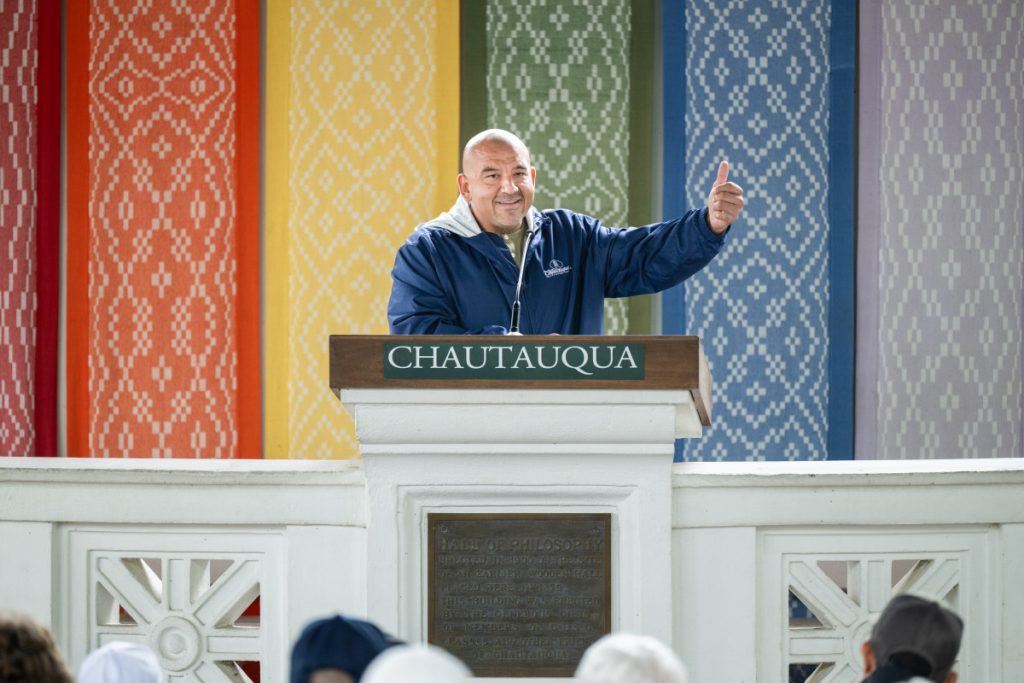
Homeboy Industries Vice President of Operations Jose Arellano gives a lecture on his life in and out of incarceration, and the work he has done at Homeboy Industries Friday in the Hall of Philosophy.
At 2 p.m. Monday in the Hall of Philosophy, Homeboy Industries Vice President of Operations Jose Arellano opened Week Nine’s theme of “The Importance of Gathering: Cultivating the Beloved Community” with a lecture that traced his journey from a gang-laden upbringing to a career in helping others break out of these traumatic situations.
He began by overviewing his childhood, which he described as being plagued by gangs, addiction and mental health issues.
Having no interest in participating in gangs, he said he enjoyed school and was on an advanced academic track. He said he had his cousin, Marlo, as a protector. Marlo, who made a promise to Arellano to never join a gang, ended up in a gang himself.
He described moments from his upbringing in which support systems turned away from him. At a low point, he said he agreed to join a gang. He went through a violent initiation process, where he was beaten to the ground and then was picked up, embraced and told “I love you” by other members of the gang.
Later, he said Marlo was shot to death at 14 years old amid gang violence.
Arellano traced the rest of his young adulthood, during which he was in and out of incarceration. He said he saw himself as someone who “did not have a heart to be broken.”
In the middle of a plea bargain, his mother died. He said that experience changed him forever.
“Everything that I grew up hating, everything that I hated, I became,” he said.
He said he did what he needed to do to get out of prison, but when re-entering his life outside of carceral systems, he knew he felt like he “no longer fit in out there.”
Amid working some odd jobs, he said his father-in-law found the number of Homeboy Industries in a newspaper and gave it to Arellano.
When Arellano called, he said he asked if Homeboy was hiring and was met with four questions: if he had ever been locked up, if he had been involved in gangs, if he was on probation or parole and if he had any visible tattoos.
He answered ‘yes’ to all and got the response: “‘OK, we’ll give you a job.’”
He recalled his first impression of Homeboy Industries, characterized by what he saw as a dissonant coexistence of gang members everywhere and a hospitality he said was unfamiliar.
“I remember thinking to myself, ‘What is this place?’”
He said several early experiences with Homies at Homeboy Industries changed his perspective on what gang members could be, including a Homie who delivered him boxers and socks, which he said seems “trivial to others, but (was) important to me.”
When Arellano said he was only just beginning to heal, his little brother came to Homeboy as well. Arellano told his brother not to talk to anyone.
Having been raised this way himself, Arellano said, “I had conditioned my brothers to never cry.” Nonetheless, he said when Fr. Greg Boyle, S.J., founder of Homeboy Industries, gave him a gift card to buy clothes, it drove his little brother to tears.
“He said, ‘Why the fuck do they care about us like this?” Arellano said he didn’t have the words at the time, but if he did, he would have answered that it was because he was worthy, he was a good kid and he mattered.
“At Homeboy, we call it ‘doses.’ I had got my first dose.” Arellano said he wishes he could say the rest was history.
When he fell back into his former life, he said, “Homeboys always kept the door open for me.”
Once again, he said, “I wish I could say the rest was history.” He said they threw everything “and the kitchen sink” at him in order for him to heal.
The third time around, he said he went from dealing with gang violence to facing addiction, which is when he experienced the Homeboy approach of “being spoon-fed recovery.”
He said the director of substance abuse at Homeboy walked him through how important it was to get clean for his future. Being accepted to the treatment center in Santa Monica required applicants to test clean, which he repeatedly failed to do.
“I remember praying one night and just saying, ‘Please God help me.’ And what’s so interesting about life is: Help comes in the form of human beings.”
Eventually, Arellano was accepted into a recovery program, where he stayed for 6 months. Four years later, the intake coordinator called him and said he replaced Arellano’s sample with his own in order to get Arellano into the program.
“As a society, one of the things that we all need to do is diagnose some of these problems a little differently,” Arellano said. He said the “gang issue” is deeper than gangs: it is trauma.
“No hopeful child joins a gang,” he said.
Returning to the metaphor of doses, he said he didn’t heal on the first or second shot, but he said Homeboy recognizes that “it takes what it takes.”
He said, “I’m just so honored to be a part of an organization that has this approach and is able to create the container in order for people to heal.”
He outlined the structure — also called the “method to the madness” — of Homeboy Industries. He said people who call him are guided down different pathways based on their situation. Incorporated in all the pathways, he said, is the understanding that “healing happens in relationships.”
He said the system is built on the recognition that people come from mostly unhealthy relationships, so the efforts are geared toward offsetting that. “From the very beginning, you have someone you can talk to,” he said.
Every person who enters the program as a trainee is given a navigator to walk side by side with, a case manager to design a plan suitable for them and an employment counselor.
He said everyone in the program is first responsible for maintenance, cleaning and general support around the Homeboy building. When a person begins to “get their footing,” he said they begin to move into one of 16 social enterprises Homeboy Industries operates.
He said the ultimate goal for trainees is job placement, whether internal or external, and each person is supported throughout the entire process. He said the hope is that trainees get placed in a full-time job, internally or externally.
“Right now, 75% of our staff are former trainees like myself. And it’s just so amazing to see our staff become hope in the flesh, to be able to provide the same experiences that help shape my journeys at Homeboy,” he said.