
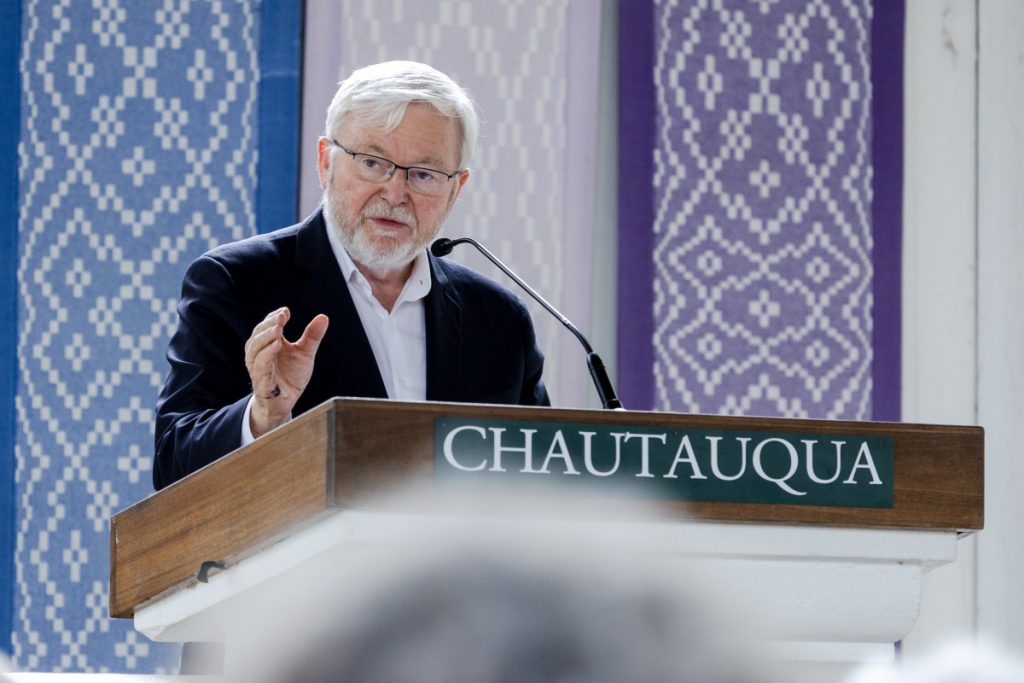
Former Prime Minister of Australia and current CEO of Asia Society Kevin Rudd speaks about global order and international relations during his Interfaith Lecture Monday in the Hall of Philosophy.
LILY RESLINK
Staff Writer
As the former prime minister of Australia and current CEO of Asia Society, Kevin Rudd brought a global political lens to the Week Seven theme of “Religion, Power and the Moral Stakes of a Changing Global Order.”
At 2 p.m. Monday in the Hall of Philosophy, Rudd spoke about his perspective on the roles of faith, democratic participation and global rules-based order among world powers beyond Australia.
Rudd’s lecture sought to answer questions regarding how the ethical underpinnings of liberal international order are being challenged and how they can withstand into the future.
Rudd examined current fault lines in global governance and China’s aim to construct an alternative framework for global order. He ended the lecture by speaking to his U.S. audience about possible actions to take amid these concerns.
Rudd said he was speaking today, not as a “confirmed pessimist,” but as someone who has been involved in many decisions about peace and war and has spent a good proportion of every 24 hours studying foreign relations.
His underlying message throughout the lecture is global collaboration; he argued that faith traditions of dignity and shared humanity can be effective in advancing it.
Rudd began by referencing the “I Hate War” address delivered at Chautauqua Institution, which he said he rewatched in preparation for this lecture. In this speech from nearly a century ago, he said Franklin Delano Roosevelt could have just as easily been speaking to the modern age. From FDR’s perspective, Rudd spoke on why people choose to destroy one another and the causes that produce war.
Rudd spoke about the new approach to global rules-based order, which included first-of-its-kind constraints toward internal treatment of its citizens.
Fueled by threats from the Soviet Union and China in the 1940s and 1950s, Rudd said the U.S. established a network of bilateral and plurilateral defense treaties to respond to security concerns. He said this led to the U.S. embracing three core principles, which, though imperfect in practice, he called “the essential features of the post war order.”
A measure of success, he said, is the fact that there has been no global war in 80 years, although, he added, the world has come close.
“At the most elemental level, the visceral, global revulsion at the orgy of orchestrated violence that the war had delivered to all humankind became a moral force in its own right,” Rudd said.
Beyond rules-based order, Rudd examined non-secular and intrinsic reinforcements of moral behavior and perspectives of dignity toward fellow humans. He noted two sources of obligation toward upholding human rights.
He named the first source as secular enlightenment and the second as “the cumulative contribution over millennia of Christian belief, as well as parallel forms of religious belief beyond the Christian communion concerning fundamental human dignity.” He said these sources are often seen as conflicting rather than harmonious.
He said Christian teachings positively shaped the Enlightenment and expanded on the application of human rights concepts found in the Bible.
“The notion that an individual human being has an intrinsic human dignity proceeds from the belief that each person is seen to carry with them the divine spark of a created God, and as a consequence, shaping the sanctity of human life,” he said.
He said the question of human dignity has remained relevant across time and space within the United Nations.
“So one of the sons of the enlightenment may have fought the fathers of the church for over 300 years over the proper relationship between crown and altar, between church and state, I argue that Christian belief is the only unalienable dignity of the human person has been in reality translated into the enlightenment belief in the unalienable rights of the individual,” Rudd said. He said faith and reason should not be in conflict.
As one example, he connected this to the Christian ideology to “steward” the earth, not “subdue” it. In another example regarding national and international security, Rudd said, “God is no respecter of nations,” but he added that theology supports “the right to defend.”
He said instruments offered through the U.N. system may be necessary, but are not enough to sufficiently sustain a just peace.
Rudd emphasized the point, “We cannot simply wish away the military capabilities of authoritarian states.”
He introduced what he called “uncomfortable questions” for those of faith, calling them, “the core ethical considerations that flow, however imperfectly, from the community of faith, together with the fellowship of reason into the global rules-based order we have painfully constructed together.”
Rudd overviewed how “moral impulses” have connected to views on the horrors of war, the intrinsic dignity of each human, social justice of the disenfranchised, stewardship of the global commons and resolve to deter armed attacks.
He emphasized imperfections in the order, saying it was better than what preceded it — because, he said, there technically was no order that preceded it.
“Politics is the art of the possible, and for reformists, the ‘perfect’ is often the enemy of good,” Rudd said.
Rudd compared today to the post-war order created after World War II, saying, “the report card on the global rules-based order is increasingly grim.”
Rudd brought up China as the new challenger to the U.S. because of artificial intelligence and its view of the U.S. as “an increasingly spent force.”
He outlined ideas for “the free peoples of the world” to address the issues laid out in his lecture, which included breaking down barricades between secular and religious traditions for better collaboration.
“Let us rediscover the passion (with) which … we constructed [the order] together after the war in the program of systematic decolonization that followed as all empires collapsed, and the building of a global rules-based order anchored in the continuing principles of universal human rights, freedom from want and deterrence from those who seek to destroy us all,” he said. “My friends, all this lies within our grasp.”