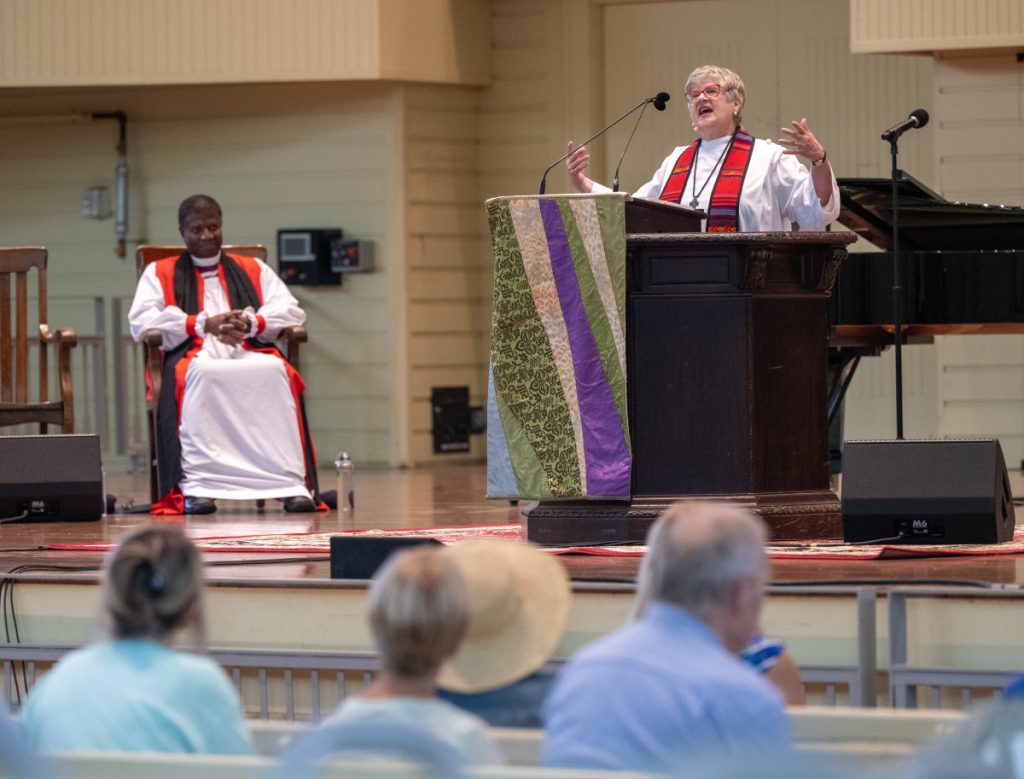
The Rev. Natalie Hanson delivers her sermon “Invitation to a Feast” during morning worship Sunday in the Amphitheater.
Column by Mary Lee Talbot
“The Parable of the Long Spoons” is a tale about people who have long spoons lashed to their hands that they cannot get off. The spoons are too long for them to feed themselves. This is sometimes called the feast in heaven or hell. “The people cannot feed themselves, and if they are in hell, they become fearful, angry, break each other’s spoons and are left starving and killing themselves slowly,” the Rev. Natalie Hanson said.
If this is heaven, “they look into each other’s eyes and faces and they think they can reach out to use their long spoons to feed each other. They get nourishment, joy and belonging. It is a different use of the same spoons,” she continued. Hanson preached at the 9:15 a.m. Tuesday morning worship service in the Amphitheater. Her sermon title was “Table Conversations,” and the Scripture readings were Proverbs 15:15–18 and Romans 12:9–10, 13–18.
Hanson began her sermon with a brief video of the parable. She said there were three things that made heaven work. The first was eye contact — to see the other person face-to-face and let them know they are worthy of your time and attention. The second is to have an open imagination, to look for the possibilities for connection. The third is the willingness to be vulnerable — to feed others and be fed by others.
“What is the point of table conversation when we are feasting with God?” she asked the congregation. “So many times we enter a conversation and get our response ready when the person is only halfway through their thoughts. We want to share what we know or manipulate the conversation.”
She continued, “But at God’s table, where it is more diverse, we increase our ability to nourish each other if our agenda is listening. Listening is the key. The conversation is not about me, but about listening to you. I am ready to be surprised and enriched and able to honor your humanity and the holy in you.”
Hanson told the congregation that it is darn hard to let go of our own agendas. Our society is set up for debate, but not the grace of the Lord’s table. In our culture today, there are purists who have closed circles and think only their values and experiences matter. “If you don’t agree with my party line, you can’t be part of my community; and this is not just in politics. I am asking if you really are a good person.”
The other issue is safety. “People say, ‘I don’t feel safe in that situation, in that place or with you,’” she said. Hanson emphasized that no one should set themselves up for self-harm, masochistic behavior or staying in abusive relationships.
She said, “How can we love if we are concerned above all about safety? How can we love without risk? Our hearts get broken and are healed and get broken again and are healed. We have to get an inner balance and ballast. Our ballast is our inner trust in God that we are beloved; nothing can shake that confidence.”
Hanson told the congregation that we have to live a lot to learn a lot and this is hard learning. “I have people whom I love dearly who are MAGA supporters. They love me and I love them, but it is not easy. We are not out to convince each other and we try to stick to the issues. Love came first, trust came first. We have a solid and firm foundation so we can embrace even when we disagree.”
The apostle Paul, writing to the Romans, urged them to outdo each other in honor to live in peace. The writer of Proverbs said it was better to have love and a simple meal than a banquet with hate.
“We have to listen for understanding, to be enriched and be able to create relationships of love and trust,” Hanson said. “We have to reach toward those at the table because this is God’s holy feast. The table conversation is to know that you are loved. This is holy conversation at God’s holy table.”
The Rt. Rev. Eugene Taylor Sutton, senior pastor for Chautauqua, presided. Alan Seale, a long-time Chautauquan and founder of the Center for Transformational Presence, read the Scripture. The prelude, played by Sonya Subbayya Sutton, interim director of Sacred Music, on the Massey Memorial Organ, was “Prelude, Fugue, and Variation, Op. 18,” by César Franck. Henrique Carvalho, a Denyce Graves Foundation Generational Voices artist, sang “At the River,” by Aaron Copland, accompanied by Sutton on the Steinway piano. The Motet Choir sang “The Alter,” music by Roland Martin, words by George Herbert, under the direction of Sutton and accompanied by Owen Reyda, organ scholar, on the Massey Organ. Reyda played “Sortie” by César Franck on the Massey Organ for the postlude. The “Parable of the Long Spoons” was produced by Food For All. Support for this week’s services is provided by The Samuel M. and Mary E. Hazlett Memorial Fund. Support is also made possible by Week Eight Presenting Sponsor Highmark Blue Cross Blue Shield, AHN Westfield Memorial and HealthNow Administrative Services.