

NORA SMITH
Staff Writer
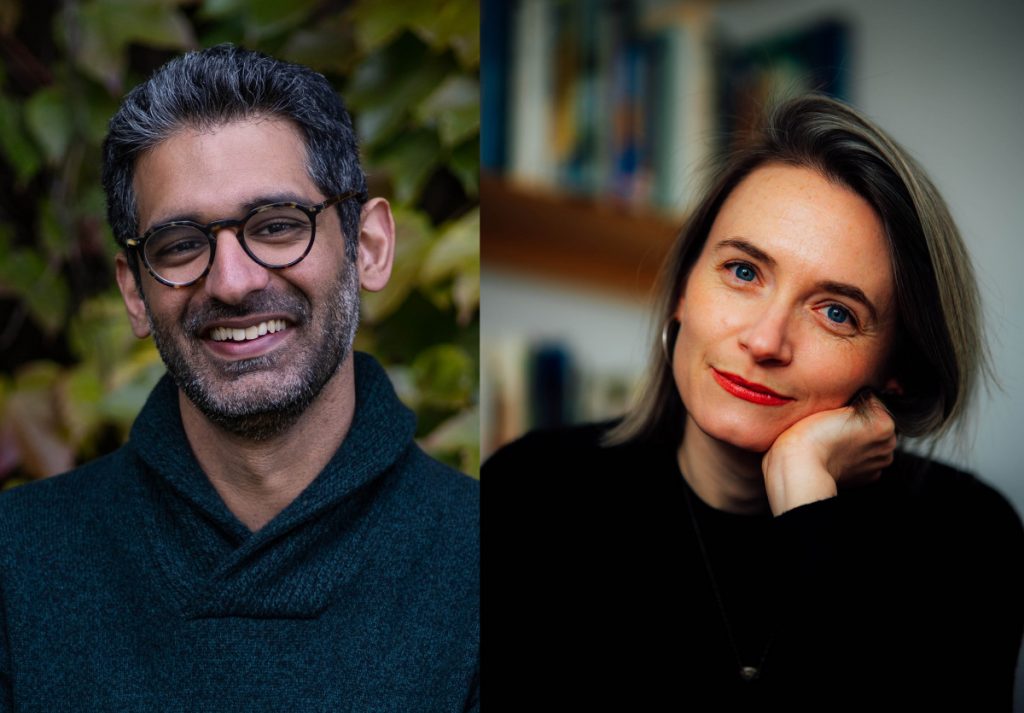
Michael I. Rudell Director of Literary Arts Stephine Hunt said she is excited to welcome two local writers to Chautauqua Writers’ Center for Week Eight after having first met essayist, poet and translator Laura Marris and author Nishant Batsha through Buffalo Literary Center Events and in working at University at Buffalo.
“I’m excited to welcome them here as folks who know each other’s work and often celebrate each other’s work in different ways, so that will be lovely,” Hunt said.
Hunt said she is excited to welcome both writers not only because they have a prior connection, but also because they touch on themes of history, food and communal celebration in different ways, aligning with Week Eight’s theme, “The Future of Food: Climate, Technology and the Next Agricultural Revolution.”
Marris said she originally started doing freelance translating after finishing graduate school to make a living, but it soon became much more than that.
“I really fell in love with translation as a way to think about literature, as a way to kind of apprentice myself to writers whom I admired,” Marris said. “The more I thought about this kind of space of being in between languages, the more really fascinating it became to me.”
Marris said translation encourages her to ask questions that fascinate her, such as, “How do you immerse yourself in somebody else’s memory and voice and language?” and “What are people’s voices really made up of?”
“Translation transformed my writing pretty profoundly, and when you’re a translator and a writer, I see translation more as this kind of intensive collaboration with another person’s voice,” Marris said. “I actually see it as an extension of my writing and as a part of it, just another mode.”
One of Marris’ newest projects will bring this work of translation into collaboration with other themes.
“I’m actually really excited to think about this new project, which I think will be focused on translation and new advances in animal communication,” Marris said. “So, thinking about some of the science of animal communication through the lens of lessons from the art of translation to see if I can find some continuity there.”
Marris said for the Free Faculty Reading at 3:30 p.m. Sunday in the Hall of Philosophy, she plans to read from her most recent book, The Age of Loneliness: Essays, which she described as a collection of essays that braid personal and environmental history.
“Part of the reason that I wanted to write essays that braid ecology and personal history and environmental history was in order to bring different voices and different parts of my life into conversation,” Marris said.
Marris said she thinks the format of an essay is a great way to make space for these conversations.
Hunt said Marris’ essay collection focuses on topics such as climate change and the COVID-19 pandemic, but focuses on the “resilience and safety and peace in that forced quiet that we encountered, and seeing how the world really bloomed without the humans.”
In the book, Marris said it was important to think about the different places she has gotten to know throughout her life and to include the community of people who have also experienced those places. She said the book begins with ecological loneliness and then moves toward understanding and finding community through caring for the ecosystems surrounding her.
Marris compared her book to people who participate in bioblitzes, animal counts and other conservation initiatives that aim to understand “how the communities that they live among are faring.”
Marris said a significant component of her book is her father, who died when she was young and had participated in many community science projects. After he died, Marris found his bird lists.
“That was one of the inspirations for the book, because I was really fascinated by looking at [the bird lists]; … some of them were lists from before I was born, and he’d just written down all the species that he had seen in the area where I had grown up,” Marris said, and added that he used to do the winter bird count every year.
Because of this, Marris said she does the same bird-count route her father had done and compares her list to his in the last essay of the book.
In addition to the reading, Marris’ flexible workshop titled “Local Muses: The Poetry of Place” will run from 8:30 to 10:30 a.m. Monday, Wednesday and Friday from Aug. 17 to Aug. 21 in the Alumni Hall Poetry Room with an enrollment fee of $145 and a maximum of 15 participants.
“We’re going to really think deeply about how it’s possible to read a place and think about relationship to place and how that can inspire new writing, and how moving through place can be a way to deepen and enrich the writing that people are doing and to kind of just play and explore,” Marris said.
Marris added that despite the workshop’s focus on poetry, all genres are welcome and that the material, exercises and prompts are applicable across all genres.
Batsha, who is interested in historical thinking and stories, said he began writing for publication in graduate school when he was working on a Ph.D. in history to become a historian of colonial India.
“I became drawn to fiction because there’s so many gaps and silences in the archive and you really want to get to know people,” Batsha said. “You really want to know them intimately, and it’s hard; … especially in an archive of the third world, there’s not a lot of priority given to regular people.”
Batsha said when looking into American history — particularly the Civil War period — there are diaries and newspapers that allow one to get up close and understand regular people’s lives, but not in the work he was doing.
“I didn’t see that in what I was working on, so I became really drawn to fiction as a way to explore how big historical events and movements have percolated down into the lives of regular people,” Batsha said.
Batsha’s first book, Mother Ocean Father Nation, originated from research he did for his dissertation on Indian indentured labor, in which Batsha said, “After slavery, the British Empire used Indians from India on five-year contracts to work the sugar plantations all around the world.”
Having read about these places, Batsha created a hybrid of them all and set the book on a fictionalized South Pacific Island.
“One of the things about these places with Indian indentures, they all had a lot of political instability after they got independence,” Batsha said. “There were a lot of military coups, a lot of racial strife and I had seen that everywhere. So, I was like, ‘What did that feel like?’”
The storyline follows a brother left behind on the island nation and a sister taking refuge in New York as they navigate the world during the historical event of the military coup.
“I really think that historical thinking truly influences everything about how I write, subject matter I choose to write about …” Batsha said. He said that in writing about historical events, he is constantly making new discoveries.
Batsha said at first, he was terrified of having to pick a specific lane to focus on in his career as a historian, but writing fiction allows him to explore and immerse himself in new projects every couple of years.
For example, Batsha said his current project is set in a Shaker community in Maine right after the Civil War, which he previously had not studied.
“I just had the chance over the last two years to read deeply in fiction and in history about a time and a place that I’ve never thought I would be able to explore,” Batsha said. “To me, that’s so special, that’s just like a discovery every day.”
During the Free Faculty Reading at 3:30 p.m. Sunday, in the Hall of Philosophy, Batsha said he plans on reading from his newest project he’s been working on.
“It’s sort of a way for me to bring it into the world,” Batsha said. “So, this will be the first time that I’ve actually shared this material with anyone besides my literary agents.”
In Batsha’s work, he said he is always looking at how changes in a nation or how historical events affect a household.
“I hope [readers] come away with the feeling that history and big world events are always alive in the smallest of spaces,” Batsha said. “They always kind of find their way to our most intimate locations. So, I hope they get that sense that history is alive in the lives of every people.”
Hunt said Batsha’s most recent book, A Bomb Placed Close to the Heart, is set during the dawn of WWII and is a “beautiful, fascinating look at friendships across cultures and experiences.”
“It’s a really beautiful historical fiction work,” Hunt said.
In addition to the reading, Batsha’s flexible workshop titled “Rewriting History,” will run from 3:15 to 5:15 p.m. Monday, Wednesday and Friday from Aug. 17 to Aug. 21 in the Alumni Hall Prose Room with an enrollment fee of $145 and a maximum of 15 participants.
“I will be leading a workshop on history and fiction, how we grapple with the archive and how we can leave history behind, leave the archive behind, when is it okay to fabulate and when is it okay to be rooted in facticity,” Batsha said.
Batsha said participants will read historical theory and historical fiction while thinking about historical fiction in a literary and historical way.
“I hope [participants] come out with a confidence of how they can explore histories that they’ve been interested in, that they want to write about,” Batsha said. “Sometimes it can feel really daunting to think about, ‘How do I research? How do I tackle the archive?’… So, I hope that they have a confidence to engage with these things in the past in ways that makes their fiction more enjoyable for themselves and for the reader.”


