
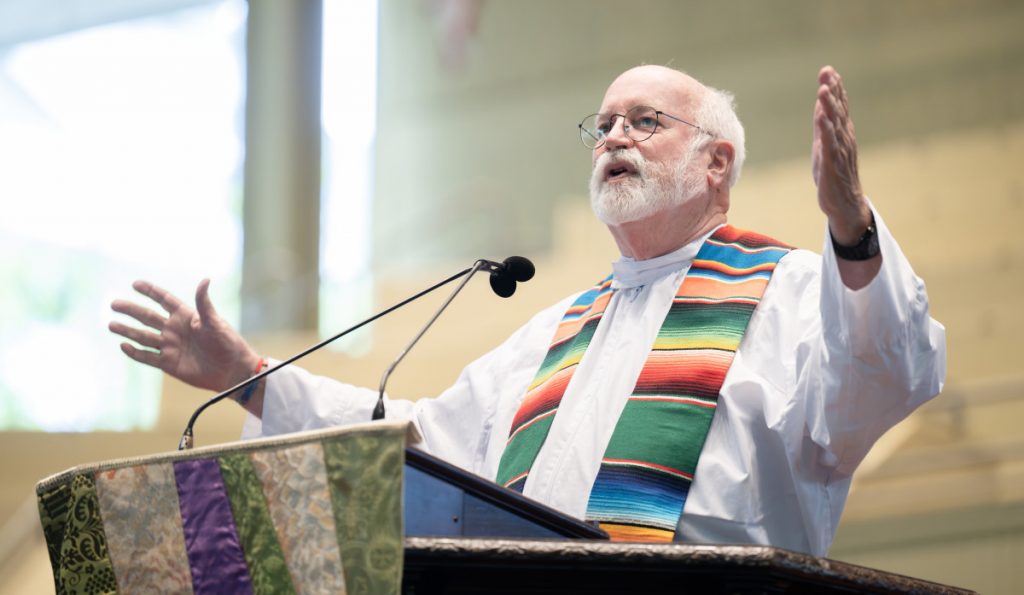
Fr. Greg Boyle, S.J. delivers his sermon “Fill the Earth with Mercy” Sunday in the Amphitheater.
Column by Mary Lee Talbot
In Matthew 16:13–20, Jesus asked the disciples, “Who do people say the Son of Man is?” Fr. Greg Boyle, S.J., told the congregation at the 10:45 a.m. Sunday morning worship service in the Amphitheater, “You know who Jesus is. It is not so much who he is, but how you say it.”
Boyle is the chaplain for Week Nine at Chautauqua. Referring to the rain that was coming in heavy downpours that morning, he said he went out for a walk. “Bob Marley said some people feel the rain, others just get wet. I got wet.” He also noted that when he first came to Chautauqua, he had hair. “Just sayin,’ ” he quipped.
The title of Boyle’s sermon was “Fill the Earth with Mercy,” taken from signs all around the Colorado shrine to Mother Cabrini, founder of the Institute of the Missionary Sisters of the Sacred Heart of Jesus and the first American to be canonized as a saint. Boyle used stories about the Homies (members of Homeboy Industries) to illustrate his sermon points.
“Maybe you say it with a megaphone at the corner of First and Soto,” Boyle said. He had three Homies in the car and was taking them to Jack in the Box for a meal after getting them out of a housing project where they might have gotten shot.
A man with a megaphone was saying who he thought Jesus was and yelling about Jesus being his personal savior. There were people on every corner handing out fliers, Boyle said. “They came over to our car and little Rusty was sitting in the shotgun seat; they handed him a flier. Then the light turned green and we started going, and Rusty read from the flier haltingly, ‘Are you tired of being tired? There is a way out. Do you drink too much? Do you get high? Are you depressed? Do you gang bang? Do you have trouble in your marriage?’ He put the flier down and looked at me and said, ‘Damn, G. Three out of five.’”
Mercy, said Boyle, is larger than what we know. “If love is God’s religion, mercy is God’s love language, to feel cherished and unconditional love.” Louie, a Homeboy, had a conversation with his daughter. She was getting to the age that she realized that her father had a past that included drugs, prison and gangs. One day, she asked her father, “Daddy, are you a bad man? Even if you are, I still love you.”
Trappist monk Thomas Merton called this act mercy within mercy within mercy. “This mercy is larger than love. We worship Jesus instead of holding out to follow him,” Boyle said. “Mirabai Starr said, ‘Once you know the God of love, you can fire all the others.’ Hold out for ‘no matter what-ness.’ Love is God’s religion and mercy is the language of God’s love.”
Michael, age 38, and Joe, age 20, went with Boyle on a speaking engagement. They both worked in the Homegirl Café, and Boyle asked Joe if that was his full name. Joe said, “My mom did not trust me with more words.” Boyle asked what Joe knew about his father. Joe said, “I have only met my dad like three times. Let’s face it, I was a mistake.” Michael, who had not said much, interjected, “I am going to stop you right there. You are no mistake.”
Boyle told the congregation, “When you have washed the world’s feet, your hands stop shaking. You are aligned with the God of love and you land at mercy, at cherished belonging. Mercy is essential; hold out for mercy.”
Saul had been left homeless at the age of 9. His mother packed up and left. Saul lived on the streets, was a dumpster diver and joined a gang. He ended up at Homeboy, and he came in one morning, excited to share something with Boyle.
“I was walking home on Soto and came to the park, and I saw an older guy on a bench, shivering with a half-empty 40 ounce beer bottle. You know my favorite sweater, my favorite blue one? I took it off and laid it on him,” Saul said to Boyle. He continued, “Hey, I’m not telling you this because I am all that and a bag of chips. I’m telling you, ‘I know that bench.’ I have been on that bench.”
Boyle said, “James Finley writes that when love touches suffering, love turns suffering into mercy. We don’t want to settle for anything less than the merciful way God sees. Pope Francis used to say mercy is God.”
Homeboy Industries has a silk-screening enterprise that has been in business for 31 years. “They are high quality at a good price and we can UPS them to Mayville,” Boyle said.
Boyle shared the story of Youngster and Puppet, who were going to work together in the silk-screening shop. Youngster was new and as he met the crew, which included at least 15 members of rival gangs, he shook hands with all of them. But he and Puppet could not shake hands. “There was a hatred too deep to get past,” Boyle said. “I told them if they could not work together, there were other people waiting for those jobs.”
One night, Puppet went to the store and on his way home, he was waylaid in an alley by rival gang members. They beat him almost to death and would not quit kicking his head. He was taken to the hospital and kept on life support for 48 hours, then the death certificate was signed. Boyle said, “I anointed him, said a blessing and we disconnected the life support. I buried him a week later.”
Youngster called Boyle while Puppet was still in the hospital. Youngster said, “That’s messed up. Is there anything I can do? Give blood? He was not my enemy, he was my friend; we worked together.”
Boyle said, “I am asked, ‘Can I say this always happens?’ I say yes. ‘Are there any exceptions?’ ‘I can’t remember any.’ When we wash the feet of others, our hands stop shaking. We are connected to each other. Are you my enemy? Even if you are, I love you.”
He continued, “We are called to be merciful. When love touches suffering, love turns suffering into mercy. Choose to go forth and fill the world with mercy, even if you are three out of five.” There was a loud clap of thunder, and the congregation applauded.
The Rt. Rev. Eugene Taylor Sutton, senior pastor of Chautauqua, presided. Gina Kudrav, host at the Catholic House for the last three weeks of the season, read the Scripture. This was the last Sunday for organ scholar Owen Reyda. He is returning to Oberlin College’s Conservatory of Music for his senior year. He played “Innig, Op. 56” by Robert Schumann for the prelude on the Massey Memorial Organ. Aug. 23 was Interim Director of Sacred Music Sonya Subbayya Sutton’s birthday. For the anthem, she directed the Chautauqua Choir in Chichester Psalms: III, “Psalm 131 and 133, verse 1,” by Leonard Bernstein. The choir sang in Hebrew and was accompanied on the Massey Organ by Reyda. The offertory anthem, sung by the choir under the direction of Sutton and accompanied by Reyda on the Massey Organ, was “Fresh Fire,” music by Robert Benson and text by Michael Hudson. Reyda played “Fugue, Op. 12,” by Maurice Duruflé on the Massey Organ. Support for this week’s preaching and chaplaincy is made possible by The Lois Raynow Department of Religion Fund and The Daney-Holden Chaplaincy Fund.