
Column by Mary Lee Talbot
“This summer is the first time we have ever worked together,” Sonya Subbayya Sutton, interim director of Sacred Music, said. “How was your summer?” The Rt. Rev. Eugene Taylor Sutton responded, “I asked all the other music directors, and they said you are the best music director I have ever worked with.”
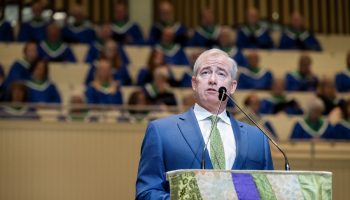
Sonya interviewed Eugene at the final 9:15 a.m. Friday ecumenical communion service in the Hall of Philosophy. Eugene has interviewed each of the weekly chaplains about their faith journey this summer. Fridays were usually short homilies by guest preachers, but for this service, he bowed to the requests to share his faith journey.
Eugene grew up in a Baptist Church, participated in a Dutch Reformed Church and became an Episcopalian. “I have never repudiated any of them. I was a stomping Baptist and we liked our religion hot. The first time I saw someone read a sermon or a prayer was in college. I learned that the best way to pray is your way. We will see which is next, but I do have a pension from the Episcopal Church, so I think that is where God is calling me.”
Sonya asked who Eugene’s heroes are. He started with his childhood pastor, the Rev. White. “He was tall, stern and had the voice of God. I was in awe and scared of him. I was in the hospital when I was about 6 and he gave me a visit. It was a large, 3,000 member church and I thought he barely knew me, but he prayed over me and it has stuck with me to this day.”
When Sonya asked about his parents and grandmother, Eugene said his parents came from North Carolina to Washington, D.C. during the Great Migration. “They were escaping poverty and Jim Crow and lack of opportunity, but they were also escaping white Christians who didn’t care about them. They didn’t leave God, but they left those people.”
Eugene’s father could fix anything, and he started Sutton’s Auto Repair, bought property and ran a taxi service. “He did what he had to do to support us.” He died four years ago. His mother “graduated from college the same year [Eugene] did. She went to work as a civil service worker in the State Department. She died three years ago and we got a letter from Secretary of State Blinken telling us how much she was missed and how they could use her skills.”
He continued, “She spent a life in service and I get angry when people disparage ‘bureaucrats.’”
Centering prayer has been another key element in Eugene’s life, he said. For many years he spent 10 days every summer at St. Benedict’s Monastery in Snowmass, Colorado. One year, the abbot asked Eugene if he had ever considered becoming a monk. Eugene told the abbott there were vows he could not make. The abbott said, ”We might be able to make an exception.”
Sonya said, “I know how much you love your vocation. What are your special gifts or strengths?” Eugene said, “It is really hard to offend me. If someone says something hurtful, I figure it is their issue and I brush it off.”
He continued, “I don’t think we understand our deep calling until about age 40. We are called to spread the Gospel everywhere. If there is good news anywhere, I will spread it. We need to stop spreading bad news in the name of religion.”
Asked by Sonya if there was anything he had failed at, Eugene said, “My first marriage. I was a minister, teaching in a divinity school and I felt like the world’s biggest imposter. On the good side, though, I have done some jobs better than others could do those jobs.”
When he became bishop of the Episcopal Diocese of Maryland, the diocese set high goals for evangelism, justice and mercy. “We achieved none of them. As Father G said, we set the mark so high we could never get there. And I am glad we failed, because if we had succeeded we would have patted ourselves on our backs and said we had it all together. The road to humility is humiliation.”
Then Sonya said, “Tell us your feelings about that oxymoron, ‘organized religion.’” Eugene said he met a rabbi at a conference who said, “I am not spiritual, I am religious.” He asked her what she meant. “Being spiritual is about me, myself and I. Religion forces us to take the God of the universe seriously, to take community seriously. We will visit the sick, we will feed the hungry, we will welcome the stranger.”
Eugene said, “I also hate the church. Institutions will fail the people.” Two weeks after he was elected a bishop, he went to a conference at Canterbury in England. He and Sonya attended a garden party at Buckingham Palace. A chamberlain of Queen Elizabeth II asked if they would like to meet the Queen. They were one of six couples formally introduced to her. The chamberlain said, “Bishop and Mrs. Sutton of Mary-land.” Eugene said, “They don’t pronounce anything correctly in England.”
He returned to the conference and found his compatriots “arguing as if their theology was the word of God. I called Sonya and said ‘I no longer believe.’ I was rocked; my crisis came because of the way the church treated people.”
Eugene said, “All we need is here, here, here; all we have is each other. God only works with sinners — you are the only one who could do what you did.”
Sonya asked one last question, a question the family asks on birthdays and special occasions. “What have you learned in your 72 years?” Eugene said, “Jesus loves me, this I know, for the Bible tells me so.”
The Rev. Rachel Stuart, senior pastor of Hurlbut Memorial Community United Methodist Church, presided. The Rt. Rev. Eugene Taylor Sutton consecrated the Communion elements. Joseph Musser and Willie La Favor, part of the Motet Consort, played a four-handed rendition of “Sheep May Safely Graze,” by Johann Sebastian Bach arranged by Henry Gheel. They also played the postlude. The Motet Choir, under the direction of interim director of Sacred Music Sonya Subbayya Sutton, sang Harold Friedell’s “Draw Us in the Spirit’s Tether” and “Break Thou the Bread of Life,” in a setting by Stanley Hovatter. Music during communion also included “Dona Nobis Pacem,” and “There Is A Balm in Gilead.” The Rev. James Brooks, senior minister of First Christian Church, Hagerstown, Maryland, read the Scripture and served as a Communion minister. Bishop Sandra Steiner Ball, bishop of the Western Pennsylvania Conference, led the prayers of the people and served as a communion minister. Other communion ministers were the Rev. Ruth Smalt, senior pastor of Siesta Key Chapel (PCUSA), Siesta Key, Florida; Bishop Tim Smith, retired Lutheran Bishop of the North Carolina Synod (ELCA) and the Rev. Steve Booth, associate pastor of First Baptist Church, Richmond, Virginia (CBF). They were assisted by volunteers from the congregation. Support for this week’s chaplaincy and preaching was provided by The Lois Raynow Department of Religion Fund and The Daney-Holden Chaplaincy Fund.