Julia Weber
Assistant Editor
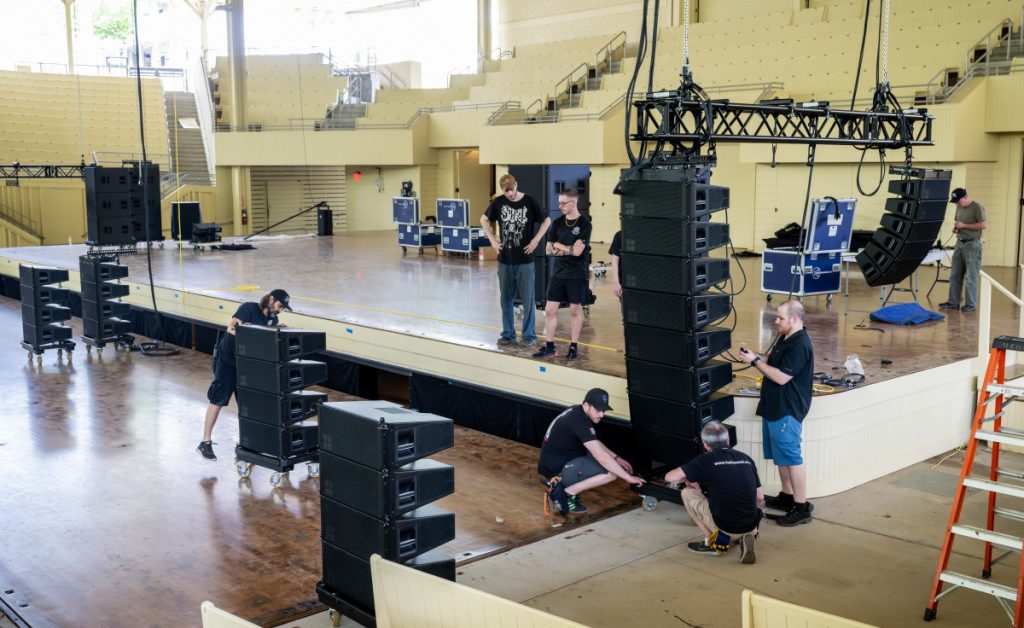
Between last season and the forthcoming one, Chautauqua Institution’s production team has been hard at work. The Institution purchased a $1.5 million audio system for the Amphitheater to better address patron concerns and increase the efficiency of the Amp’s production staff.
“We wanted to make sure that the quality of our audio system matches the quality of our programming,” Interim Chief Executive Kyle Keogh said. “When I joined last summer, I heard a lot of feedback from folks that the Amp audio system was not up to snuff.”
For Director of Production Paul Anton, the new audio system completes one of his first major goals since joining the Institution. After assuming the role in January 2025, Anton took an audit of the production department to better understand its resources, equipment and performance. He said it became “very apparent” that the Amphitheater audio was a big concern for the Institution and for patrons.
“When we pulled the trigger on an over-$1.5 million system, we looked at it from every aspect and every scientific principle that we could to see that it was the best system to serve the Amphitheater,” Anton said.
Early on in the process, the Institution turned to Chautauquan David Dibble, vice chairman of Las Vegas immersive music venue Sphere, for insight on the new system. Bringing his perspective from other large-scale music venues like Radio City Music Hall and Madison Square Garden, Dibble was able to provide insight about the Amp’s needs.
Following the conclusion of the 2025 Season, the Institution brought in two consulting firms to take a full evaluation of the Amphitheater and design a new system. The first firm, Jaffee Holden, originally opened the Amp and returned to provide guidance for the new system; the second, Buro Happold’s subsidiary Vanguardia, provided guidance for the design and installation. Once the system was designed, Sound Associates Inc. handled the installation process.
Frank Reder, associate principal and U.S. acoustics lead at Buro Happold, said he was in communication with Anton “many times a week” to coordinate the development of the new audio system.
The Institution previously rented the former audio system from an outside company on an annual basis, but it didn’t comprehensively meet the needs of the Amp. The consultant team proposed multiple options, including adding additional cushions to the Amp and doing major acoustic treatments in the space, but the Institution determined that replacing the audio system would be the best course of action.
Reder said a major priority for both Chautauqua and Vanguardia was to maintain the historic character of the Institution and receive community buy-in before they moved forward with executing the project.
In designing the new system, Anton explained that there was significant focus on achieving enhanced clarity for spoken-word audio. With that aspect of audio design as the focus, Anton said all other areas of audio benefited.
“Even with that being the focus, all the other aspects too — the popular entertainment performances, the times that we do mike the orchestra, opera — all of those would benefit from the new system as well, but the primary focus was to make sure that the spoken-word programming had the biggest improvement.”
The old sound system achieved between 75% and 80% coverage of the Amp, meaning there were “dead spots” where audio was not clearly heard throughout the venue. The newly installed system achieves closer to between 90% and 95% coverage, according to Anton’s estimate.
“It was very difficult for the audio team to achieve a clear and audibly loud enough mix for the patrons to get the full experience no matter where they sat in the venue,” Anton said.
He explained that the Amp differs from other performing arts venues in the amount of different styles of programming happening each day.
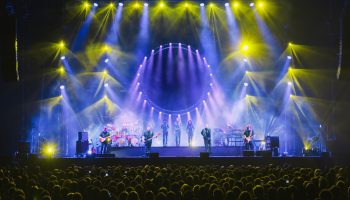
“The level of difference in programming between spoken word to orchestra, choir, dance, popular entertainment — which can be anything from a jazz trio up to a major rock band — all that can happen in the span of a day, and then it happens seven days a week for nine straight weeks,” Anton said.
For Keogh, it was important to ensure the patron experience was consistently high-quality regardless of type of programming, weather, attendance or any other factor that can influence the audio experience.
“We needed something that works across all of those [areas of programming], and also has to work [when the Amp is] empty and full,” Keogh said.
For Reder, part of the challenge was balancing the audio needs of orchestral performance and spoken-word programming, two things he describes as being at “the opposite ends of the spectrum.”
“The question is: ‘How do you balance those two?’ What we arrived at was a system that took a really good compromise between clarity and intelligibility for spoken word and maintaining envelopment and dynamic range for musical performance so that both could still be supported in a really good way,” Reder said.
Throughout the design and installation process, it was also important to ensure the audio system was equipped to meet the needs of such a wide array of audience members. As bodies age, the physics of their auditory systems change, making the Amp’s ability to adapt to the needs of all listeners a prominent consideration. The consideration yielded an emphasis on designing for speech intelligibility, employing audio technologies like array processing (which digitally steers audio away from acoustically reflective surfaces) and a tool called “Soundscape,” which Reder described as being akin to a “spotlight for audio.”
“It allows you to suspend your disbelief a little bit. It sounds like it’s coming from where it looks like it’s coming from. That’s a reduced mental load,” Reder explained. “When you’re there listening, it is so impactful because you’re going directly from experience to understanding. There’s not that additional layer of trying to mentally sort through the information that you’re receiving.”
The new system will affect the Amp’s production crew, too. Sometimes staff worked with rental gear with which they were already familiar, but sometimes they had to acquaint themselves with new rental equipment, which meant increased time spent testing and troubleshooting throughout the day. The new audio system allowed the Institution to purchase more equipment rather than renting it, meaning the production staff was also able to cut down on the costs of renting equipment and the time spent troubleshooting it.
Anton said the new system will be a major improvement to both the patron experience and the Amp staff workflow because its updated technologies allow for increased productivity and higher-quality sound.
“Each day, we were having to tear apart — to a degree — everything that was set up for the morning to be able to facilitate the evening, and at the end of each night, restore. It eats a lot of time, it means we’re not efficient when we’re getting asked to do large things or new things; it’s a lot harder to manage because we’re also having to facilitate those turnovers on a constant basis.”
Anton added that while the system is a significant upgrade, there are elements that are still not within the Institution’s control. Touring artists often have their own audio team controlling the system, and human errors happen regardless of the level of quality a system boasts.
“A system only operates as well as the individuals operating it,” Anton said. “We have an amazing audio team, most of which is returning from last season. They are doing an amazing job with the new system and I think they are going to absolutely crush it all season long. That being said, they’re human.”