
Arianna Nevarez
Staff Writer
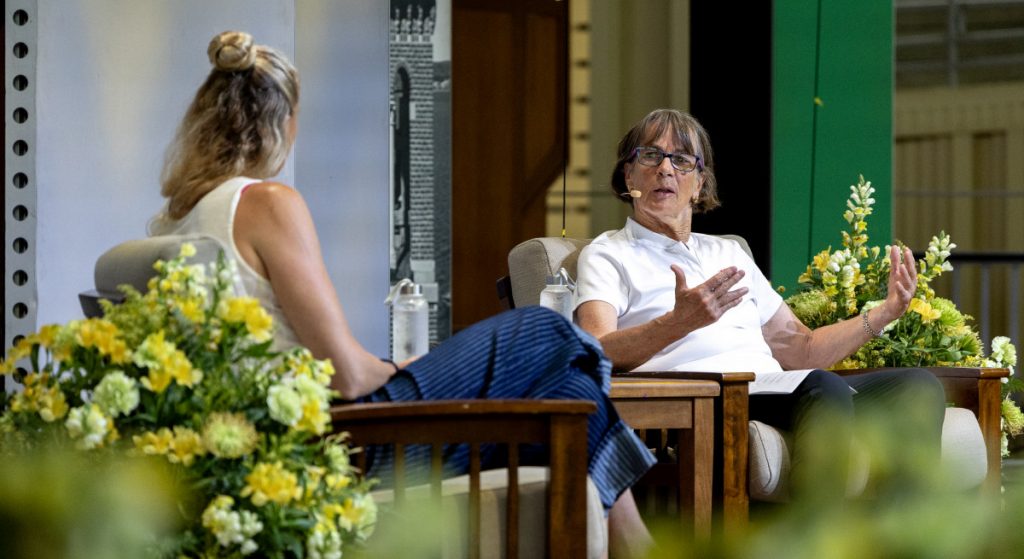
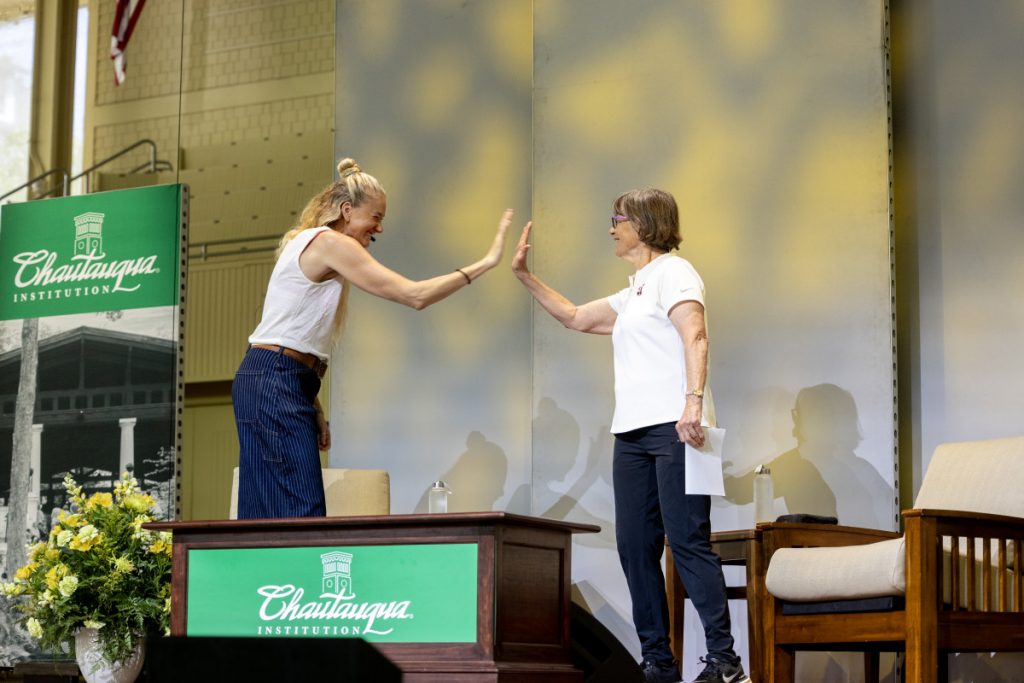
Kerri Walsh Jennings and Tara VanDerveer joined together for a conversation at 10:45 a.m. Wednesday in the Amphitheater to continue Chautauqua’s Week One Theme “Icons and Instigators: Women Who Change the World.” The two talked through Jennings’ upbringing, Olympic journey and how she became the athlete she is today.
Jennings stands as one of the most dominant beach volleyball players worldwide and has been recognized for her achievements in the International Volleyball Hall of Fame and U.S. Olympic & Paralympic Hall of Fame. VanDerveer, a lifelong Chautauquan, is the second-winningest coach in NCAA basketball history and coached the 1996 women’s basketball Olympic team to gold. The two speakers’ paths crossed at Stanford; when VanDerveer coached women’s basketball, she attended some of Jennings’ beach volleyball matches.
Jennings said she grew up seeing lots of competition in the people she looked up to the most: her parents. She said competitiveness was in her DNA and she played all kinds of sports growing up, but volleyball became her favorite. For Jennings, volleyball was different from other sports because she was playing with people who were like her, girls, and she saw “her voice” represented in the sport.
Using dance as a metaphor for volleyball, Jennings said, “I really love the fact that I started as a bad dancer … everything felt very poetic, and like a dance, and I just loved repping it out. I never got sick of working on the little things.”
VanDerveer then talked about her own relationship with basketball and how it grabbed her the same way volleyball grabbed Jennings. However, VanDerveer said her family never recognized basketball as something that could grow beyond a hobby.
Jennings’ parents were athletes, so she said they served as role models for her and pushed her to want more in life, regardless of whether she was interested in sports. Her parents influenced how she approached her mindset, mentality and emotions following a bad match. Instead of feeling discouraged or disappointed in herself, losses in her sport drove her to want more. Her pressure was self-sourced, but her parents showed her that weakness was simply a place for growth.
“There’s something about the proximity of greatness, the proximity of people who care so much,” Jennings said. “… They were very present, and I think ultimately that’s what I learned from parents, and being great is that the more you can be in the moment, what you need shows up.”
Jennings said she had wonderful coaches throughout her whole career. To her, coaches can make all the difference for athletes because they are crucial to building up the human spirit. She emphasized the need for human connection between coaches and players because, without that, there can be no trust or understanding during hard times.
“The tone you set — the tone we set, as parents and as coaches — to me is everything,” Jennings said. “You are the leader, so you’re the nervous system of the team … I was able to be coached very hard if I had a connection with my coach. They could tell me I was terrible. They could tell me I was hurting the team. I could accept it as long as they knew that they cared for me as a human.”
After talking through Jennings’ younger years, the pair shifted focus to their Olympics experiences. Jennings first went to the Olympics with the USA indoor volleyball team, but they placed fourth, leaving her heartbroken. She was forced to consider her next step in her career. But her parents ended up putting her in a blind audition with Misty May-Treanor, a volleyball player Jennings played against before, who needed someone to complete her beach volleyball pair.
Jennings never thought about beach volleyball and was scared to step in the sand. After the tryout, she realized there was “magic.” The pair ended up earning three consecutive gold medals.
“Misty changed my life. That decision to be brave and to put myself out there in a realm that I was uncomfortable with absolutely changed my life,” Jennings said. “That’s why I’m so grateful for sports.”
VanDerveer said as a coach, she notices her players struggling with confidence. Jennings replied that confidence doesn’t come from crowds who cheer for you, parents or even your coach. She explained her confidence comes from the way she talks to and uplifts herself instead of feeding into the inner critic. She also uses this confidence to help her in those big moments, like the Olympics.
“The big moments are just another moment, right?” Jennings said. “My sports psychologist taught me that, and I’m like, ‘I call BS.’ Some moments feel bigger than others, … but again, to me, it’s all preparation.”
Being part of different generations, both have seen changes in the sports industry, especially for women. Jennings discussed the difference in depth of talent. More kids are starting to play sports at a young age, creating a bigger pool of contenders across the country. She also said the options for volleyball players after college have broadened to allow people to stay close to home rather than go overseas.
VanDerveer said Title IX — which passed in 1972 — hadn’t existed when she was growing up; women didn’t have the chance to play sports at all, and there were no scholarships. During her talk, she mentioned a time she told a basketball camp about these circumstances, and someone asked: “Why was it like that?”
“And I was like, ‘How do I explain this to an 8-year-old?’” VanDerveer said. “I said, ‘Can anyone else answer this question?’ And another little girl goes, ‘Sexism.’”
Following the June 30 court decision to prevent transgender girls and women from playing on gendered athletic teams, VanDerveer and Jennings discussed their differing opinions. Jennings said she agrees with VanDerveer in the way that every young person should have a chance to play sports, but said, “I agree with the Supreme Court ruling. I really believe fundamentally biological sexes should
be the marker.”
Jennings also said it’s not a black-and-white conversation, and her “goal is to never make anyone else feel wrong.”
VanDerveer said Chautauqua is a great place to talk about this because differing opinions can co-exist and become a conversation.
“I’ve had young athletes come to basketball camp that were trans athletes, and I think that we have to figure this out for our athletes — for every young person — so that they have an opportunity to play,” VanDerveer said. “We don’t have it figured out yet, and just by excluding any young person from the opportunity to play is wrong.”
The two closed the conversation by talking about their next chapter. VanDerveer said she loves spending time at Chautauqua and enjoys the opportunity to talk to accomplished people like Jennings. Jennings said retirement has been a challenge, but she is working on her nonprofit, p1440, to help give back to the beach volleyball community.
“When I started playing pro, my goal was to leave the sport better,” Jennings said. “I can proudly say I’m not done yet, but we’ve come really far in that way.”