Jenell Taylor
Staff Writer
Artist Kerri Ammirata first visited Chautauqua Institution in 2005 — and returned in 2006 — as a participant in Chautauqua Visual Arts’ School of Art residency program.
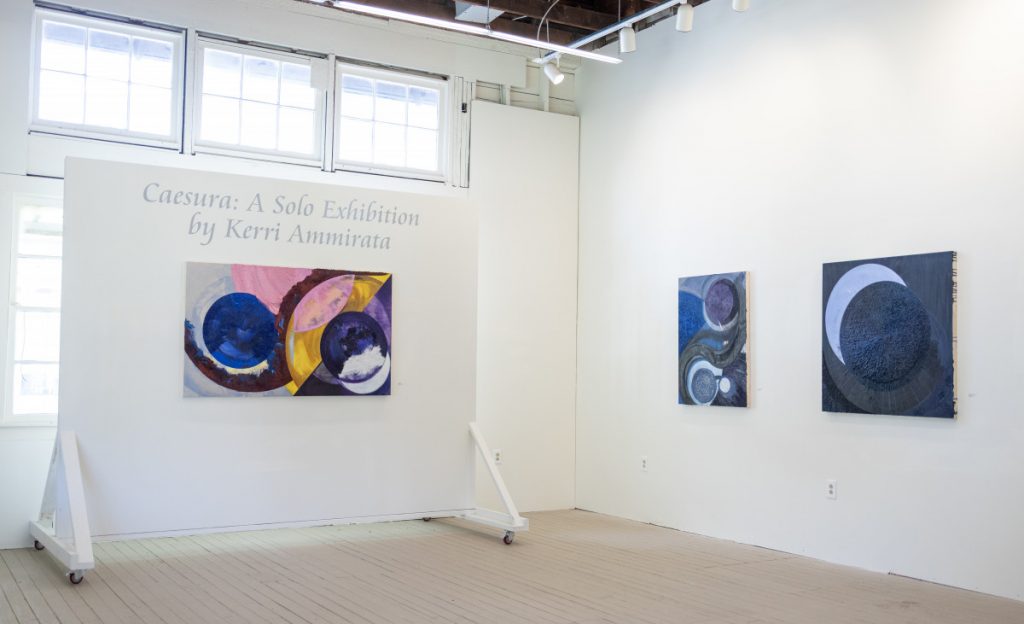
Now, she returns to Chautauqua to exhibit a collection of poignant new paintings under the title of “Caesura” in the Arts Quad, made possible through a grant by the New York State Council on the Arts. The exhibition opens with a reception from 3 to 5 p.m. Sunday and will remain on view at the Quad through July 19.
“I’m excited to walk the paths I’ve walked for two full summers,” Ammirata said. “It really is where I fell in love with painting … it was vital for me to be there, spending my summers continuing to develop my practice.”
The exhibition gets its name from an excerpt of Louise Glück’s poem “Labor Day,” in which the poet writes, “Not a sentence, but a breath, a caesura,” describing an interruption or pause that alters the rhythm of the space that surrounds it.
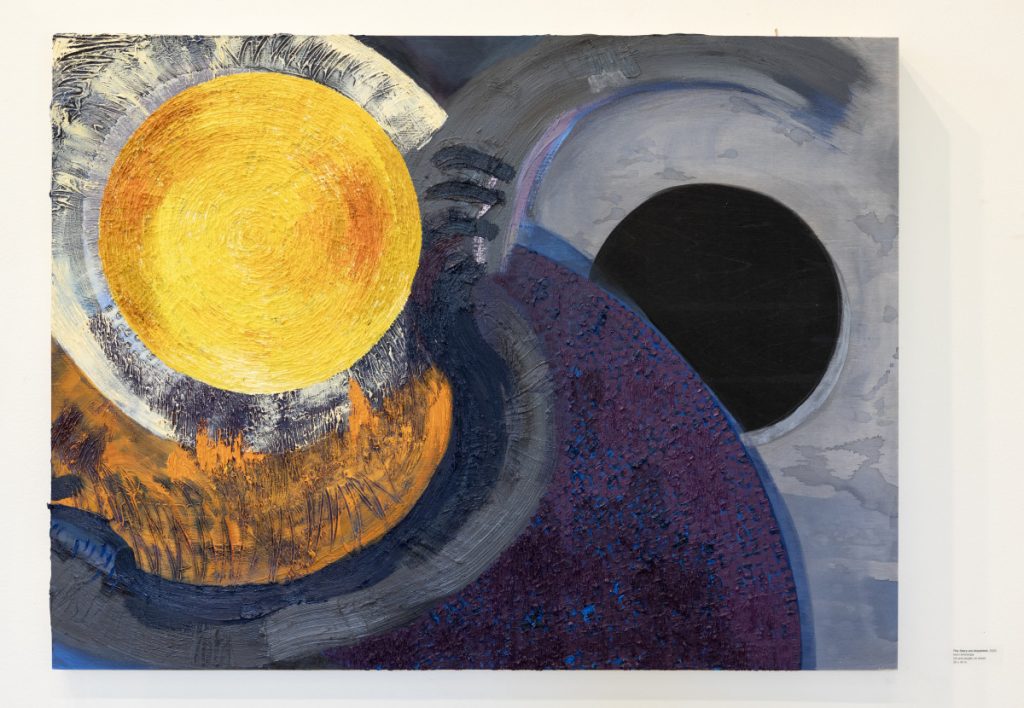
Ammirata created this collection following her diagnosis and treatment for breast cancer in 2024. The works explore the process of transformation, the fluid nature of identity and the importance of patience for growth.
“This is how I’m able to express myself and what gives my life meaning and joy,” Ammirata said. “And art — not just my own — all art is where I learn about the world, where it breaks me open and lets me grow.”
The paintings in this exhibition draw from celestial imagery, taking inspiration from the sun, moon, stars, planets and other celestial bodies. Ammirata uses fluid brush strokes, deep purples and blues and sacred geometry to make sense of her experience and to honor her practice with intention.
“It’s not that I’m purposely trying to use the cosmos,” she said. “It’s just how I deal with these large emotions about life. It’s where it starts to become clearer to me.” She described being inspired by the work of late British American astronomer and astrophysicist Margaret Burbridge, famously nicknamed “Lady Stardust,” when explaining her connection to the universe.
“She was around in the 1950s and wrote a really important paper about how we’re all made of stardust. The Earth is made of the clashings of planets and stars and all these things,” she said. “And I find that the idea of science and poetry sort of slammed together for me when I think of space and the cosmos.”
Prior to her diagnosis, Ammirata’s practice was very labor-intensive and repetitive. Making frequent use of chisels, saws and other materials, she was able to create paintings that were quite heavy and dense. After undergoing treatment, she had to abruptly abandon that process, noting that it was very demanding for her body. In its absence, she reignited a love of oil paint that had previously been dormant.
“I had to change my practice completely, and picked up oil paint for the first time in years,” she said. “It freed me to really get to the heart of my emotions and my feelings about life and what I was going through.”
As Chautauquans engage with “Caesura,” Ammirata hopes that “people come in being able to attach their lives to the paintings.” She said she’d like for the works to transcend her own experience to a more universal one. “I hope that it’s more universal than just about my specific experience; I want it to be for everybody.”