ARIANNA NEVAREZ
Staff Writer
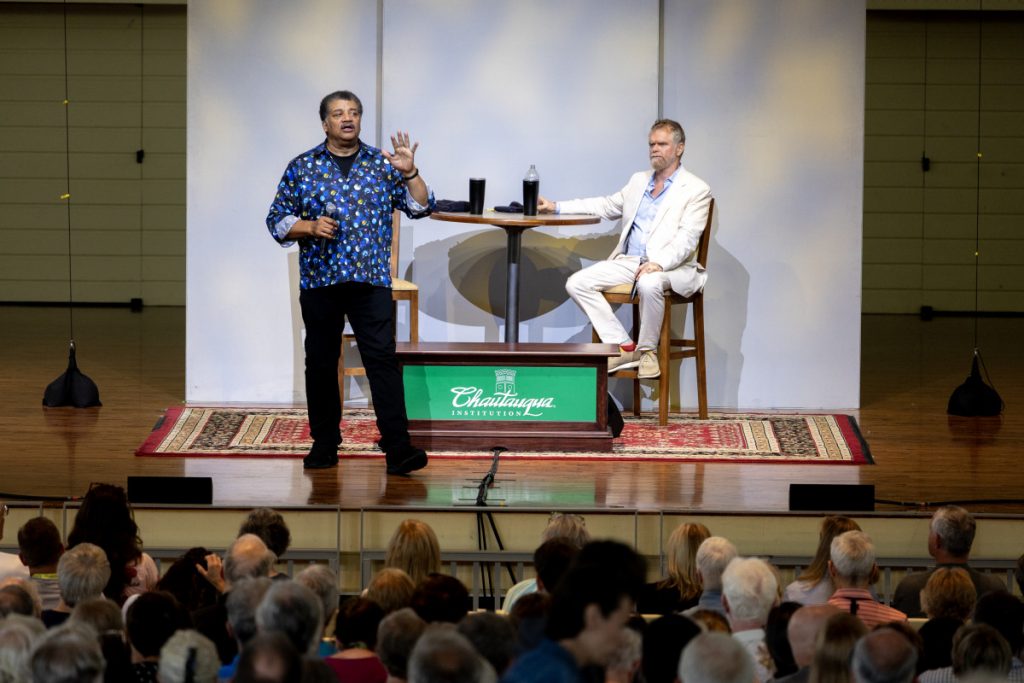
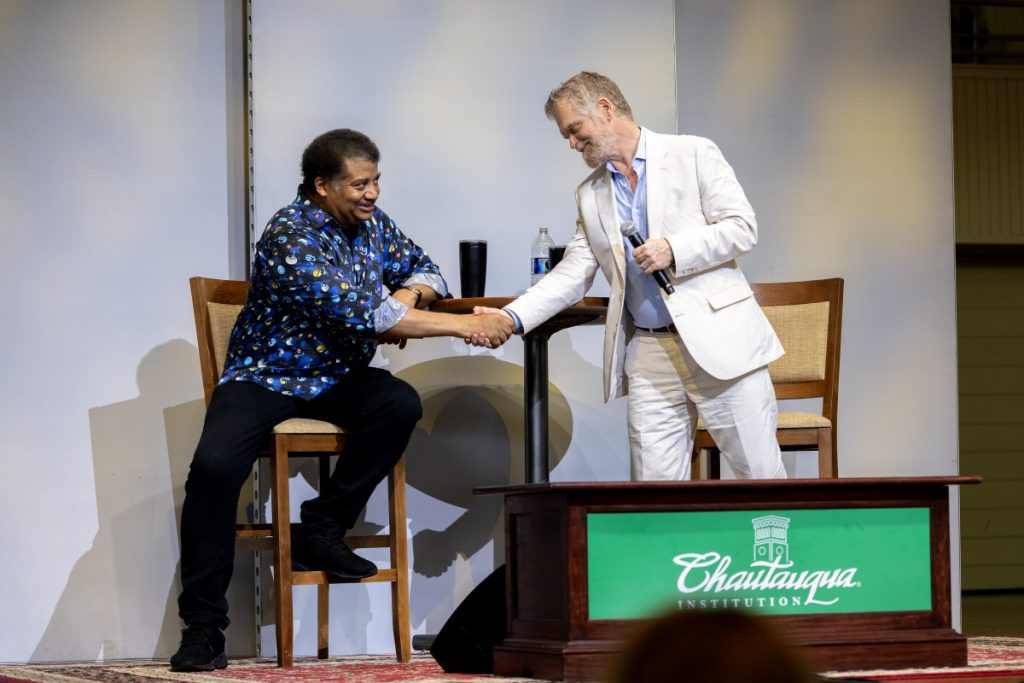
Closing Week Two, Neil deGrasse Tyson and Scott Hamilton Kennedy discussed the ways in which misinformation affects the scientific community and shared insights into the documentaries they have collaborated on at 10:45 a.m. Friday at the Amphitheater.
Kennedy opened up by introducing the story of his and Tyson’s first film together, “Food Evolution” (2016). Kennedy pointed out that, according to a 2015 Pew Research study, 88% of scientists had confidence in genetically modified foods, but 37% of the general public said the same. Then, he shared a video with the audience of Tyson saying practically every food people buy in a store for human consumption is genetically modified through the process of artificial selection.
“We are creating and modifying the biology of the world to serve our needs. I don’t have a problem with that because we’ve been doing that for tens of thousands of years. So chill out,” Tyson said in the video.
When Kennedy saw this video, he contacted Tyson to work with him as the narrator and script consultant for “Food Evolution.” Kennedy said when looking for subjects in a documentary, he sought out diverse voices and saw this represented in Hawaii. There, some politicians — without any scientific evidence — wanted to ban all GMOs on the island; there was a complication in their plans, however, because GMO technology saved the Hawaiian papaya industry.
After Kennedy began screening the film for different audiences, he started to see hesitation about GMOs and thought the Q-and-A section following the screenings might be a “disaster.” After the showings, audiences surprised him.
“We made ‘Food Evolution’ because we saw problems with misinformation and mega-marketing that, too often, was winning out over verifiable science. But then, when we released ‘Food Evolution,’ we started to see something else happen at screenings,” Kennedy said. “We saw changing minds.”
After receiving positive feedback from viewers of the film, Kennedy shifted to talk about how he felt the work to combat scientific misinformation was incomplete. Kennedy said he saw parallels between public distrust of GMO consumption and distrust of vaccinations.
Due to the anti-vaccine movement, some people decided not to vaccinate their children, Kennedy said. A measles outbreak hit New York City in 2019; he developed another documentary, titled “Shot in the Arm,” to educate the public.
As Kennedy was working on his new film, he ran into a roadblock. The COVID-19 pandemic broke out worldwide and created complications, but he saw this as an opportunity and reached out to Tyson again to bring him in as an executive producer for the film. On the subject of misinformation in both films, Kennedy said overlap exists as people approached two different topics.
Kennedy also pointed out that the people who now have influence over essentially every aspect of our science and public health, including Robert Kennedy and Dr. Mehmet Oz, are the ones spreading misinformation.
“Science and scientists [are] going up against clever and sometimes ruthless communicators, using fear and silly bargaining to undercut established science,” Kennedy said. “But thankfully, just like with food evolution, we started at screenings. We started to see that ‘Shot in the Arm’ was moving people.”
Tyson opened with how science can be fused with storytelling. He said films can make one feel different about a subject, but added that scientists aren’t trained to be storytellers or charismatic. Tyson explained that this can create difficulties for the field because scientists have objective truth, yet they also need to be effective communicators.
“You can sit there and say, ‘I know I’m right, and you’re an idiot.’ And what good is that? How are you influencing anything? People are just digging their heels harder into the ground,” Tyson said.
The pair then displayed a clip from “Shot in the Arm” about the anti-vaccine movement that took place in Samoa after two infants died following a vaccination. Due to the movement, they explained, a measles outbreak occurred which killed 83 people — mostly children. It was eventually proven that nurses incorrectly prepared the vaccines, making human error the cause. Tyson said bias can feed into misinformation.
“At the time, the reason [for the infants’ death] was a mystery, but the anti-vax movement immediately said that the vaccine is killing us, without realizing it was actually a mistake,” Tyson said. “But if you have a bias that has whatever foundation at all, you’re less likely to search for what the real answer is. You’ll go with what fits your confirmations, justifiably known as a confirmation bias.”
Science requires probability and statistics, Tyson said. In Texas, a child died due to measles, yet the mother still refused to vaccinate her other child. Tyson underscored the importance of statistics in this circumstance.
“They want to take the chance with the disease rather than take the chance with the vaccine, which means they have not looked at the data or the statistics,” Tyson said. “The death rates of measles versus the extremely rare and unfortunate case if someone dies from a vaccine. Compare the numbers; just compare them.”
Tyson posed the question, “Is science political?”
Since 1945, Republican presidents have funded significantly more science than Democratic presidents, and President Trump has shifted that, according to Tyson. He said American scientists who are losing funding in the U.S. are now being offered opportunities in other countries to do research elsewhere. Tyson said this is different from historical precedent, when foreign researchers came to America.
Tyson described the attack on science in recent years as “entirely Trumpian.” He continued, “It is not Democrat. It’s not Republican. It’s not American. It is Trumpian.”
There are signs of hope, Tyson said, such as the Senate rejecting President Trump’s proposal to cut funding from NASA, the National Science Foundation and the National Institute of Standards and Technology. He also said judges were striking down Robert F. Kennedy Jr.’s vaccination policies.
Tyson and Kennedy closed with conversation regarding the importance of storytelling to reaching audiences across America with facts and science.
“Science matters here,” Tyson said. “So these two films, they embody communication at its finest. You’re not just delivering information. You can get that on a [Wikipedia] page. It’s not about information. How does the information rest within you? How does it affect you intellectually, psychologically, emotionally? And if it does not impact you, then we don’t need stuff. But storytelling predates science. It’s in our species. It’s in our DNA.”