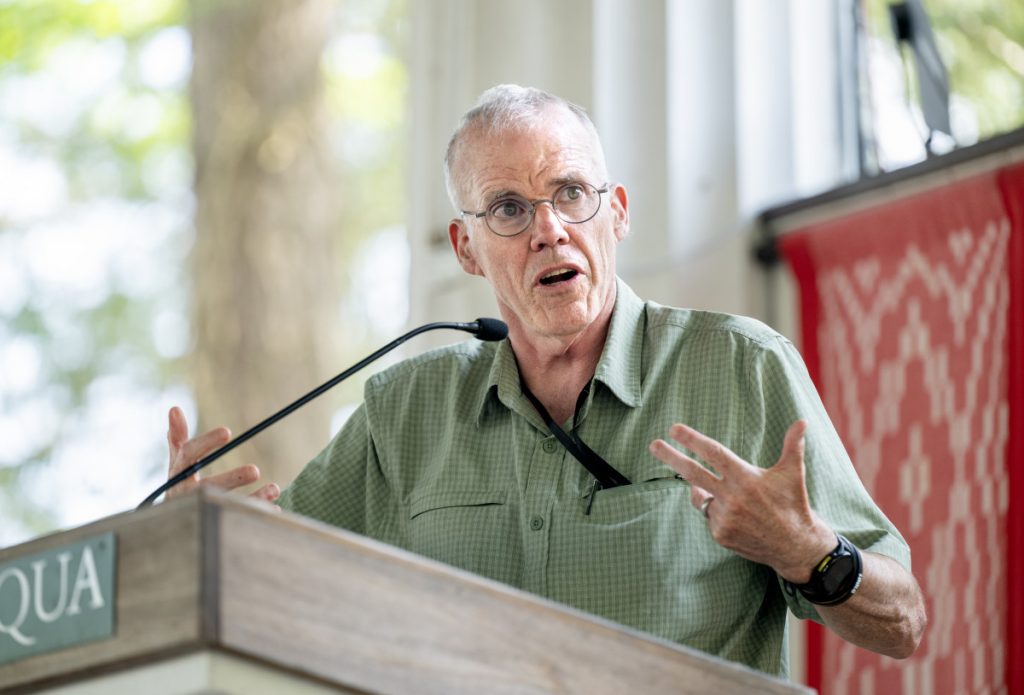
Author, activist and educator Bill McKibben discusses the impacts of climate change and the rising role of renewable energy Monday in the Hall of Philosophy.
LILY RESLINK
Staff Writer
During his 2 p.m. Interfaith Lecture Monday in the Hall of Philosophy, Bill McKibben said he would be optimistic while discussing environmentalism, but it would take him a minute to get there. He said he needed to “start with some realism” about the climate crisis.
“We’ve raised the temperature of the Earth as much as scientists said we would,” McKibben said. “It has had more dramatic effects faster than they expected because science is basically a conservative business, and their predictions have been surpassed by what’s going on on our planet right now.”
McKibben pointed to several areas where he has seen environmental devastation and responses to that devastation. He said the locations differ in publicity, from places like Los Angeles, California, which receive frequent media coverage, to Derna, Libya, where he said there are fewer eyes. He spoke of a flood three years ago that drowned out Derna in just one hour.
He said there is a pattern in countries that contribute the least to climate change bearing the worst of its consequences. He pointed to the conversation of taking accountability. The U.S., he said, represents 4% of human beings, but has produced about a quarter of all greenhouse gas emissions.
McKibben said reducing natural gas energy dictates the ability for many humans to live healthy lives.
“At this point, every tenth of a degree we raise the temperature moves 100 million of our brothers and sisters from a safe to a dangerous climate zone.” He said this harm is motivation for people to act quickly and consider the impact of societal institutions.
“The wounds of our planet are now going beyond the superficial flood and fire to the deeper, systematic level,” McKibben said.
He said simultaneous with environmental devastation across the world are new kinds of autocracy and authoritarianism.
He transitioned from “the bad stuff” to what he said is “the one big good thing happening on our planet.” He said he sees the rapid rise in cheap, clean energy as “big enough and good enough that it gives us some hope of taking a bite out of both the climate crisis and authoritarianism crisis.”
Learning to control combustion of coal, gas and oil, McKibben said, “gave us modernity.”
However, McKibben said describing renewable energy as “alternative energy” undermines the technology he sees as a necessity.
With his work as the founder of Third Act — an organization focused on engaging people 60 and older in climate action and justice — he highlighted the credibility of this demographic, who, he pointed out, have lived for a fourth of the United States’ existence.
He said green energy requires a “fight” because it directly opposes authoritarian powers in the fossil fuel industry.
He gave examples of green energy initiatives in other countries, including Pakistan, which he said was led by the people rather than a government or organization, and Cuba, which implemented a rapid spread of solar power out of necessity after oil embargoes left the country without power.
McKibben said he thinks the trend of renewable energy will continue.
“It’s a beautiful idea to imagine people around the world relying on energy that comes from where they are. Think about the sun coming our way today. Think about the breezes that have been blowing through this hall as we speak.”
McKibben emphasized renewable sources of energy are not just realistic, but in fact necessary.
“Every corner of this planet is stocked with enough energy from above to get the job done,” McKibben said, adding that this is good news for all — except owners of oil wells and coal mines.
He called for people to seek “energy from heaven, not from hell.”
McKibben said speeding up the transition to sun and wind power is necessary to address climate change and function on a more stable and less costly energy system. He said, however, if it takes 40 years to get to that point, then Earth will be a “broken planet” by then.
He said creating a society that is possible to sustain comes with fighting authoritarian powers within the fossil fuel industry.
McKibben said this fight must also take place at the federal level, which includes gearing up for upcoming elections. McKibben said he has concentrated his recent efforts in Republican districts and states, and his efforts have focused on “trying to get some foothold back in D.C. so that we have some chance of getting America back on track.”
Regarding the question of who should be engaged with this fight, he boiled it down to “old people like [him]” and “people of faith.” He said people over 60 have several advantages, including political and social movements being like “muscle memory” given the era they grew up with.
McKibben also addressed the crowd, saying: “Politicians pay attention to us because they know that every single person in this room voted in the last election. There is no known way to stop old people from voting; we might as well make the most of it.”
For people of faith, he said, environmental stewardship is central. Regarding the Bible, “the very first page is filled with the story of the good Lord creating this beautiful place and giving us our first job, which was to take care of it, to exercise dominion over it,” McKibben said, adding this is something society has “done a very poor job of.”
He said that hope lies in motivations of faith and higher powers that connect individuals to nature.
“We were not supposed to cook the planet. We were supposed to take care of it,” McKibben said.
McKibben called people of faith to action, saying that their obligation is clear. He said seeing religion enter the environmentalism movement has been beautiful to watch, and “that’s begun to be a very important part of this movement.”
McKibben said while 2026 will induce questions of what Christianity will look like politically, he said with certainty: “This is not what the good Lord had in mind.”