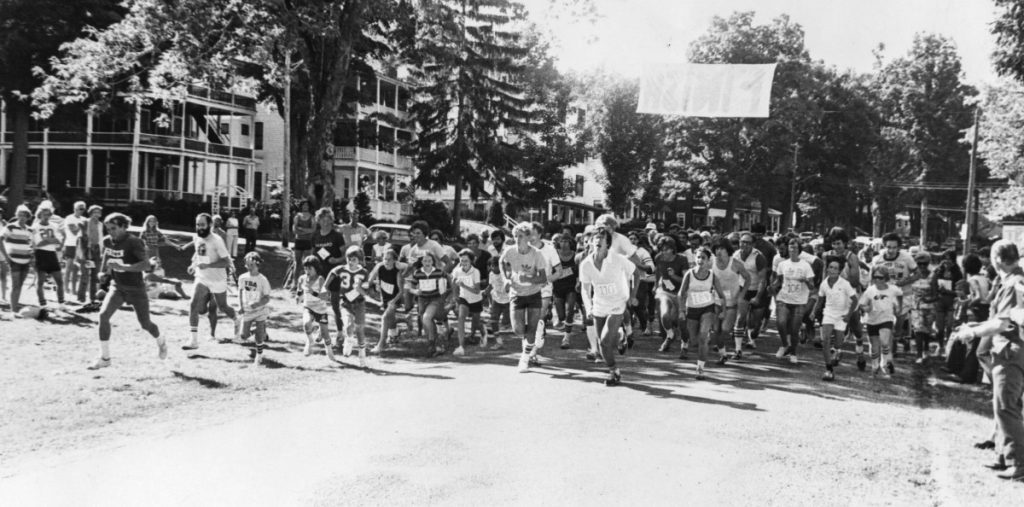
The starting line of the Old First Night Run/Walk in 1977.
CODY ENGLANDER
Staff Writer
“Farrah Fawcett-Majors does it… Leonard Bernstein does it… You can do it!” read an article from The Chautauquan Daily in 1977, announcing the inaugural Old First Night Run/Walk.
“Jogging, of course,” the article continues. “If not, try walking. One way or the other, Chautauquans by the dozens are limbering up to run, jog or walk the 2 1/2 mile Chautauqua Sports Club ‘O.F.N. Run’ …”
Years later, the annual tradition has continued, as runners lace up their kicks in hopes of their name being forever displayed in Chautauqua Sports Club fame.
At 8 a.m. today, the Old First Night Run/Walk begins Chautauqua Institution’s birthday celebration. The race was founded by John Rogers and then Sports Club director David Peckinpaugh in 1977.
“We didn’t know what the heck we were doing with it, but it worked,” Peckinpaugh said. “… We had no clue [the race would have legs]. We didn’t know what we were doing, we were goofing around and we had a little tape for the finish line.”
The first ever finisher for the run was Robert Steele, a two-time NCAA Champion in the 440-yard hurdles and competitor for the 1972 Olympic trials. Steele finished with a time of 12:47, which shocked Peckinpaugh.
“We weren’t prepared, so when someone said, ‘There’s a runner coming around the corner of the Bell Tower,’ we scrambled to get the finish line set up,” Peckinpaugh said. “It was pretty rudimentary back then.”
The first race saw nearly 150 participants and has since become a staple of Chautauqua’s OFN celebration. In 2025 alone, the race saw nearly 300 participants.
“To have that permanent impact, that’s wonderful to see,” Peckinpaugh said. “It’s a great little cross-section of the entirety of the Chautauqua experience, because you’ve got serious runners, walkers, people pushing strollers [and] dogs. It’s a perfect slice of Chautauqua.”
In the last 49 years, Peckinpaugh has seen the rewarding parts of the run continue to have an impact to this day.
“The opportunity to raise money for the Annual Fund [is rewarding]. At the end of the day, that’s the ultimate motivation, and to do it in a way that sort of fit into the theme of Sports Club and what we were trying to accomplish, which was getting people active and giving them more access to the lake and other sports-related activities,” Peckinpaugh said.
The run, originally one-tenth the distance of a marathon, was touted as a “deci-marathon,” though it now boasts an additional .15 mile. Most of the race has stayed loyal to the original course, however.
“I think [the course] has been altered a little,” Peckinpaugh said. “We measured the distance by riding a bicycle and having a little pedometer on it. I think they’ve gotten the distance fine-tuned, but for the most part it’s the same course.”
For many Chautauquans, the run has transformed into a cornerstone of the annual OFN celebration.
“It’s pretty remarkable,” Peckinpaugh said. “There are people like Bob Bowers, who have been able to join in every time.”
Peckinpaugh said he hopes the tradition has legs to continue, having seen its impact on the community.
“It just needs someone with some energy behind it,” Peckinpaugh said. “It better continue on for another [fifty runs]!”