
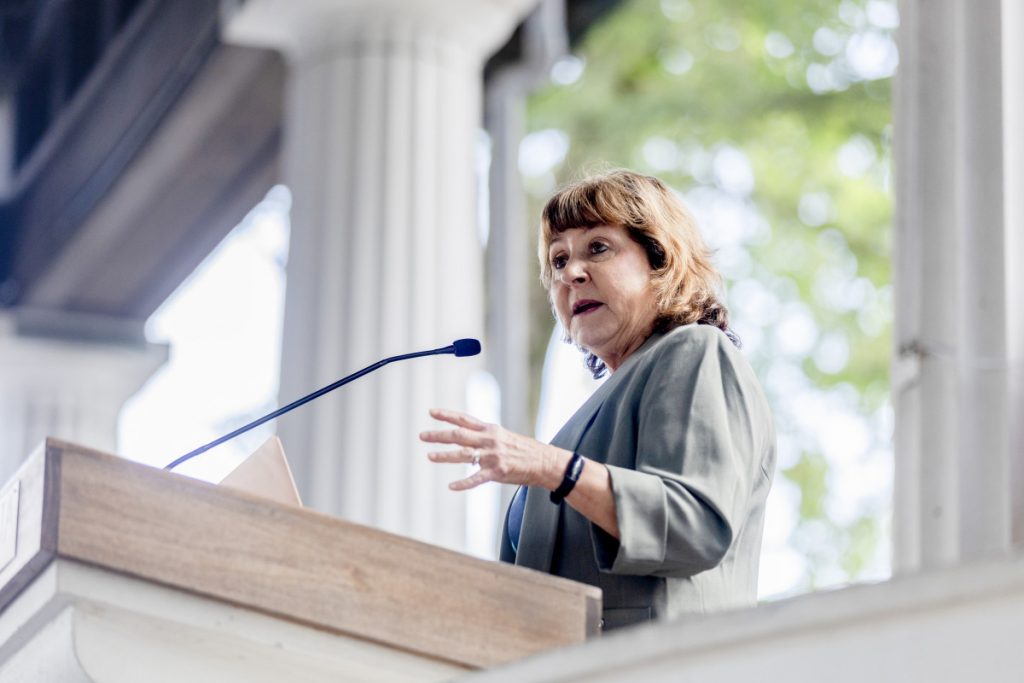
Rosemarie Zagarri, George Mason University distinguished professor of History, talks about women’s role in politics during the Revolutionary War Monday in the Hall of Philosophy.
LILY RESLINK
Staff Writer
During her 2 p.m. lecture Monday in the Hall of Philosophy, Rosemarie Zagarri shed a light not commonly shone on women’s informal roles in the American Revolution, which she said “did start out as a revolution for and about white men.”
Zagarri’s lecture presented claims that the American Revolution had unintended consequences for women’s roles, and women influenced the revolution through informal political channels. Zagarri used historical examples of Mercy Otis Warren, Phillis Wheatley and Judith Sargent Murray.
“The American Revolution would not have been won without the participation of women, and you may think that’s a hyperbolic claim, but it’s not,” Zagarri said.
Zagarri first provided background on the status of women in colonial America when the nation consisted primarily of farming families and offered very little opportunity for women to work outside of the domestic realm. She traced the revolution’s impact through case studies of three influential women “whose faith informed their patriotism and political activity.”
Zagarri said the relatively high literacy of American women compared to the rest of the Western world at the time enabled women to self-educate through reading and participate in “the explosion of print culture.”
Prior to this era, Zagarri said, “Both legally and by custom, politics was considered a male realm.”
“Women were not thought to be appropriate interlocutors and appropriate thinkers about political matters — about politics, war, political philosophy,” she said.
Through a lens of timeless civic engagement opportunities beyond voting and public office occupancy, the rest of Zagarri’s lecture traced the impact of the Revolutionary era as it marked women’s entrance into the U.S. political realm.
Fostered by what colonists called “a long train of abuses” from the British Parliament meant to deprive them of their rights and liberties, Zagarri said opposition brewed in grassroots forms. People, through informal gatherings, devised the idea of “an intercolonial boycott” of British goods.
According to Zagarri, the boycott’s reliance on women’s participation necessitated women’s entrance as active participants in the revolution. As a result, women began to identify with the cause and mobilize as “patriots.”
In addition to adjusting consumption habits, such as wearing homespun rather than imported clothes, Zagarri said women also joined in local organizations called the Daughters of Liberty.
“They began to practice a kind of patriotism which was ‘appropriate to their sex,’” Zagarri said.
Regarding what Zagarri said was an oversight of women by the writers of the Declaration of Independence, she said, “the phrasing of that document and the principles espoused in the Revolution opened up, from the men’s point of view, a can of worms, and from the women’s point of view, a can of possibilities.”
She said women began applying language from the Declaration of Independence, such as equality and natural rights, to themselves — within their domestic roles, the legal system and as participants in “the fight for liberty.”
For her historical case studies of women in colonial America, she assigned a “watchword” to encapsulate each of their respective influences.
She used the watchword “morality” to describe Mercy Otis Warren, a satirical playwright successful in rousing people in Massachusetts against “the threat posed by British tyranny.” Zagarri spoke about the role of her faith and education.
“She really believed that God’s hand was behind the American victory of the American Revolution,” Zagarri said, adding that Warren simultaneously recognized “civic virtue” as foundational to the U.S. government’s success.
Zagarri’s second example of a woman who both influenced and was influenced by the American Revolution is the iconic enslaved poet, Phillis Wheatley. She said Wheatley’s watchword was “virtue.” As a young girl, she was taken in by the Wheatley family, Zagarri explained, and was encouraged to pursue an education; she went on to publish Poems on Various Subjects, Religious and Moral.
“… After the Wheatleys took Phillis into their home, they realized that she was precocious. She was a 7-year-old girl and within about a year and a half, she was perfectly fluent in English,” Zagarri explained. “And then, it became clear that she wanted to learn to read and write. And they taught her. And soon after that, she had just a voracious intellect … so she was also extremely well educated; more educated than certainly most other women, but most other men as well at the time.”
Zagarri said Wheatley started “borrowing from the rhetoric of the Constitution” to write poems of more “political valence.” Through peculiar and remarkable circumstances, Zagarri noted Wheatley’s identification with the cause of the American Revolution.
As Zagarri’s third example, she presented the story of Judith Sargent Murray alongside the watchword of “equality.” Murray, according to Zagarri, resonated with ideas of the equal spiritual potential of all humans regardless of physical bodily differences.
Zagarri said Murray pointed out that any alleged intellectual disparity between men and women was a result of situational education inequality.
“In 1779, she wrote a piece … where she said there is no sex of the mind — that is, men and women are equal — and that women should take their place in the order of nature, in the equality assigned to them by God,” Zagarri said.
After the revolution, Zagarri said many people began to support more education opportunities for women.
Gradual progress began toward equal education opportunities for women, not just in sewing and music, but also in subjects such as geography and math. She said this led to the first women teachers and other long-term impacts on the status of women.
She stressed that women’s informal impact through writing, domestic contribution and emphasis on education illuminated the possibility of civic impact while women still lacked voting rights.
“The women of the revolution show us that other forms of political engagement are as necessary to the politics of our times as they were during the era of the American Revolution,” Zagarri said.