
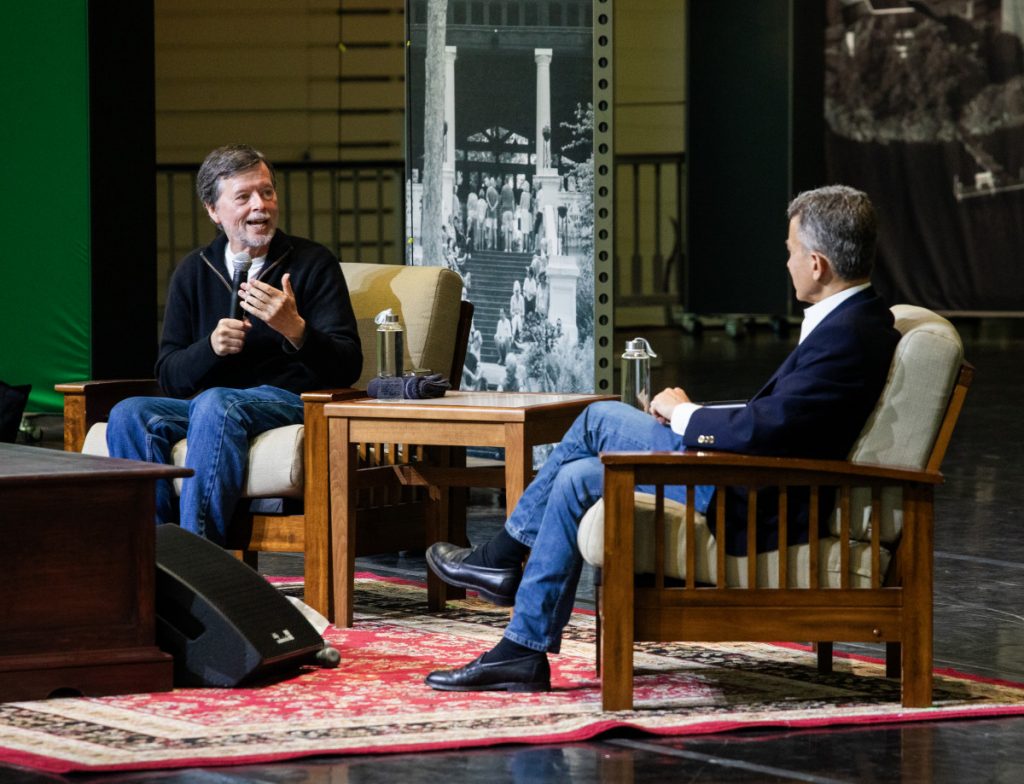
Ken Burns, renowned documentary filmmaker, speaks with Jeffrey Rosen, CEO emeritus of the National Constitution Center, Tuesday in the Amphitheater.
ARIANNA NEVAREZ
Staff Writer
Following their Monday discussion of the American Revolution and the battles that led to American independence, Ken Burns and Jeffrey Rosen analyzed the Declaration of Independence, their interpretations of the document and how the words originally came to fruition at 10:45 a.m. Tuesday in the Amphitheater.
The idea of “one people” came from James Wilson, who said independence is in the name of one people rather than the sovereign states, according to Rosen. Burns said this phrase is “the birth of an idea of an entity that contained the entire body.” He said this is the first time in history that there is a collective “we” operating under “natural laws” without intervention by religion or a monarch.
To understand the idea of “one people,” Burns cited Abraham Lincoln’s first inaugural address, where he addressed southerners.
“We must not be enemies. We must be friends,” Burns said, recounting Lincoln’s words. “Though passion may have strained, we must not break our bonds of affection. The mystic chords of memory, stretching from every battlefield and patriot grave to every living heart and heartstone all over this broad land, will yet swell the chorus of the Union, when again touched, as surely they will be, by the better angels of our nature.”
The first clause of the declaration states, “We hold these truths to be self-evident.” Rosen said this originated from the core of the Scottish Enlightenment. To understand this phrase, he referenced David Hume’s concept of relations of ideas. Rosen said the clause cannot be that “kind of axiom” because people throughout history have created unequal power dynamics, from tyrants to enslavers to kings.
Burns said to make these ideas of equality “self-evident” is to move them “into the realm of the unassailable.”
“The sense of the philosophy of the time (is) that if you can gravitate this, then there’s no argument that all the things that are out to follow in this magnificent question are just part of the equation’s solution, not the problem,” Burns said. “So, what we have here is, there’s no argument here. This is like night and day.”
After “we hold these truths to be self-evident” comes the phrase “that all men are created equal.” Rosen said this idea appears in many ways, through the contributions of individuals such as John Locke, John Wilton and Algernon Sidney, as well as in the Common Sense School. James Wilson, one of the most democratic founders, concluded, “if [people] are equal in moral capacities, then [they’re] equal in their political capacities and [they] are therefore equally entitled to the right to vote,” according to Rosen.
Burns played a clip from “The American Revolution,” which showed the audience how common people interacted with the Declaration of Independence at the time of its creation and asked, “What’s in it for them?” Thomas Paine’s “Common Sense” stirred people’s minds about the possibility of a different kind of world.
“What you see (at the time) is everything’s changing now. After this January publication, people are beginning to inhale the heavy notion of independence based on — not their anger — but on big ideas,” Burns said. “… People at the margins are deeply affected by it.
Burns said the concepts presented in “Common Sense” would have only extended to white men at the time, and many marginalized groups would have been left out, but the information resonated with people and opened a door to new possibilities for the time period.
“This is the world’s — not just our — but the world’s attempt at pressing reset, and it happened,” Burns said.
The pair progressed to the next words from the Declaration of Independence: “they are endowed by our Creator with certain unalienable Rights.” Rosen said to split this into two parts. First, he referred to the rights of conscience, which is to think as you will and speak as you think. The second “unalienable right” is the right of revolution.
“If I’m surrendering to government temporary control over my unalienable natural rights, government has to keep its side of the bargain,” Rosen said. “If it doesn’t, then I have not only the right but the duty to alter our policy.”
Burns defined unalienable rights as “a law of three things: … life, liberty and the pursuit of happiness.” He said there is mystery at the center of the pursuit of happiness, which includes questions about purpose, a citizen’s role and tensions between individual and collective freedom.
Burns showed another clip from the television series about the government’s formation and the creation of many legislative committees that made it difficult for citizens of the new nation to follow the developments of the country. It highlighted women in the story, such as Abigail Adams, and provided insight into how people were initially opposed to democracy because of the problems that can arise.
Rosen introduced the idea of sovereignty and how James Wilson said, “sovereignty is unalienable.” Wilson said the power lies in the people, and they have the right to rebel if the government is “exercising unjust powers.”
Building on this point, Burns cited Bishop Thomas Nechich, saying democracy “is not passive, it is an active verb.”
“What’s so beautiful is that inherent in this document is also the idea of the liberation of the spirit,” Burns said. “That through this discipline and self-denial, we have the possibility to rise and perhaps, in a religious sense, move closer to our… right of resistance.”
After the Constitution was ratified, the Bill of Rights was introduced. Burns said the three-part First Amendment ensures there is no establishment of religion. Rosen also said that James Madison, although a Presbyterian, thought about the effects of an established religion, saying, “What’s the point of having one church try to force you into their model because it’s going to be ineffective anyway because you can’t force them to think?”
“Although they had different views of the divine, they were believers in the divine. Many believed that faith was compatible with reason, and that it was possible to, and that led inevitably to religious toleration,” Rosen said. “… It’s just the glory of the American First Amendment, which has so many glories in it, that we are the first religiously tolerant nation.”
Burns said, reflecting on the conversation and the document, the Bill of Rights is still central to the country and a recipe for happiness.
“Happiness of the people is the object of government. That brings us back to where we began,” Burns said. “… But this is why the founders believed that personal self-government was necessary for political self-government. We cannot constitute ourselves as united people until we first achieve the same self-mastery over our own souls.”
In closing, Rosen referenced the founders’ pessimism about the union’s success. Washington worried the union wouldn’t be sustained without the spirit of religion, according to Rosen. He also said Thomas Jefferson feared civil war, but Madison was more optimistic and said open-mindedness and reason could sustain the country.
“If they’d come here,” Burns said. “They would be overjoyed to see that the pursuit of happiness was living and breathing in Chautauqua.”