SOPHIA ROOKSBERRY
Staff Writer
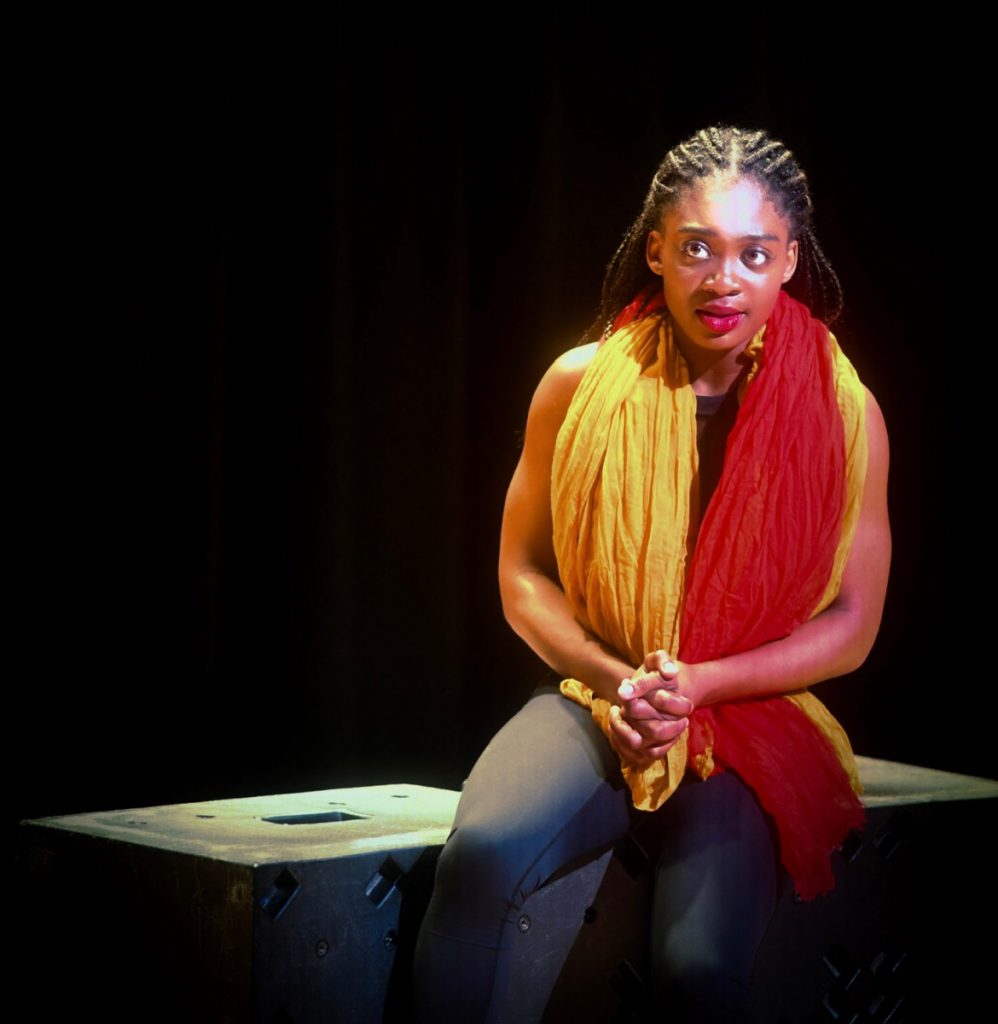
When Ntozake Shange wrote for colored girls who have considered suicide / when the rainbow is enuf in the 1970s, she intended the piece to be performed by an ensemble of seven actors. More than half a century later, Chautauqua Theater Company Conservatory Actor Mengwe Wapimewah is reimagining Shange’s play for a cast of one.
“It’s a piece that I’m pretty sure every Black actress has come into conversation with at some point during their career, because there’s a lot of great text, there’s a lot of great monologues, a lot of great poems which span the ages of eight years old to 60, 70 years old, and it covers a lot of the trauma that Black women endure in the world — abortion, rape, emotional [and] physical abuse — but there’s also a lot of joy and love in there,” Wapimewah said.
Wapimewah decided to become the first woman in history to perform for colored girls as a one-woman show while in her last year of graduate school at the University of North Carolina at Chapel Hill. Through conversations with Vivienne Benesch, former artistic director of Chautauqua Theater Company and current artistic director of PlayMakers Repertory Company at UNC, and Tia James, one of Wapimewah’s professors, the actress began pursuing the seemingly unattainable dream of performing for colored girls on her own.
“Whenever something seems impossible, I want to do it,” Wapimewah said. “I was like, ‘This seems absolutely impossible to play seven different women and all these life experiences that I haven’t had yet … Let’s do it.’”
Wapimewah performed her rendition of the play twice in North Carolina and is reprising the show at 10 p.m. tonight in Roe Green Theater Center for an audience of Chautauquans.
“How do you find the ensemble nature of this piece in a single vessel?” Wapimewah said. “That’s where Tia and I started: how do we find and highlight all these seven different women in one body? My initial philosophy, which developed into how I approach the piece, is that all these women are present in me … and understanding that I’m using my vessel as a conduit for all these women was a fun experience.”
Amid the challenges of performing this one-woman show, Wapimewah has also been reconciling with the intensity of the stories she is bringing to the stage; she said the emotional weight of that responsibility has been as empowering as it has been demanding.
“It is an honor to be able to give voice to someone who isn’t able to give voice to their situation,” Wapimewah said. “There are a lot of domestic violence victims who haven’t survived. There are a lot of Black women who don’t feel safe enough or don’t have the confidence to tell their stories … so finding the truth in the language has been something that I’ve really been able to allow that to guide me.”
In addition to drawing on the language of the script, Wapimewah has also found herself inspired by the movement that lies at the center of the piece, which Shange defined as a “choreopoem” — a combination of poetry, dance, music and song onstage.
“I’ve been dancing since I can remember, and that’s a way that I use to communicate because I have social anxiety and autism,” Wapimewah said. “… More often than not, I can trust my body to guide me, so when I found out that this was not just a play, it was a choreopoem specifically and movement is integral to telling the story, I was like, ‘Movement is integral to my existence’ … The fact that you can’t do this piece without having movement, it drew me to it even more.”
Through spirited movement, dance and language, Wapimewah will bring these seven women to life onstage for one night only. Compared to a traditional run of multiple weeks or sometimes months, the duration of this play at Chautauqua comes with its own implications for the actress.
“I get to share this experience and bring these girls and these women to all these different people just one time, which means I’m going to be as present as possible because I don’t know when I’m going to get to do this again,” Wapimewah said.
Whether this is the last time for colored girls is performed as a one-woman play, or Wapimewah’s bold iteration inspires a theatrical shift for productions of the choreopoem, she said she encourages Chautauquans to witness and learn from the stories she will bring to the stage tonight.
“Black women suffer the most in this world, and I think Ntozake did a beautiful job of articulating a lot of the things that we experience, and our stories aren’t often given the platform to be shared,” Wapimewah said. “One of the poems says, ‘Sing her song of life, sing a song of her struggles, her possibilities, her cares, her hard times.’ I think it’s important to give Black women the opportunity to speak and to move and to exist in this world and to be seen.”