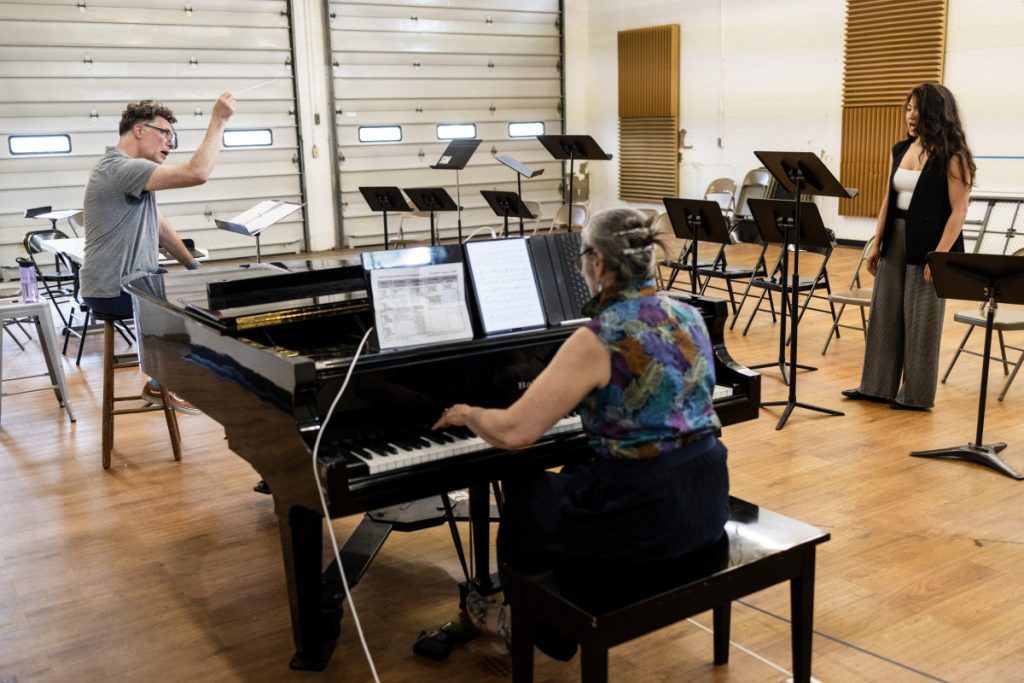
Apprentice Artist Kelsey Watts, soprano, rehearses for Chautauqua Opera Company’s performance of A Prayer for Owen Meany conducted by General and Artistic Director of Chautauqua Opera Company and Conservatory Steven Osgood Saturday in Jane A. Gross Opera Center.
LAYLA VINSON
Staff Writer
Based on John Irving’s felicitously selected novel, A Prayer for Owen Meany, Chautauqua Opera Company’s operatic workshop will follow its partner workshop, Anne of Green Gables, beginning at 3:15 p.m. today in Fletcher Music Hall for the penultimate day of the 2026 Opera season. 2021 Grammy Award nominee Luna Pearl Woolf and 2017 Pulitzer Prize winner Royce Vavrek have rekindled their partnership as composer and librettist to bring the unmistakably distinct voice of Owen Meany to the Chautauqua Institution stage.
“[John Irving] said Owen Meany is the one [novel] that was always envisioned as potentially having another life as an opera,” Woolf said, highlighting the early stages of work for the project in her initial meeting with Irving several years ago. “And that was very exciting because that was sort of where I was coming from; I’ve also felt as though it belongs to the operatic world.”
Following childhood friends and foils Meany and John Wheelwright, the story explores the lives of two boys struck by tragedy within their small New Hampshire town and beyond. Described in the novel as having an “emphatic falsetto,” Meany’s voice serves as a striking and integral element of his characterization.
“His voice is so important in terms of his identity, in terms of how people think of him and in terms of how he surprises them. He surprises every character, and they’re shocked by him in different ways,” Woolf said. “His power is a very, very small person with a very, very large presence, and part of that is his voice. You could describe almost any opera singer like that, as long as they’re in a big hall.”
Deeming Meany and opera singers as individuals capable of performing “superhuman feats,” Woolf explained that Meany’s voice has served as both an initial draw to the story and a challenge to cast.
“The question of, ‘How do you represent that [voice] within a context where everybody is singing and everyone’s an opera singer?’ — that has been an interesting question and this workshop is going to serve to challenge that and whether I’ve hit upon the right formula,” Woolf said, explaining that the scenes being presented in today’s workshop will largely be exploratory and introductory to the characters.
Between experimenting with gender-bending and grunge rock songs in operatic style, the Young Artists have tackled the workshop with expressed excitement to work alongside Woolf and Vavrek.
“It’s a little more difficult to be dropped in the middle of something without really hearing the rest of the context,” said Sydney Dardis, the soprano playing Tabitha Wheelwright, regarding working on a workshop compared to a full-length production. “But also exciting because we’re kind of the first ones to discover this, so I’ve been enjoying it.”
Offering audiences insight into the developmental process, the workshop will feature approximately 35 minutes of music bookended by brief conversations with Woolf regarding the material.
“What is being tested in that book is belief and faith, and belief in one’s meaning, in one’s purpose,” Woolf explained, refuting claims that the text argues on behalf of any particular religion. “The fact that Owen Meany himself is so confident and so sure that he has a role to play and that he knows exactly what it is and exactly how he’s supposed to go about living in order to be there at the right moment to do the thing he’s meant to do — very little of that has anything to do with that ritual, right? It’s all a question of identity.”