Missy Mazzoli: Orpheus Undone
American composer and pianist, Missy Mazzoli, was born in Lansdale, PA on October 27, 1980. She studied at the Yale School of Music, the Royal Conservatory of the Hague and Boston University. Her teachers have been David Lang, Louis Andriessen, Aaron Jay Kernis, Martin Bresnick, Martijn Padding, and John Harbison. Having previously taught at Yale, she is now a member of the composition faculty at the Mannes College of Music. Mazzoli has received critical acclaim for her chamber, orchestral and operatic work. She is also the founder and keyboardist for Victoire, an electro-acoustic band dedicated to performing her music. Her music is published by G. Schirmer. Mazzoli also served as Mead Composer-in-Residence with the Chicago Symphony Orchestra. Chautauquans are especially excited about her new opera, Lincoln in the Bardo, which was workshopped at the Chautauqua Institution during the 2025 season, and which will be performed this Fall at New York’s Metropolitan Opera. The opera is based on the award-winning novel by George Saunders with a libretto by longtime collaborator Royce Vavrek. Orpheus Undone is a Suite derived from Mazzoli’s 2019 ballet, Orpheus Alive, and was commissioned in 2020 by the Chicago Symphony Orchestra. The Suite comprises two sections and is scored for 2 flutes (piccolo), 2 oboes, 2 clarinets, 2 bassoons (contrabassoon), 4 horns, 2 trumpets, 2 trombones, bass trombone, tuba, percussion, piano, harp, and strings.
Missy Mazzoli’s 2019 ballet, Orpheus Alive, is a reimagination of the myth about the Thracian demigod, composed in collaboration with choreographer Robert Binet and playwright Rosamund Small. According to a program note on the composer’s website, the ballet “turns the traditional Orpheus myth on its head; Orpheus is a woman who creates the ballet as it unfolds around her. She creates a stunning offering to the audience, who have been cast as the gods of the underworld, ready to decide her fate.” Interestingly, American composer, Matthew Aucoin, premiered an opera in 2019 entitled Eurydice, a work that also offers another fresh perspective on the Orpheus myth. Indeed several of the earliest operas from the late 16th and early 17th centuries dealt with the same subject, most notably Claudio Monteverdi’s Orfeo of 1609.
Orpheus Undone comprises two movements entitled, respectively, Part 1: Behold the Machine (O Death) and Part 2: We of Violence, We Endure. They follow one another without pause. The titles are derived from two of the fifty-five sonnets written in 1922 by poet Rainer Maria Rilke entitled Sonnets to Orpheus. The first part of the work depicts and interprets the moment in the Orpheus myth in which Eurydice, Orpheus’ betrothed, dies due to a serpent’s bite. The second part concerns Orpheus’ decision to descend into the underworld to retrieve Eurydice. As the composer explains, “this work explores the baffling and surreal stretching of time in moments of trauma or agony.”
Program Note by David B. Levy, ©2026
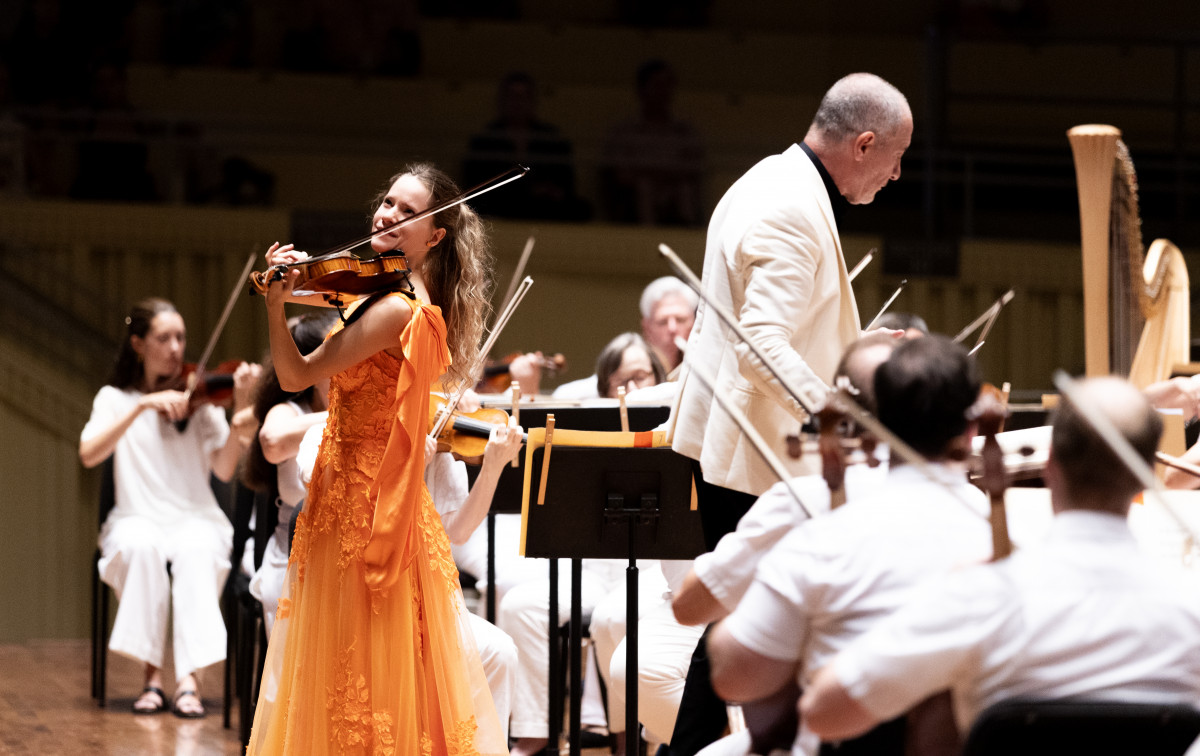
Antonin Dvořák: Concerto in A Minor for Violin and Orchestra, Op. 53 (B. 96/108)
The Czech master Antonin Dvořák was born inNelahozeves, near Kralupy, on September 8, 1841; and died in Prague, May 1, 1904. B. 96/108 refers to Jarmil Burghauser’s thematic catalogue of the composer’s works, analogous to thematic catalogues such as the ones created by Kőchel for the works of Mozart. Dvořák composed his Violin Concerto between July and mid-September, 1879, and was revised in April/May, 1880. Its premiere took place in Prague on October 14, 1883 with František Ondřĭček as soloist and Mořic Anger leading the National Theater Orchestra. It is scored for solo violin, 2 flutes, 2 oboes, 2 clarinets, 2 bassoons, 4 horns, 2 trumpets, timpani, and strings.
Less well-known than his magnificent Cello Concerto, Dvořák’s Concerto for Violin contains all the qualities of its sister work—tunefulness, the spirit of Czech dance idiom, drama. and opportunities for plenty of virtuosic display. The reason for the gap between its date of composition and first performance, as well as its publication, was due to the fact that the composer had written the concerto in the hopes that it would be accepted by the one of the nineteenth-century’s most celebrated violinist, Joseph Joachim. This Hungarian virtuoso and composer had long been associated with Johannes Brahms. It should come as no surprise, then, that Dvořák, a beneficiary of support from Brahms, would approach the man for whom Brahms had composed his own Violin Concerto in 1878. At first, Joachim was receptive to the idea, but kept on putting off acceptance of the concerto and its dedication, suggesting that Dvořák make several revisions. But Dvořák was only willing to go so far, however, and finally his patience grew thin. He turned to his fellow countryman, František Ondřĭček, who was more than happy to give the concerto its premiere performance. It is ironic that Joachim, who never performed the work in public, remained its dedicatee.
Cast in the traditional three movements, Dvořák’s Concerto does contain a few unconventional features. The pithy dramatic opening gesture of its first movement (Allegro ma non troppo), played by the full orchestra, is immediately answered by the soloist introducing the movement’s principal theme, followed by a quasi-improvised flourish of arpeggios. The gesture is repeated again on a different harmonic level and a full-scale orchestral tutti ensues, including a hint of a new and more lyrical theme. Perhaps inspired by Mendelssohn’s Violin Concerto, Dvořák makes no break between the first movement and its central one, an expansive Adagio ma non troppo, in F Major. Right from the start the composer presents the listener with one of his most beautiful themes. Some dramatic moments follow, but the lyrical sweep of its main theme dominates the sonic landscape. The finale (Allegro giocoso, ma non troppo) is a playful rondo whose principal dance-like theme is a blend of Czech folklorism with more than a hint of inspiration from the finale of Beethoven’s Violin Concerto. This takes nothing away from Dvořák’s originality, however. One of the secondary themes of the movement plays metrical tricks of three-beats against duple groupings that were a signature feature of Slavic folk idioms. But it is the sheer joyfulness of the opening theme that wins the day.
Program Note by David B. Levy, © 2022
Kevin Puts: Concerto for Orchestra
American composer Kevin Puts was born on January 3, 1972 in St. Louis, Missouri. He studied composition and piano at the Eastman School of Music (BM and DMA) and Yale University (Master’s). His composition teachers include Samuel Adler, Jacob Druckman, David Lang, Christopher Rouse, Joseph Schwantner, Martin Bresnick, William Bolcom, and Bernard Rands. He taught at the University of Texas, Austin from 1997 to 2005. In 2006 he joined the faculty of the Peabody Institute of Johns Hopkins University in Baltimore. He studied at the Tanglewood Festival in Massachusetts and has been associated with several of the most important summer music festivals, including Aspen and Cabrillo, and he has been composer-in-residence with the Fort Worth Symphony in Texas. He has an equally impressive number of awards and fellowships to his name and continues to receive commissions from prestigious artists and performing arts institutions. His opera Silent Night was awarded the 2012 Pulitzer Prize following its 2011 premiere by Minnesota Opera The Deutsche Grammophon recording of his triple concerto composed for Time for Three, Contact, with the Philadelphia Orchestra and Xian Zhang, conductor was awarded “Best Contemporary Classical Composition” at the 2023 Grammy® Awards. Mr. Puts was named Musical America’s Composer of the Year in 2024. His Concerto for Orchestra was composed in 2023 to fulfill a joint commission from the St. Louis Symphony Orchestra, the Minnesota Orchestra, and the Cabrillo Festival of Contemporary Music. Its first performance took place on January 21, 2023 with Stėphane Denève leading the St. Louis Symphony Orchestra. It is scored for 3 flutes (piccolo), 3 oboes, 3 clarinets, 3 bassoons, 4 horns, 3 trumpets, 3 trombones, tuba, timpani, percussion, harp, and celesta.
The composer provides the following program note to his Concerto for Orchestra:
Concerto for Orchestra grew out of my friendship with conductor Stéphane Denève. It is dedicated both to him and to the musicians of the Saint Louis Symphony Orchestra, for whom I have developed great admiration since their first performance of my music in 2004. The creative entry point for me was the discovery of young Amanda Gorman’s beautiful poem “Hymn for the Hurting” written in response to the horrific school shooting—an occurrence now routine in our country—in Uvalde, Texas in May 2022. The music at the concerto’s opening—recalled briefly at various places throughout the piece—is my immediate musical reaction to it. The title of the second movement, “Caccia”, is a reference to the 14th century musical form depicting the hunt or the chase and flows directly from this opening hymn. It continues the opening movement’s focus on the various groups of instruments in the orchestra beginning with the oboes and punctuated at all times by the orchestra’s three percussionists who play identical collections of six drums. “Music Box with Arietta”, by contrast, explores the gentler side of the percussion section, led here by cascading gestures played by the harp and celesta, giving way to a lyrical counterpoint of woodwinds. “Toccata” is a quick exchange between the strings, the winds, and the percussion. Eventually the brass section asserts itself, cutting across these exchanges with brash, angular lines. A brief refrain of the opening movement leads to a gentle “Siciliana” featuring nearly all instruments in the orchestra in lyrical ways, perhaps most prominently the piano. Another refrain introduces the final movement, another “Caccia”, this one containing a brief quotation from the Mozart opera which inspired it.
Program Note by David B. Levy/Kevin Puts ©2025/2026