

Jeffery and Suzanne Watters stand front of their home Tuesday on Longfellow Avenue. The Watters designed their home through local sourcing and other sustainable practices to minimize their environmental impact and prioritize environmental health.
JENNA OUTCALT
Staff Writer
Chautauqua Lake is an essential part of the community, providing an opportunity for boating, swimming, relaxation and education. However, the lake is not immune to environmental threats, including influxes of nutrients picked up by rainwater that run into the lake. Throughout Chautauqua, homeowners are thinking creatively about how their own yards can help the lake remain as healthy as possible.
At the north end of the lake, Justin Stewart and Mamie Kanfer have transformed their yard into a system of streams and cisterns that turn rainstorms into their own babbling brook.
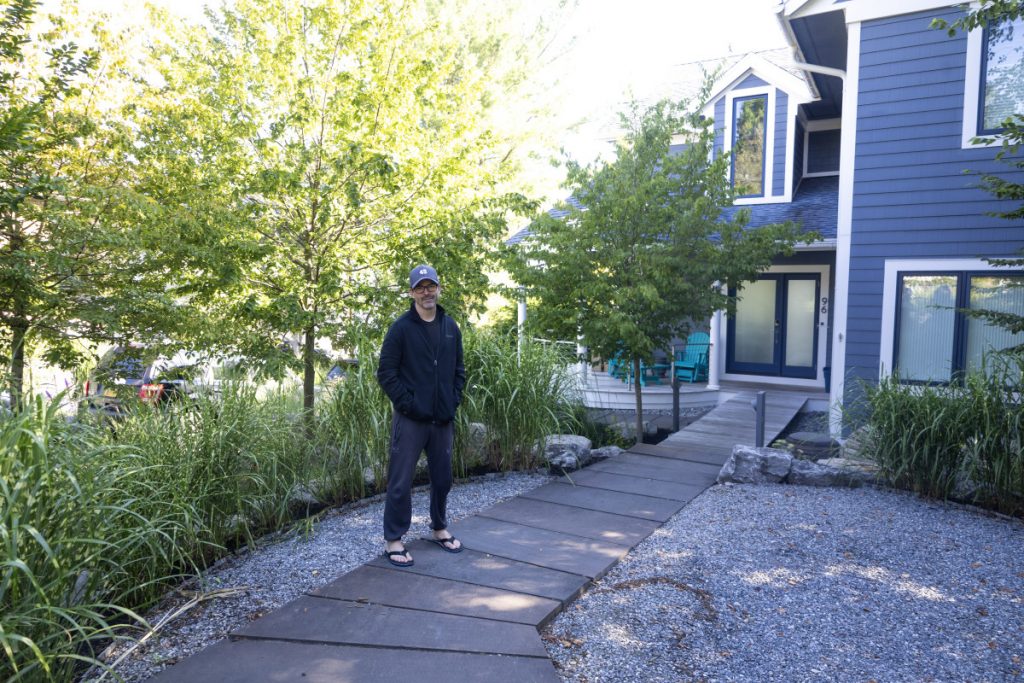
Justin Stewart stands in front of his home July 31. During the landscaping and renovation process, Stewart designed the property to capture as much rainwater as possible.
“Having a way to grab the rain and activate the landscape while it’s raining, it really just makes the whole experience better,” Stewart said.
In the couple’s front yard, rainwater flows through carved-out streams in the front yard. At various points, water can seep into underground cisterns, then continue on if enough rain falls to fill each cistern.
When rainwater flows into the lake, it carries nutrients from the ground that encourage algae and plant overgrowth. Stewart said using permeable surfaces to absorb rainwater and engineered landscapes to divert it is not only healthier for the lake, but also a way to deepen connection to the environment.
“If you grab that water, put in a pipe and send it into the lake, you’re missing an opportunity to engage with it,” he said. He said that although people did not understand how the yard worked at first, they now seem to enjoy the unique view.
“I think it looks great from the street now,” Stewart said. “But it’s much more unconventional.”
The lake-facing backyard has natural growth extending to the water, with young trees spotted throughout the yard.
“As these trees grow in, they’ll make a little canopy over it,” Stewart said. “It just brings down the scale and makes everything a little more intimate as you’re coming off the street.”
Stewart said the trees and landscaping enhanced the view of the lake rather than obstructed it.
“The lake is beautiful, but if you just have (the) lake, it’s like having a painting with only background and no foreground,” he said.
Stewart and Kanfer bought their house in August 2020 and finished landscaping and renovations in June 2021. Stewart, who worked in design and construction for 10 years, said he drew inspiration for the project when he helped his in-laws, who live only a few houses away, set up their own property with stormwater management in mind.
“I took those goals and was like, ‘Okay, we’re just going to slow down as much of the water and keep it as much of the water going underground as we can to slow it on its way to the lake,’” Stewart said.
Stewart emphasized that everyone wants the lake to be healthier, and ensuring his property helped keep the water healthy was “like paying the lake tax.”
“I think that we all need to do our part to make the interventions that we can to make our local area better,” Stewart said. “And these were my interventions that I wanted to make.”
On the southern end of the lake, Suzanne and Jeff Watters’ house sits atop the hill overlooking the John R. Turney Sailing Center. The Watters have been coming to Chautauqua for about 20 years, and the couple bought their current home almost a decade ago.
“I really believe we’re in a crisis situation with what’s happening with the environment,” Suzanne said. “I think it’s something people really need to start thinking about.”
The Watters’ house does not use any fossil fuels and is built with energy efficiency in mind, from the windows and doors to the thermal insulation to keep it warm in the winter. However, the Watters said they also tried to prioritize sustainable design inside the home.
“We really thought a lot about reuse. Some of the furniture that’s here we reused, and there’s recycled material … like the flooring and a lot of different elements of lighting,” Suzanne said. “And then another really important piece is trying to source everything as locally as possible.”
The Watters offset about 50% of their energy usage with solar panels on the roof. They’ve also reduced the number of cars the family uses down to one, which is mainly used for long-distance travel.
“We’re doing everything we can to manage down our consumption through choices big and small,” Jeff said.
Beyond the walls of the Watters’ house, brush and wildflowers frame the view of the lake. The yard is almost entirely composed of native plants, with more and more wildflowers coming in to support pollinators every year, Suzanne said.
The property also includes rain gardens and a permeable driveway to absorb water during storms, preventing runoff from reaching the lake. The Watters said back when they were renovating the property, it was hard to even find contractors who were familiar with the designs they wanted.
“Hopefully, as more people start to want to build this way and want to have driveways like this, there’ll be more contractors out there to make it easier,” Suzanne said.
The Watters said they have seen trends moving towards more environmentally friendly lawns, especially in Chautauqua.
“The more you can visibly manifest that, which is what we’re trying to do here, the better, because it gives people an actual frame of reference to unpack and connect the dots between the words and concepts and what reality might look like for those of us that have stepped from the concept into actual implementation of it,” Jeff said.
Jeff said they were very conscious of how whatever choices they make on their property “will have a direct bearing” on the lake.
“We were very mindful as we began the rebuilding of this property that we had an opportunity here to be stewards not only of the immediate environment that this footprint resides on,” Jeff said, “but because of the land that we own, we had a real responsibility to ensure that the landscape design thinking accounted for the lake and the ways in which our property might interact with the lake.”
The Watters emphasized the importance of the lake to Chautauqua Institution as a recreational touchstone to round out the intellectual offerings.
“I think this place minus the lake is every bit as big a question mark as this place without the Amphitheater,” Jeff said.
He said the lake is at an “existential risk” if the community turns its back on it.
“We’re all the lesser for it if we can’t figure out a way to sustain the lake as a bridge to helping the lake thrive at some point 20, 30, 40 years from now,” Jeff said. “I think it’s a long journey.”
Suzanne said Chautauquans in particular have a responsibility to be leaders in lake health.
“It’s kind of who we are as lifelong learners and as people who just care for each other in community and care for the planet,” she said.
Suzanne also uses art to consider humans’ connection to the environment. She works with a variety of mediums, including sculpture, textiles and painting. Suzanne explained that as she realized how many resources were used in common art mediums, she shifted to using things she found in the natural world and reused materials for her pieces.
“I feel like as a society we’ve moved too far away from nature and we’re almost detached from it,” she said. “So I try to, in my own making, think of ways to signal more coming back to a connection with the
natural world.”
The Watters emphasized how much the lake meant to them as a place that their family could enjoy for years to come.
“We wanted to build a multi-generational happy place for our family, but we also wanted to do so in a way that could almost serve as a benchmark or a standard for others to follow as we thought about doing the right thing by the planet,” Jeff said.
Suzanne said the home was a valuable counterbalance to the rest of the year in New York City.
“This is our happy place in part because of the intellectual and cultural pursuits that it affords us,” Suzanne said, “but also because of the simplicity and the meditative refuge that this home overlooking the water represents to us.”