
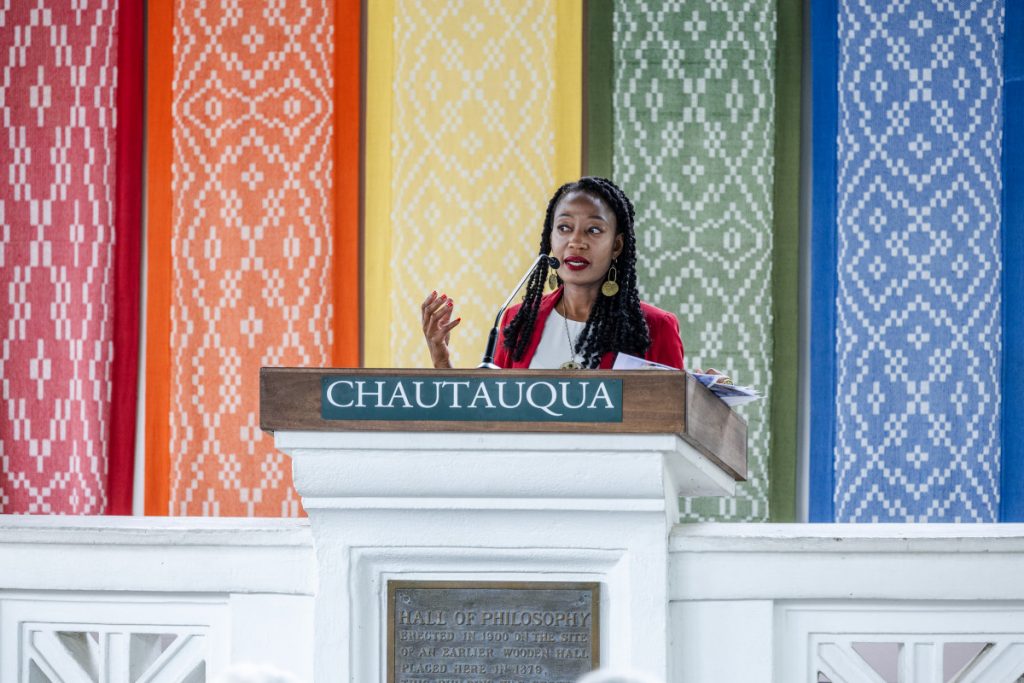
Miami University Global and Intercultural Studies Professor Naaborle Sackeyfio speaks about human interconnectedness through spiritual tradition Wednesday in the Hall of Philosophy.
LILY RESLINK
Staff Writer
At 2 p.m. Wednesday in the Hall of Philosophy, Naaborle Sackeyfio spoke about how religion and spiritual tradition can shape responses to human rights, migration and climate change.
She said understanding human interconnectedness through this tradition can “give us the moral courage to act with compassion … through reimagined dialogue that moves us those 12 inches from the mind to the heart.”
In her first of three points, she said, “Observations on human rights, migration and climate change require a new approach that centers inner development goals — a matter of collective wellbeing for which faith and spiritual tradition are well-tailored to address.” Within this point, she explained how “inner development goals” can support sustainable transformation.
For her second point, she said each of these three challenges result from forgetting intrinsic human nature. Her third point articulated the need to lessen global dissonance through dignity-based frameworks, which she said come from humans remembering “our individual and collective energy currency.”
She explained how the plurality of views she was introduced to in West Africa laid the groundwork for her beliefs and scholarship; although not religious, she has identified a role for religion in combatting contemporary challenges.
“It is alarming to see what appears to be the crumbling framework of global norms and respect for human rights,” she said.
Individualistic ideas prevent an understanding of human interconnectedness, she said, and because humans are responsible for others’ welfare, she began using a framework centered on “using inner development to power outer change and transformation.”
According to Sackeyfio, “embodiment” provides a starting point to approaching social and spiritual divides within humanitarian and ecological issues.
She related these issues to authoritarianism, crimes of international law, repression of protests, mass deportation of refugees, racial discrimination and displacement of people across borders.
She said policy has accelerated the “doomsday clock,” and the need for a changed approach is dire.
“Let’s return to human rights,” she said. She pointed to areas of incongruity and imperfections that inhibit progress and pose some challenges, but affirmed her view that the global framework of human rights is worth upholding.
“Because human rights, migration and climate change, broadly speaking, are in fact human security problems, they really have to do with our collective well-being,” she said.
In thinking of Earth as “an international community,” she asked how to navigate rights, responsibilities and protections she said are necessary.
“Faith and spiritual worldviews matter because they offer belief systems that remind us of what’s sacred,” Sackeyfio said.
She pointed to examples of faith-based networks that met needs by acting from values of hospitality and refuge across faith traditions and emphasized dialogue as a driver of peace when it is “embodied” by these values.
“Recognizing our energy currency, recognizing inner development goals and recognizing the potential for citizen action, citizen diplomacy, requires embodied approaches that move from the macro to the micro and in between,” Sackeyfio said.
She emphasized the importance of achieving progress through humanization, and said forgetting humans’ state of “interbeing” deepens fractures in global frameworks.
“All faiths and religions have pathways that point to something inner — to the sacred in us that we can bring out to deal with the present moment,” she said.
Sackeyfio questioned human responsibility in a modern life “organized around extraction” and noted the timeless challenge in finding “balance between what we take from the biosphere and what we leave for our descendants.”
“In our vast chain of existence is this beautiful chain of reciprocity of giving that everything around us is life-giving, life-affirming, yet we create death worlds,” she said.
She said bridging intellect and heart is part of the promise of faith and spiritual tradition, which is necessary to support “a flourishing planet in which we respect the dignity of all persons.”
“How do we ensure that justice isn’t occurring at a distance?” she asked, pointing to the contemporary challenges that some audiences may be detached from. Sackeyfio said part of the hope that faith and spiritual tradition can offer is “tools for individual and collective engineering for outer change.”