NORA SMITH
Staff Writer
Spoiler alert: we are eating the earth, both figuratively and literally.
According to award-winning journalist and bestselling author Michael Grunwald, the food system — the amount of agricultural land in the world and therefore continual growth of it — makes up “the biggest environmental issue we face.”
“Agriculture is the leading driver of deforestation,” Grunwald said. “It’s the leading driver of wetland destruction, it’s water pollution. Agriculture uses 70% of our fresh water, so when we have water shortages, that’s agriculture.”
Grunwald said because fossil fuels are the biggest cause of climate change right now, there are so many books on both energy and fossil fuels; but, food and agriculture are a third of the climate problem, and there is a lack of knowledge around it.
“It’s definitely not a third of our climate discussion,” Grunwald said. “I think, at least with energy, there’s this kind of feeling, like, people know it’s a big problem. We’re actually starting to solve it in some ways, I mean, not fast enough, but most new power plants are now clean energy. But food and agriculture, my feeling was like, ‘Not only are we not solving the problem, most people don’t even know it’s a problem.’”
Grunwald said despite having been a reporter for a couple of decades and having previously written about the environment, he didn’t know much about the issue agriculture poses.
“I felt like I had been writing about climate essentially for 20 years and I didn’t know about [the environmental impact of agriculture] . . . I really felt like if I didn’t know squat about the problem, then probably others didn’t,” Grunwald said.
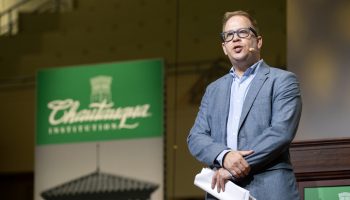
Grunwald said he spent five years immersing himself in the issue of agriculture and writing about potential solutions for his book titled, We Are Eating The Earth, which he will present in his lecture at 10:45 a.m. today in the Amphitheater.
Grunwald said most people think the extent of the connection to their food and the environment is that they should eat organic foods, like regenerative beef.
“Without trying to give away too many spoilers, that’s wrong,” Grunwald said. “That’s often even worse for the environment and the climate, and because you can imagine, a lot of people are angry about the things I found, but I can honestly say that I didn’t come into it biased because I didn’t know anything. It wasn’t like I had preconceived notions; I had no notions.”
Unlike the proposed solutions to resolve environmental issues like fossil fuels and energy, Grunwald said the agriculture issue is much more complicated. In addition to people thinking eating organically will solve the issue, they also think decreasing food waste will resolve the issue. Although both can solve some problems, neither is a sustainable solution.
“The world ate 350 million tons of meat last year, and it’s on track to eat 70% more by 2050, so it’s like, how’s that going?” Grunwald said. “You can’t really just sort of ‘hand-wave’ it away.”
Grunwald said the main challenge in combating the environmental issue caused by agriculture is to pursue solutions that produce more food but require less land and result in less of a mess.
“It’s a really hard problem, and that’s why that’s a very long answer to why [these problems] haven’t been solved; if it was easy, it would have been solved already,” Grunwald said. He added that the most powerful industry in America is the agricultural lobby, and cited this as one of the biggest reasons these issues have yet to be resolved.
“Change is hard,” Grunwald said. “In the U.S., whether you’re a right-winger or a left-winger or a buffalo winger, it doesn’t really matter. Everybody says, ‘Oh, you know, farmers, they’re the heartland of the country. They’re these hardworking, good-hearted people, and essentially, it’s sort of a race between the parties to throw as much money at them as possible and to protect them from environmental regulations.”
Grunwald said he often returns to the idea that change is hard in his work.
“All of my books have been about change in one way or another,” Grunwald said. “It’s kind of what I’m interested in, and the answer is always that change is hard but not impossible. So, I’m going to keep banging my spoon on my high chair about it.”
Because Grunwald has presented this uncomfortable truth, he said, in the food world, he has found many people are angry at him; however, most people interested in “big problems and people curious about food” are the readers who support him. He said he hopes open-minded and curious people at Chautauqua will want to learn more about the issue.
“Food is political, food is cultural, food is personal — like, we vote on these issues three times a day, and people feel really connected to their food. I always try to make it clear that I’m not telling people what to eat or how to live,” Grunwald said. “I’m just trying to explain that these are really big problems, and we can’t just keep ignoring them.”