
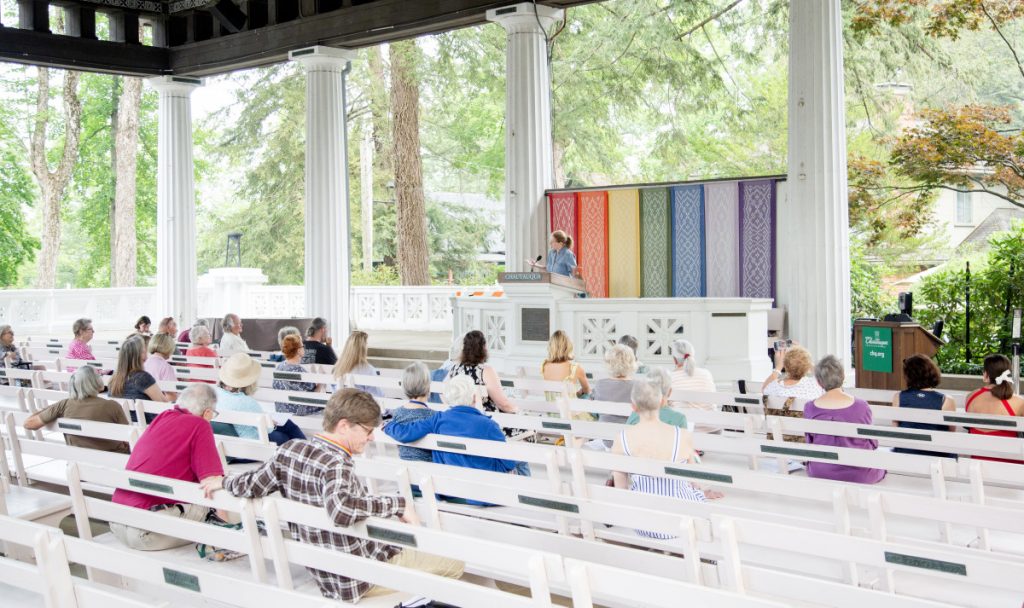
Sarah Rosen reads “The Breeze at Dawn/Be Your Note” by Rumi on Aug. 4, 2025 in the Hall of Philosophy. Rosen connected the poem to her interfaith family, with her being Christian and her husband and children being Jewish. To “finish the circle,” Rosen’s family named their dog Rumi to honor the Muslim faith.
NORA SMITH
Staff Writer
Norma Rees, longtime member and volunteer for the Friends of the Chautauqua Writers’ Center and Chair of the Robert Pinsky Favorite Poem Project, said when Robert Pinsky, poet laureate of the U.S. from 1997 to 2000, realized poetry was too exclusive and often only appreciated by academics and educated people, he wanted to bring poetry to everyone.
“[Pinsky] started the Pinsky Project by inviting everyday people off the street who might have a favorite poem that they wanted to share,” Rees said.
Georgia Court, longtime supporter of literary arts at Chautauqua, first brought the project to the grounds in 2008. This is the 18th year Friends of the Chautauqua Writers’ Center will host the Annual Robert Pinsky Favorite Poem Project, which will take place at 3:30 p.m. today in the Hall of Philosophy.
“There’s love and loss and horizons and adventures, and everything comes out in poetry; and now … in these troubled times or divisive times, artists are really being called on to spread the message, and poets are really in one of the leading edges of that movement,” Rees said.
Each year, selected Chautauquans read their submitted favorite published poem and briefly explain its meaning to them and why they selected it.
“We try to go around and beat the bushes and get the bus driver and the newspaper salesgirl and the lady out at the coffee shop,” Rees said. “We try to get everyday people to read their poems.”
Rees said she’s always curious about which poems Chautauquans will choose; she and longtime member and volunteer for the Friends of the Chautauqua Writers’ Center Bethanne Snodgrass sift through the submissions together.
“Some of it’s humorous, other times it has a very personal meaning — like it might be about loss, for example, and there’s a wide range,” Snodgrass said.
When Rees and Snodgrass dive into the submitted poems, they said they try to include everyone, with a balance of young people alternating with older readers, to maintain a variety of everyday people.
“We’re always encouraging the next generation, too,” Snodgrass said. “Let their voices be heard.”
Rees echoed, “Let their choices be heard,” and added that it’s always interesting to see what certain age groups select as their favorite poem. In addition, Rees said multiple people have even begun their own Pinsky Poem Project at home.
“It’s a great project,” Rees said.
Snodgrass mentioned Sony Ton-Aime, former Michael I. Rudell Director of Literary Arts, for his efforts to promote poetry while in his role at Chautauqua. In addition, both Rees and Snodgrass mentioned projects like Poetry Makerspace and the Weekly Community Poem.
“All these things seem like separate things, but they’re not really,” Snodgrass said. “They’re all building out of this desire to promote poetry within the organization, but literary arts as a separate art form really was not promoted here for a long time, and that’s really why Mary Jean Irion started the Writers’ Center and to put it on par with the music, the theater and the visual arts.”