NORA SMITH
Staff Writer
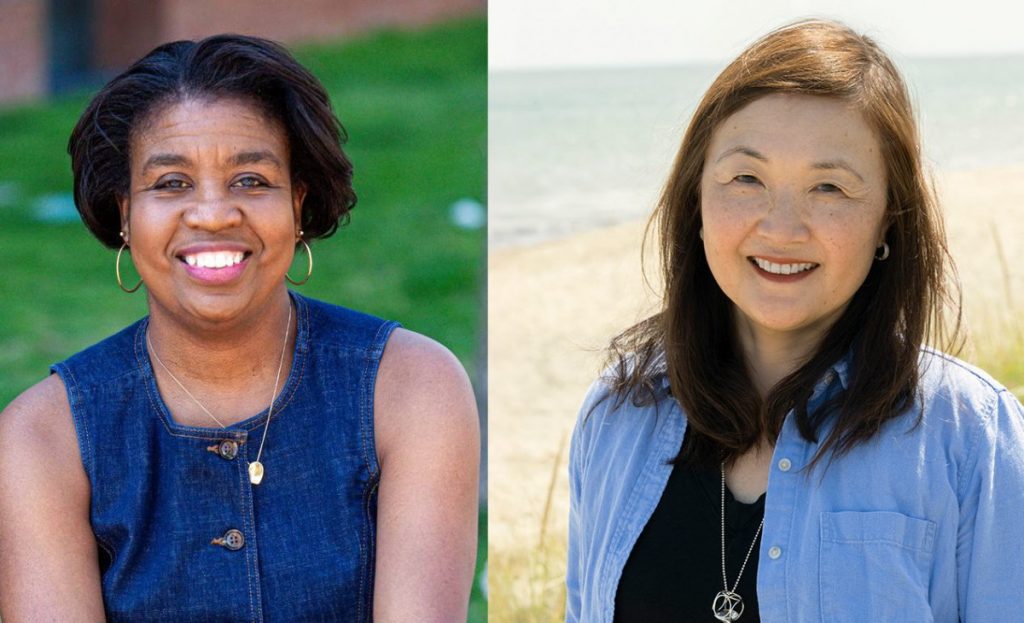
January Gill O’Neil, poet and professor at Salem State University, and Jimin Han, novelist and professor at Sarah Lawrence College, hope to leave Chautauquans with newfound confidence in writing as they close out the 2026 Chautauqua Writers’ Center Season.
“Poetry is my core, and I always say, ‘No matter what people are doing, whatever their center is, whatever it is that they get up in the morning for, to honor it,’” O’Neil said. “‘Find time to honor these parts of you that need a little more love and care.’”
O’Neil said poetry alone is a great foundation for generating dialogue, and the act of writing allows writers to immerse themselves in past experiences, something she wishes more people had the chance to do.
“I often say how lucky we are that sometimes we get to experience these joyful moments or difficult moments twice,’” O’Neil said. “We live it when it happens, and then we get to pick it apart and turn it into art and release it, and I think that’s an amazing part of being a writer. It’s true for any artist.”
Michael I. Rudell Director of Literary Arts Stephine Hunt said O’Neil is a brilliant poet and specifically noted O’Neil’s most recent collection, Glitter Road. Hunt said having O’Neil in attendance is a great opportunity for Chautauquans to potentially reintroduce themselves to her work if they have encountered it, because she’s been to Chautauqua before, but it’s also a chance for those who aren’t familiar with O’Neil’s work to learn something new.
“Anyone who hasn’t encountered her yet, at the end of our Summer Assembly season, what better way to wrap up your writing experience here than a note to say, ‘This may be the end of the summer, but you can begin again here and take something away that gets you started on a new path,’” Hunt said.
Hunt said with Han’s book Dreamt I Found You being a 2026 Chautauqua Literary and Scientific Circle Unbound Selection, this is the first time an Unbound author will join Chautauquans on the grounds in a different program.
“Since Jimin has worked with us in so many different capacities, from Writers’ Center to Janus Prize Guest Judge, … it’s really just a delight and honor to celebrate her in this way as part of the CLSC and exciting to use the CLSC Unbound program to do so,” Hunt said.
Both O’Neil and Han will give a Free Faculty Reading at 3:30 p.m. Sunday in the Hall of Philosophy.
“[Stories] tell us who we can be and what we can aspire to and what we can expect for ourselves, and so that makes [stories] have such an enduring impact, and I’m interested in pulling back those layers to figure out, ‘Do you know why you think the way you do?’” Han said. She added that by examining these layers of a story, people might be able to understand one another better.
When teaching, Han said she encourages her students to think about who they’re writing for, and when writing Dreamt I Found You, Han wrote for her younger cousins because she wanted people in the U.S. and those in the Korean diaspora to know “The Tale of Chunhyang” and to know it through the perspective of someone with Korean heritage living in the U.S. and trying to understand it themselves.
Then, in The Apology, Han featured a discerning Korean woman because she said most of the time, Korean women are represented as grandmothers cooking in the kitchen, but these assumed boxes we put people in aren’t always the limits.
“I wanted them to be out there in the world for people to know,” Han said. She added that she is also interested in breaking out of boxes and assumptions that people make. She questioned why people must be defined and why someone has the ability to say what something should or should not be.
“If we have more experiences out there, by more diverse groups of people, then who we are as human beings can be seen in more complicated ways, and we can see that we can have more in common than not,” Han said.
Han said she finds herself returning to fiction for this explorative experience.
“It’s because fiction is immersive in a way that changes people’s perspectives,” Han said. “It changes their hearts and minds, and in a way, that is dangerous for some people.” She added that this power in fiction is why it’s the most-banned genre.
O’Neil said inspiration for Glitter Road began when she traveled to Mississippi on a fellowship as a John and Renée Grisham writer in residence at the University of Mississippi. She said it was “a completely new experience,” and at first, she didn’t have a book project and wasn’t sure what she’d work on.
Then, O’Neil learned of Emmett Till’s story, but it wasn’t until she attended the 2019 rededication ceremony of a memorial sign in his memory that his story became an inspiration for writing.
“We went down there, and once I was standing on the land watching these people who cared so much about this piece of history, saying, ‘Every time it comes down, it’s going back up,’” O’Neil said. “That gave me the resolve to think about Mississippi but also interact with the land, the people and to think more deeply about my connection to the enslaved.”
O’Neil said thinking about this connection was one of the most rewarding things she’s ever done for both herself and her family.
During the reading, O’Neil plans to read some poems from Glitter Road, her poem, “American Pokeberry,” published in the June 22 issue of The New Yorker and potentially a few poems from Valentine, an upcoming collection to be published in February 2028.
“I hope [the reading] encourages them to read more poems, to buy a poetry book — if not mine, someone’s — and support poets and writers…” O’Neil said. She added that there are so many great writers, but oftentimes not enough readers or supporters.
O’Neil’s generative poetry workshop, titled “Begin Again,” will run from 8:30 to 10:30 a.m. Monday, Wednesday and Friday from Aug. 24 to Aug. 28 in the Alumni Hall Poetry Room with an enrollment fee of $145 and a maximum of 15 participants.
Here, O’Neil plans to talk about poems of all sorts while encouraging participants to write regularly and to realize that poetry is for everyone; everybody can write.
“We’re always writing as we move through our spaces and we breathe and we rest and we walk, we’re writing all the time, so that by the time you’re ready to sit down and write, you’ve got that poem that you’ve always wanted to write, the one that bubbles up,” O’Neil said.
Han’s generative workshop, titled “Myths, Folktales, Family Stories, & You,” will run from 3:15 to 5:15 p.m. Monday, Wednesday and Friday from Aug. 24 to Aug. 28 in the Alumni Hall Prose Room with an enrollment fee of $145 and a maximum of 15 participants.
Han said it took her a while to feel comfortable enough to take the risk and put her own writing out there. So, when teaching classes or workshops, she tries to include aspects that she wishes she had to help guide others to tell their own stories.
“I believe everyone has a book in them, many books in them, and writing is one of those things that we all do,” Han said. “So, it feels like it’s just a little out of reach to some people, and I want to close that gap, and I want to show people they can do it.”
Han said most people have just been told, as she was, that “You either have nothing to say, or no one wants to hear what you have to say,” but for Han, the more voices that are out in the world, the more we all benefit.
In the workshop, Han said participants will do lots of generative writing exercises to try and get the editor out of their heads and to eliminate self-judgment when writing.
“If we know that stories have been around us forever and that we tell the stories all the time, then it becomes less intimidating,” Han said. “It’s really a community storytelling activity that we’re going to be doing, and we still have to make decisions about what it is we write and how we shape it so that it’s for the public … but the main thing is to make people understand that what they have to say is really important.”