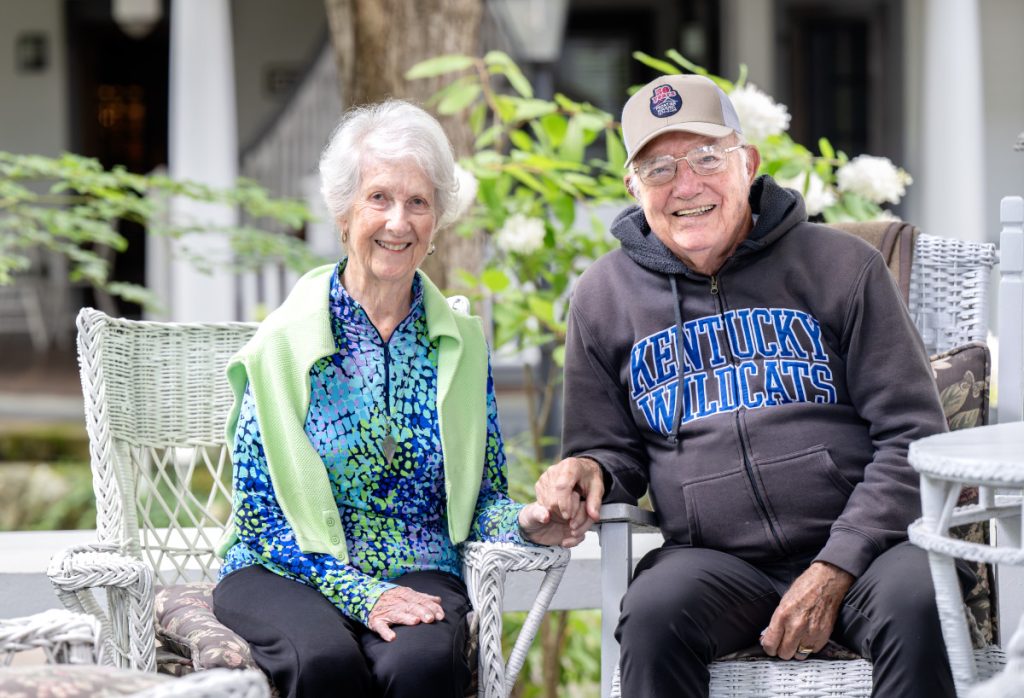
Former Chautauqua Association of Denominational Houses and Religious Organizations David Lollis and his wife Betty Lollis sit together on the porch of the Disciples of Christ House Wednesday. David and Betty were hosts of the Disciples House together for 17 years.
LILY RESLINK
Staff Writer
Denominational house history is as vast as the number of people who have contributed to it across time.
The Chautauqua Association of Denominational Houses and Religious Organizations, also known as CADHRO, is a group that lists three primary purposes: “to welcome, assist, and network with organizations operating denominational houses and/or serving spiritual needs of Chautauquans”; “to advocate for the needs of CADHRO members in interactions with Chautauqua Institution”; and “to help familiarize Chautauqua summer students in residence with available spiritual support and resources provided by CADHRO member organizations.”
Its history, however, is split across institutional archives, personal collections and denominational house files; some resides only in the minds of human sources.
Hosts, organizational leaders and representatives said the CADHRO serves an essential function of connecting ideas and liaising with the Institution amid considerations such as natural turnover in staff and abundant commitments to one’s own house or organization.
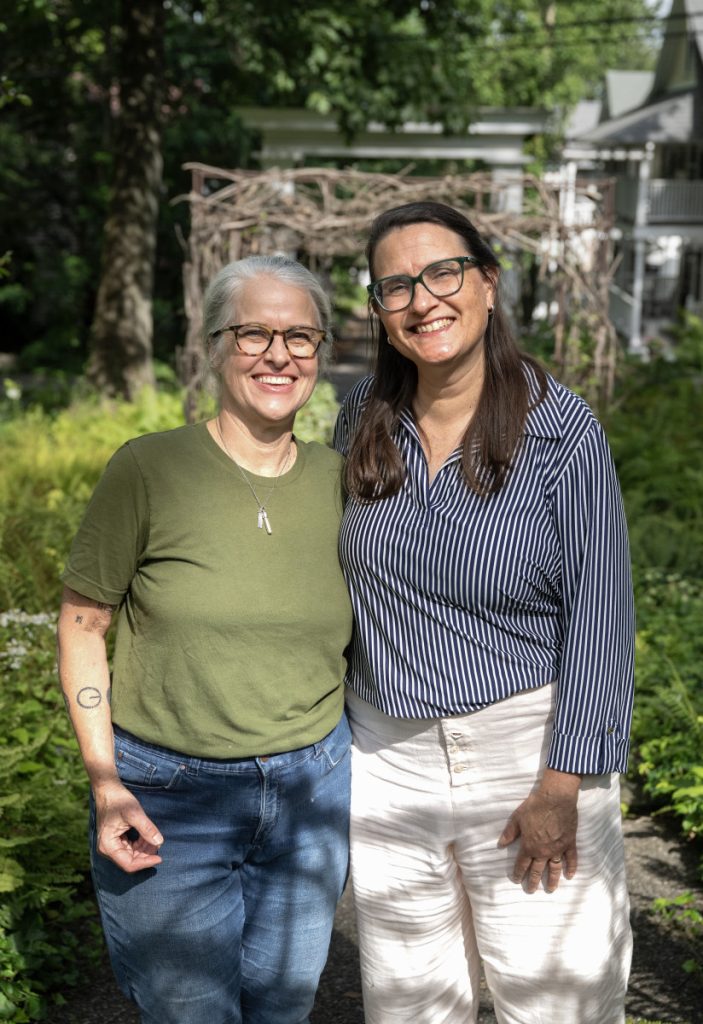
Kriss Miller and Beth Brockman Miller, pictured outside the Hall of Philosophy, are the co-presidents of CADHRO.
Former CADHRO President David Lollis said he has yet to identify records of the CADHRO’s origins before his tenure started in 2001, and at age 89, he said tracking down this history is a mission he fully embraces. As this project unfolds, denominational house leaders have been assessing the past, present and future of denominational houses at Chautauqua through oral history.
On the legal side, former Director of Religion Maureen Rovegno created a religion advisory group in 2004 to officially establish a framework on how to define and create a denominational house at Chautauqua.
She said she invited the great grandson of Chautauqua’s founder, Dick Miller, whom she called “a brilliant lawyer,” to create the framework. Rovegno said the criteria is simple but necessary for longevity.
“We wanted to make sure whatever criteria we come up with could stand the test of time,” she said.
Lollis said, “One of the primary missions of the denominational houses on the grounds was to create guest houses [for] preachers, social workers, teachers and other people who … loved the idea of Chautauqua but couldn’t afford to come.” For example, the Disciples of Christ House offers rooms for $400 a week, which can accommodate up to two people and a child.
To CADHRO Recording Secretary and Historian Brigitte Popelars, denominational houses are “the bread and butter of this community.” Popelars hosted the Unitarian Universalist House from 2009 to 2018, but her introduction to Chautauqua was staying at the Disciples of Christ House as a guest for five years.
She said her experience at the Disciples of Christ House was a sort of “apprenticeship” in which she learned from David and Betty before she assumed her role at the UU House in 2009.
“When I house hosted the UU House, people would arrive on a Saturday as strangers and would leave as friends — some of them lifelong friends,” Popelars said.
Beth Brockman Miller, current CADHRO co-president and Ecumenical Community of Chautauqua manager, said denominational houses can serve their own faith communities and interfaith relations between houses, and also all Chautauquans — including new ones here for a short time. Since 2025, Miller has also served as executive director of the CoGen Scholars program, which sponsors students to attend Chautauqua for a week and houses them across multiple denominational houses.
Popelars recalled that the International Order of the King’s Daughters and Sons House, which she said was on the grounds for a century and was sold two years ago, once sponsored a scholarship program to host college students on the grounds. Popelars explained students’ financial constraints led to a reduction in programming from six to four weeks. The program ended in 2020, and Popelars said it is still emotional to think of memories from the house.
Miller said when she asked the Performing and Visual Arts Office how CADHRO could be most helpful to students, the response was providing essentials commonly forgotten, such as toothbrushes, soap, deodorant and menstrual products. With their dues, she said CADHRO could purchase a few hundred dollars’ worth of dorm essentials.
Afternoon social hours are some of the most outward-facing programs the denominational houses host, and although they have continued like clockwork each Tuesday of the Summer Season, their origin is largely unknown. As David Lollis continued archival research on the topic, Miller recently caught wind of an original 1914 document in UCC Headquarters stating that “punch and wafers were served at the social hour.” This is now the first known documentation of what may be a precursor to the program unofficially titled the “cookie crawl.”
Many denominational houses outsource preparation to external congregations — some of which,
according to Popelars, come from more than five hours away.
As host of the UU house, Popelars said she believes she witnessed the first Chautauqua Dialogues. She said Roger Doebke, a Unitarian Universalist, initiated the program and hosted them in the UU House backyard. She recalled, “We would set up chairs in the backyard and people would show up 15, 20 at a time and have some really good debates and discussions about what they’ve heard throughout the week, or maybe just the previous lecture that they came from.”
Popelars said she observed people returning to the denominational houses for dialogue after the Interfaith Lecture, limiting discussion to one’s own faith practice.
“There was such a desire for people to communicate with each other, to field each other’s questions, to get a sense of, ‘Am I right about this?’” Popelars said the program explicitly welcomes people outside of the denomination into the houses with no requirement to discuss religion.
Most of the history Lollis can confirm begins only when he stepped into the role in 2001, which he said occurred quite suddenly after the former titleholder stepped down. He said he was made president in his first meeting.
The president is typically also in another denominational house leadership position. Lollis said other responsibilities of the CADHRO president dictate its function. Lollis, former host of the Disciples of Christ House, attributed his extra dedication toward denominational house history to personal interest and having a good teammate: Betty Lollis. The couple house hosted together for 17 years.
In his time as president, Lollis explained that, as well as digging into archives, he compiled information straight from the source. He said, “One of the things I did was go around and talk to all the houses.”
Much of CADHRO’s purpose lies in facilitating communication among one another to improve the overall functioning of denominational houses and religious organizations, as well as offering a unified voice to the Institution, according to Lollis and Popelars.
From her perspective as a former UU House host, Popelars described Rovegno as “the go-to for anything that has come up in terms of the denominational houses.”
She added, “Then Melissa Spas followed her. Right now, we have Robert Wilson-Black. They’re just all very approachable people and very helpful for all of the denominational houses. In some ways, I consider them the guiding leadership for the denomination houses.”
Lollis, Popelars and Miller agreed that their goals lie in upholding what they view as the integral, communal nature of the houses and organizations represented by CADHRO.