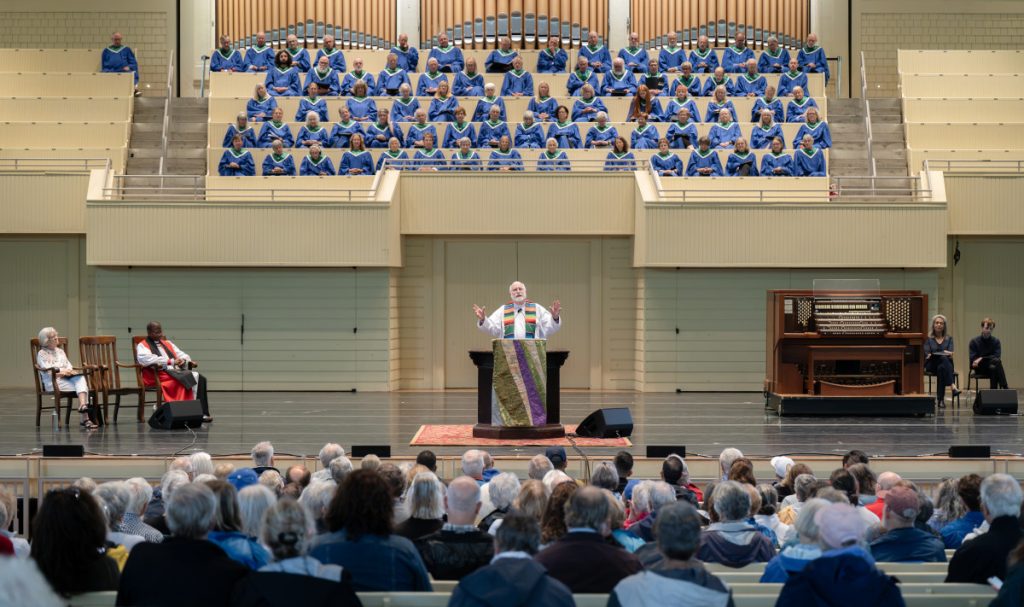
Fr. Greg Boyle, S.J., delivers his sermon “Fill the Earth with Mercy” Sunday in the Amphitheater.
Column by Mary Lee Talbot
The Scripture reading for the morning was 1 Corinthians 13:4–13. “You may have noticed that I picked this reading, but I only want one sentence, but you have to hear it all. Love is patient, love is kind, love is blah blah blah. You’ve heard this at every single wedding you’ve ever been to. And as soon as you get to that third love is, you travel elsewhere. You go, ‘Did I move my clothes from the washer to the dryer?’” Fr. Greg Boyle, S.J., said.
Boyle preached at the 9:15 a.m. Wednesday morning worship service in the Amphitheater. His sermon title was “The Infinite Moment When Everything Happens.”
The sentence Boyle wanted was 1 Corinthians 13:9: “For we know in part, and we prophesy in part, but when completeness comes, the partial disappears.” Boyle said, “We need the whole thing. We are walking each other home to wholeness. Sometimes it (the text) says perfection, but that causes a lot of difficulty for us. Not be perfect as your heavenly Father is perfect, (be) whole, that is the goal.”
He continued, “(We are) walking each other home together in this community of belonging, to wholeness, because when the wholeness comes, the partial disappears. We have settled for the partial God; we have to hold out for more. Wholeness is the goal, not perfection.”
Boyle was at Juvenile Hall in San Fernando, California, to do Mass for about 300 young people. He closed his eyes to listen to the Scripture readings. The first one, from the Hebrew Bible, was read well. The second one, a responsorial psalm, got his attention. The young man got up and read “The Lord is exhausted.” Boyle said he thought this was way better than “The Lord is exalted.”
He told the congregation, “Instantly, we are connecting to the wholeness of exhaustion, of the self donation of generosity. Yes, that’s the God we have, the exhausted God is who we would want to be if we were God.”
Boyle continued, “This God is generous and is self-giving; we want to somehow totally surrender to that God and to our own unshakable beauty, which is how he sees us. We shall become a mighty kindness in the force in the world. We aligned the compass of our hearts to the energies of our exhausted God. We surrender to that magnetic pole of the God who never stops cherishing us. Behold the one beholding you and smiling.”
About ten years ago, Boyle went to Sacramento with Robert, who is at Chautauqua this week, and another Homeboy named Carlos. Carlos was called “Chamuco,” which means devil, because he had devil’s horns tattooed on his forehead.
On the shuttle bus to the rental car office, Boyle and Robert sat across from each other in the middle while Chamuco went to the very back of the bus and sat in the middle of the seats. The bus got more and more crowded until the only seats were beside Chamuco. People gingerly sat on either side of him.
Suddenly, the bus stopped and the driver could not get it started. She called the office and told them she was doing what she could, but the engine did not start. From the silence came a voice, “I saw this in a movie once. It does not end well,” Chamuco said. The whole bus burst into laughter.
Boyle said, “This was the Sunday after the Tuesday of the 2016 election. Perhaps half the bus voted one way and the other half voted the other, but God was brought to us by Satan in the back row.”
He urged the congregation not to settle for our tribe and to instead hold out for the village, God’s village, a community of kinship that God might recognize. “We settled for the description of the place and not the place itself; hold out for the place itself. Jesus doesn’t say, ‘I am the light of the world,’ he says you are. So we want to be a light that people can see by so folks can be seized by a fierce love that brings us back to the entrance of our hearts.”
Boyle concluded his sermon with the story of Danny. At age 13, Danny told Boyle he would never set foot in Homeboy Industries. He had a gun that he showed Boyle and spent years getting into trouble until he ended up in prison at age 18.
When Danny got out of prison, he took over the hospice care of his mother, who was dying of pancreatic cancer. Although she had been torturous to him, he treated her with kindness and love. A week after Boyle buried her, Danny came to Homeboy and found his true self “so he could work with other gang members and laugh from the stomach.”
One day, Danny came into Boyle’s office and said, “What happened to me last night has never happened to me before,” and he told Boyle about his journey home. He had gotten on the train and got a seat. There was a man who was drunk, holding on to a pole. He had a gang tattoo on his hand, but he was older than Danny. Danny was wearing a shirt that said “Homeboy Industries — Jobs not Jails.”
The man asked Danny if he worked there and he said yes. The man asked if it was any good. Danny said, “It helped me not to go back to prison.” Then Danny fished a piece of paper out of his pocket and wrote down the address. He told the man, “Call us, come see us, we will help you.” The man thanked him and left the train.
Danny said to Boyle, “I couldn’t believe I knew the address by heart. But what happened that has never happened before: I looked around and people were staring at me, nodding at me. For the first time, I felt admired.”
Boyle said, “And everyone on the train stopped settling for a tribe and held out for a village. Everyone on the train didn’t settle for partial piety; they held out for holiness and completeness. Everyone on the train chose to be a light that people can see by.”
He continued, “The exhausted God is rooting for us to become reservoirs of joy for each other. Then we can cease to argue with an existing model and just decide to fashion a new one, the place itself. We surrender to the arms of God and become a mighty kindness and create a counterbalancing act of tenderness that is atmospheric, a world we’ve never seen before, in kinship, in God’s village, the place where hope itself flourishes. All of you know the fierce love of our exhausted God, for all of you are a light that people can see by.”
Robert Wilson-Black, director of the Department of Religion, presided. Long-time Chautauquan Allison Marthison read the Scripture. Sonya Subbayya Sutton, interim director of Sacred Music, played “Aria on a Chaconne” by Joel Martinson for the prelude on the Massey Memorial Organ. The Motet Choir, under Sutton’s direction, sang a cappella, “Down to the River to Pray,” a traditional American folk hymn arranged by Sheldon Curry. The postlude, played by Sutton on the Massey Organ, was “Concerto, Op. 4, No. 5: Presto,” by George Frideric Handel. Support for this week’s chaplaincy and preaching is provided by The Lois Raynow Department of Religion Fund and The Daney-Holden Chaplaincy Fund.