

Henry Louis Gates, Jr., Alphonse Fletcher University Professor and Director of the Hutchins Center for African & African American Research at Harvard University, speaks about his personal search for his family history and the advent of the PBS television series “Finding Your Roots” Wednesday in the Amphitheater.
SOPHIA ROOKSBERRY
Staff Writer
Henry Louis Gates, Jr. began Wednesday’s morning lecture by flipping the script of his acclaimed PBS series, “Finding Your Roots.” Instead of sitting across the table from celebrities and informing them about their ancestry, Gates stood at the podium and shared his fascination with genealogy by tracing his own genetic history.
“It all started the day I met this lady,” Gates said before projecting a faded portrait onto the screen. “This is Jane Gates, who is my great-great-grandmother. She was born in 1819, she died in 1888. Obviously, I didn’t meet her literally, but it’s the day I first saw that photograph, and I remember the day exactly, because it was the day we buried … my father’s father.”
Gates continued presenting photos of his relatives, including pictures of his father and six uncles. He explained that he comes from a family of Black individuals who inexplicably “looked white and could have passed for white,” especially his grandfather.
After the funeral, Gates’ father took him and his brother to his grandparents’ house, which Jane Gates bought in 1870. Gates said he watched as his father rifled through numerous scrapbooks in his late grandfather’s armoire.
“After he had gone through about the sixth scrapbook, he found [what he was looking for],” Gates said. “It says, ‘Died this day in Cumberland, Maryland, Aunt Jane Gates, an estimable colored woman,’ and he read it to us and had us look at it, and then he pulled this photograph out between the leaves of the scrapbook, and he said, ‘This is the oldest Gates. She was born a slave. She was a midwife … I never want you to forget her name, and I never want you to forget her face.’ ”
Gates dedicated himself to this promise almost immediately. The next day, he asked his father to buy him a composition book and proceeded to interview his parents about their family tree.
“I wanted to know how I could possibly be descended from a man who looked so white we called him Casper behind his back, and how my great-great-grandmother could have been something called a slave and a midwife with those features,” Gates said.
However, his interviews proved fruitless; Jane Gates had died without telling her children anything about the identity of their father, other than the fact that he was a white man.
“Cut to the year 1977,” Gates said. “What’s the biggest thing in the history of TV? ‘Roots.’ … I wanted to be like Alex Haley, trace my family back deep into the abyss of slavery, and then when the paper trail ran out, I wanted to reverse the middle passage and see what tribe or ethnic group from which I had descended in West Africa, but only Alex Haley could do that.”

Henry Louis Gates, Jr., Alphonse Fletcher University Professor and Director of the Hutchins Center for African & African American Research at Harvard University, speaks about his personal search for his family history and the advent of the PBS television series “Finding Your Roots” Wednesday in the Amphitheater.
About two decades later, Gates received a letter from a geneticist at Howard University, saying they had discovered a way to scientifically verify genealogy, and the geneticist was interested in testing the genetics of African American men. Given his lifelong fascination with his family tree, Gates agreed, and within a few months, he was given some answers.
“He said, ‘You are the only African American we’ve ever tested who descends from the Nubian people,” Gates said. “Now, all African Americans want to be descendants of the Nubian people … They were the Black pharaohs of the Nile.”
Although Gates joked that the idea of being a Nubian prince aligned with his own self-image, he was still unclear about the multiple facets of his heritage.
“All of this is swirling in my subconscious, and … I get up in the middle of the night to go to the bathroom in the year 2000,” Gates said. “I’m standing in the bathroom, and like a bolt of lightning out of the sky, I was hit with an epiphany … I realized I could get eight prominent African Americans, and I could trace their genealogy back into the depth of slavery when the paper trail disappears, and then … I could do their DNA, see what tribe or ethnic group they were from in Africa and I could create a PBS series.”
Gates immediately started calling his connections and eventually got Oprah Winfrey to sign on to the pilot season of “African American Lives.” Other names quickly fell into place behind her, including Quincy Jones, Whoopi Goldberg, Chris Tucker and others. “African American Lives 2” featured names like Morgan Freeman, Chris Rock and Tina Turner, but the network requested a change in structure for the next season.
“They said, ‘This is too good for Black people, you’ve got to let white people in on this,’ ” Gates said. “… I said, ‘OK, but then if you do white people, you’ve got to do Asian people and you’ve got to do Black people, and white people come in kinds.”
With that idea, “Faces of America” launched in 2009, featuring Stephen Colbert, Malcolm Gladwell, Yo-Yo Ma and nine others. The show evolved into “Finding Your Roots,” which has garnered 3.6 million viewers and is premiering its 13th season in January.
“People ask me all the time why I think ‘Finding Roots’ is so popular,” Gates said. “… It’s because each episode has two subliminal messages. The first is that America is a nation of immigrants … My African ancestors didn’t come here willingly, but they came here from elsewhere. They were unwilling immigrants, and even our Native American sisters and brothers, their ancestors migrated over the Bering Strait 15,000 years ago. The other is that … despite our apparent phenotypical, physical differences, at the level of the genome we are 99.99% the same. America needs to hear that message more urgently than ever.”
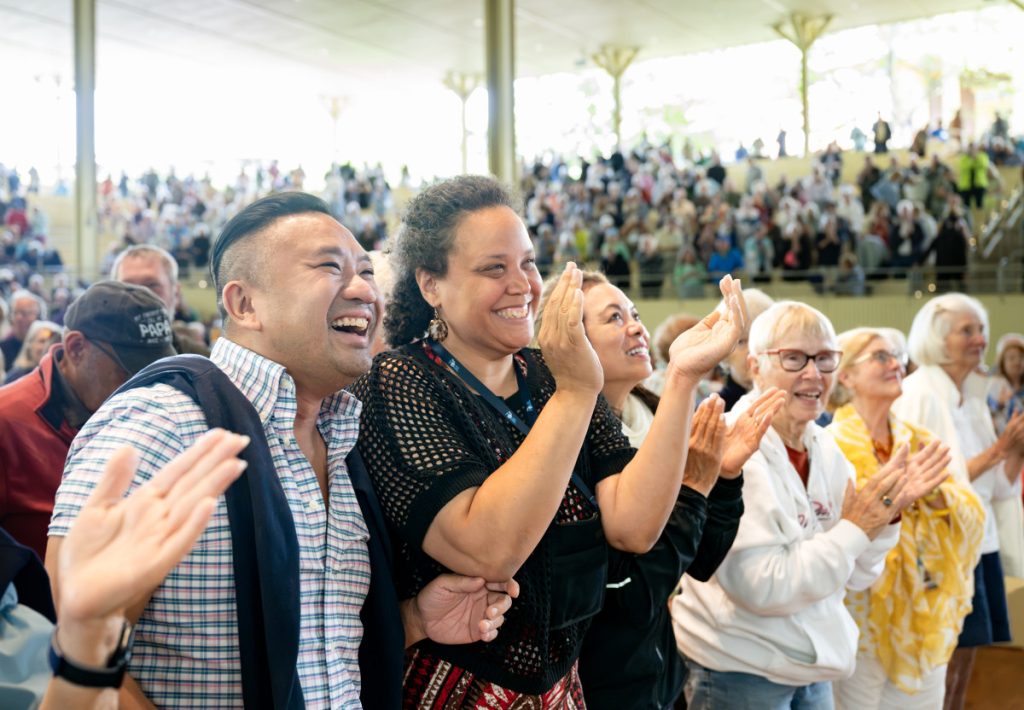
From left, Joey Bonifacio, Corinne Hatcher and Marcelle Lawas give a standing ovation as Gates concludes his lecture.