
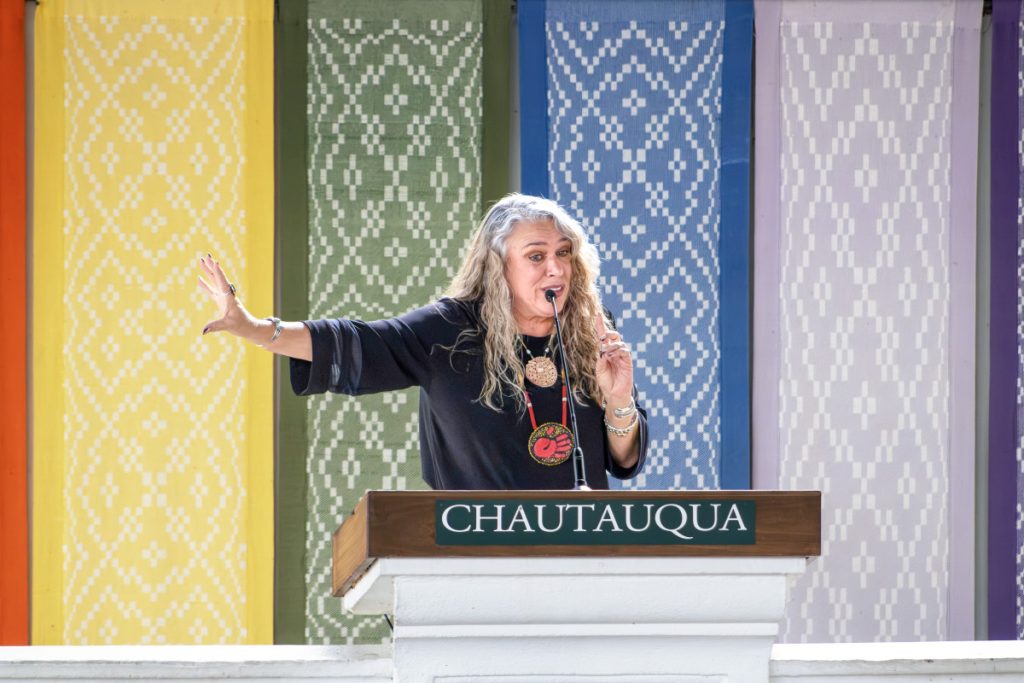
Chickasaw storyteller Amy Bruton Bluemel discusses what ancient people believed to be the origin of humanity and the journey of the soul beyond life on Earth Wednesday in the Hall of Philosophy.
LILY RESLINK
Staff Writer
Chickasaw storyteller Amy Bruton Bluemel delivered a lecture at 2 p.m. Wednesday in the Hall of Philosophy to transport the audience into stories of human origins on Earth and the journey a soul follows to return to one’s ancestors. These stories, she said, are written in the stars.
She began her lecture by teaching the audience a Chickasaw greeting for “hello” that translates to “good.” She explained the significance of tribe names and Anglican mispronunciations that produced an altered history. To Bluemel, this points to a larger question: “What does it mean when someone won’t take five seconds to learn your name?”
Bluemel shared the story of the Mound Builders, the ancient peoples she said built mounds in a “spiderweb” fashion from the top of the land that is now the U.S. to where the Mayan people resided.
“Their name has been lost to history and time,” she said. “We don’t know what they called themselves; we know what they did.”
One belief they are known to have is that the world was broken into three pieces: the upper world, where the creator sits; the middle world, for the humans; and the underworld.
She said the Mound Builders “knew all the constellations like the back of their hands” and placed importance on tying the constellations to “the Earth plateau.” Bluemel explained that this connection between life on Earth and the stars above was the basis for practices that facilitated this circulation of souls.
“Medicine people,” she explained, created “sacred bundles” assigned to the “bundlekeeper,” who cared for it as if it were alive; these bundles were thought to serve the purpose of connecting Earth to the constellations “like an umbilical cord.”
Bluemel explained how, through these beliefs about stars and the three worlds, Mound Builders conceptualized how humans came to Earth. The Mound Builders held the belief that “we come from the stars and we had to return to the stars,” she said.
Her lecture focused on the mound site, now a town called Moundville, which is outside of what is now Tuscaloosa, Alabama. She said Moundville was once a thriving Indigenous city, but its population — except for the “medicine people,” also known as the “holy people” — began to leave slowly for unidentified reasons.
She explained that the holy people were thought to have an important role in initiating the journey of a deceased person’s soul back to their ancestors; this is where the story meets the stars.
In the second person, Bluemel took the audience through the journey that the ancient Mound Builders believed every soul must follow. They used what they saw in the constellations to create narratives told across generations. This path of the soul, according to Bluemel, involved trials and guiding figures.
“Your people would carry you from wherever you were, all the way back, and give you to the holy people,” she explained. Bluemel said rituals from the holy people began the first step of returning to one’s ancestors.
She explained how the people saw the circle of stars, now called Orion, as a portal. Due to seasonal constellation changes, in October, this empty circle was filled. This constellation imagery is the origin of the symbol, still known today, of rattling snakes circling a hand with an eye in the center.
She said, in what scientists now call a nebula, these ancient people saw “a path of souls” and “the doorway to get home.”
She said an eagle guarding a doorway marks a point of the journey that is “far enough to see the fire of your ancestors.” Bluemel illustrated the image of “running back home.”
Men and women are led respectively back to “the fire” of their ancestors. Through this story, Bluemel explained the cyclical nature of their beliefs.
“Once you reach your home with them, you will stay, you will be relaxed, you will be comfortable, until it’s time to return. And when you return, you will come back into the families you left behind.”
In Alabama, she said, an artifact was found depicting the aforementioned rattlesnake symbol. “It’s a carved stone, a holy object, a sacred object.”
Bluemel said this image has become an iconic symbol, appearing on newspapers, bumper stickers and coffee mugs. She said it was once plastered on Moundville’s water tower as well.
“It doesn’t bother me,” she said. For anyone who sees it, she said she hopes the symbol is “doing what it is supposed to do,” which is calling people home.
She ended her lecture by sharing a stomp dance with the audience. She explained how a common phrase at the dance roughly translates to “Come fast, dancing turtles.”
This was not because they were calling dancers turtles; rather, it referred to the turtle shells traditionally filled with river rock dancers wore on their legs as “shakers.”
In these stomp dances, Bluemel said the elderly will stand to the side and rock and the children will stay in the back as they learn, but it is customary for everyone to participate. She spoke about the cultural impact of Indigenous dancing practices being outlawed until the late 1930s. Using small cans from the government-issued rations — which Bluemel said were given to merely keep them alive — she said women secretly created makeshift shakers. She said they would sneak off in the woods and sing.
The shakers that Bluemel brought to show Chautauquans, she said, are a nod to these women. Her shakers contain river rocks from many homelands’ waters. She shook them and said, “They say you hear that sound before you are born.”
She said because “you can’t carry your mother,” the river rocks in a shaker are a means of carrying Mother Earth. She said going into the veins of the Earth — water — and pulling up rocks allows one to carry the sounds of Mother Earth in a way that aligns with ancient peoples’ circular view of human existence.
“That’s the story of the stomp dance, and we still practice it today.” She said — just as it has always been — Indigenous people practice it as a form of prayer and a way to get together and celebrate who people are, what they believe and where they came from.
“I believe that’s important for all of us these days to understand who we are and celebrate it. And I encourage each of you to find that in your own life and explore it,” Bluemel said.