
CODY ENGLANDER
Staff writer
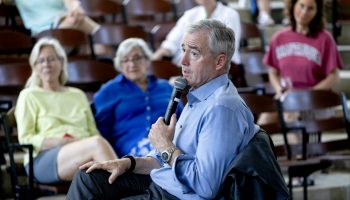
On Aug. 24, Chautauquans gathered in Smith Wilkes Hall for Interim Chief Executive Kyle Keogh’s final “Conversations with Kyle” community forum about topics important to Chautauquans.
One of the first comments made during the town hall-style forum was about updating the Institution’s website for next year; Keogh noted that the Institution is using an outside company to help with the updates.
“We should have it by next season, and then we’re going to also go back through and explore ticketing, too. That is slightly separate, right? Because you get your ticketing through the site, but also our ticketing system is behind the site, so to speak,” Keogh said. “So there are impacts there. But yes, we should have a new system for next season. I will say, it is a broad set of folks and things that people do on that website, so it is very hard to get to every area.”
The discussion then shifted to patron housing, with community members discussing Chautauqua’s housing presence on the other side of Route 394.
“We could expand over there. It’s about a 30% discount usually for the price points that you get there,” Keogh said. “So if we build any housing, it makes more financial sense to build on this side of the street. Still, if anyone’s done real estate development in a while, my wife and I built a house in COVID. We built a house in 2025, and it was a 40% increase [in cost]. So we’re just trying to be mindful of that. The other part, and the reason I pushed off making some of the decisions, is the feedback was, ‘It needs to sit within a master plan and probably be something larger.’”
Keogh said tiny homes have also been considered as a course of action. He said affinity houses can accommodate a higher density per square foot as multi-story buildings, compared to a tiny home, which tends to serve a smaller number of people.
The next topic was reducing the budget; Keogh addressed increasing prices the Institution will face in the coming years.
“One of the challenges for Chautauqua is we roughly have about a $45 million budget just for an easy run back. Each year, we’re going to see cost increases. [Our] general insurance will probably go up. Liability insurance will go up somewhere around 15%. We think we’re trying to negotiate that down,” Keogh said. “ … [New York] state minimum wage is, we think, about 3.2%. That’s going to add another $400,000 to $500,000. And then we have wages for our general employees, which we did not give any real increase in the past year. So we need to do something there.”
According to Keogh, there will be between $1 million and $2 million in cost increases. He addressed some of the changes next year may bring.
“We’re going to have to cut somewhere unless we get more philanthropy, and that’s going to be hard. There’s no easy spot to do it,” Keogh said. “It was hard enough last year. We hit the staff really, really hard last year. We have to do a raise this year. We have to figure out how to support that.”
The conversation returned to housing across Route 394. Keogh acknowledged that eventually housing may have to be added in that area.
“When someone wants to be here, they should be in Chautauqua, and we should be able to make that space if we can for ourselves, and if we push them across the street and we make it sort of a two-tier system,” he said. “ … And that may be really hard for us, but we have to be willing to have those honest discussions amongst ourselves and realize that there are some trade-offs to this, right? If we want to preserve the Chautauqua we have, we are 4% down in terms of attendance post-COVID, and it looks like a structural shift. That means that everyone else who’s here needs to pay more to get the same.”
While Chautauqua has the facilities, Keogh said he believes that housing across the street may lend itself to some difficulties; he acknowledged that developers need to make money as well.
The next topic was about scheduling Week One of the Summer Season earlier in June next year. The Chautauquan who suggested this idea noted it may bring in more attendance for the final two weeks of the season.
“We’ve had limited discussions [about] it,” Keogh said. “We have not fully analyzed it.” He said that attendance metrics are one of several data points the Institution considers, and he cited 2025’s Week Nine as last season’s second-highest-attended week, following Week Two.
Keogh concluded the meeting by addressing a Chautauquan who asked if purchasing property on the grounds was a good investment, as well as addressing the final forum’s audience.
“When my parents bought the house just off the street on Janes [Avenue] … in 1983, my dad was a successful venture capitalist, and he said it was the worst financial decision he ever made. He’s like, ‘Joan,’ my mom, ‘If you want to buy it, we will. This is a really bad financial decision.’ Now it actually wound up being probably the best,” he recalled.
Keogh thanked Chautauquans in attendance and expressed gratitude for the community; he said he appreciated the people who have shown up to the forums and other events, donated to the Institution or expressed their opinions or offered feedback.
“This is a place that matters in the world. It matters to each of us individually. Otherwise, you wouldn’t take your time out of a rainy Monday to be like, ‘I’m going to go across this campus to get here.’ You wouldn’t have bought your houses. You wouldn’t have come here for a week. You wouldn’t have established traditions across your whole family. And so the place really matters, and it’s been an honor to lead it. Thank you.”